All posts by blackfriar

Catfish Quote

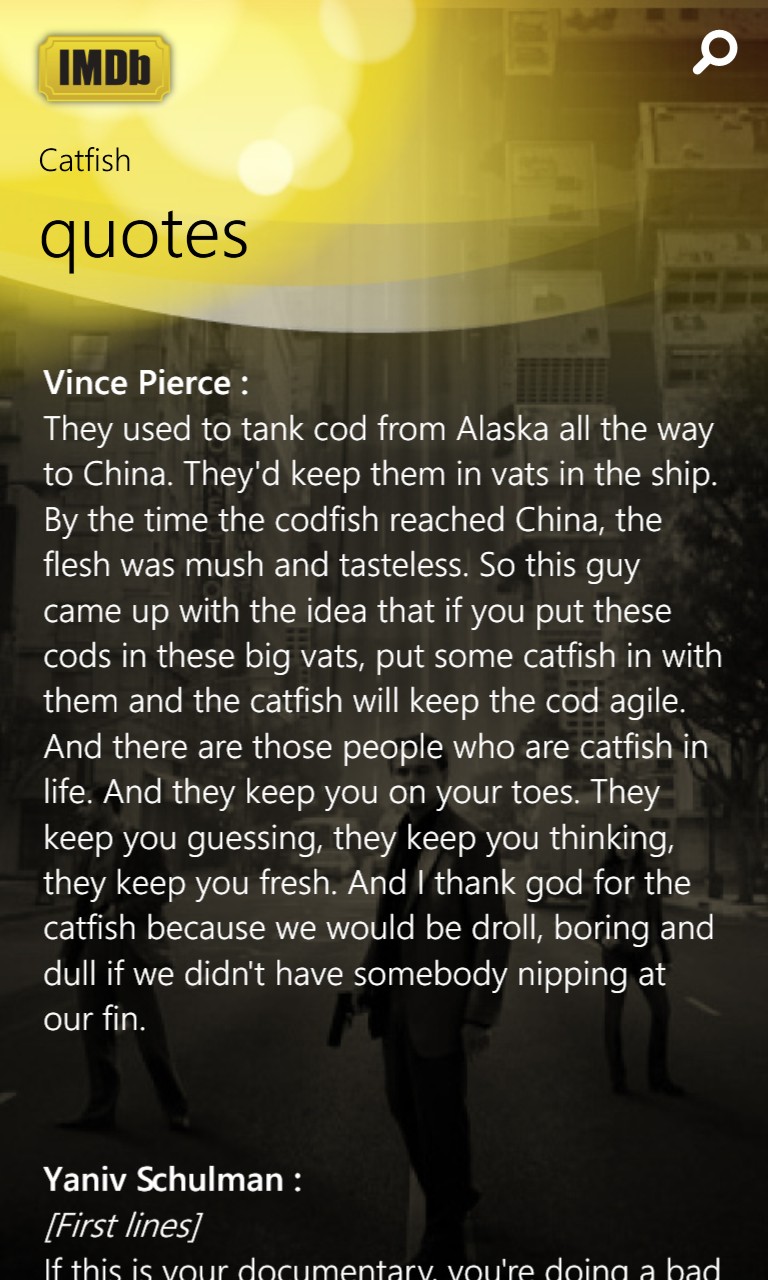
They used to take cod from Alaska all the way to China. They’d keep them in vats in the ship. By the time the codfish reached China, the flesh was mush and tasteless. So this guy came up with the idea that if you put these cods in these big vats, put some catfish in with them and the catfish will keep the cod agile. And there are those people who are catfish in life. And they keep you on your toes. They keep you guessing, they keep you thinking, they keep you fresh. And I thank go for the catfish because we would be droll, boring and dull if we didn’t have somebody nipping at our fin.

Vince Pierce – Catfish (The Movie)


catfish_quote_wp_ss_20140725_0003

John Perry Barlow: Which side of history do you want to be on?

“The main thing here is for people to recognize that what we’re doing is creating the foundations of the future in a very fundamental way.

I mean we’re building the future that we all might want or all might not want, depending on our current vested interests.

I think it takes a really crummy ancestor to want to maintain his current business model at the expense of his descendant’s ability to understand the world around them.

And if you really want to figure out which side you’re on, ask yourself what’s going to make you a better ancestor?

John Perry Barlow
Co-founder, Electronic Frontier Foundation

Interviewed in the feature documentary “Downloaded” aired on SBS.

UK privatising public health messaging – what could possibly go wrong?


http://www.londonlovesbusiness.com/8431.article?mobilesite=enabled

Source PDF: PHE-StrategyDoc-2014-10

Sophie Hobson: All public health messaging is now officially up for sale. Yes, you should be worried

Skull and cross-bones

The government has quietly announced a major change – but you need to know about it

Sophie Hobson is the editor of LondonlovesBusiness.com. Tweet her@sophiehobson

The government is making a radical change to the way it delivers public health campaigns.

It is a shift in the modus operandi that has been creeping in over the last couple of years, and has now been made universal in a new publication on Public Health England’s Marketing Strategy for 2014-17.

All government public health campaigns will now be launched in partnership with another organisation – as cheerily announced in a section titled “We will only ever work in partnership”.

Some of these organisations will be NGOs. (The government has worked in partnership with NGOs since 2002.)

But many will be corporations, paying for their involvement in public health messaging.

To give you an idea of the pace of the shift towards corporate-funded public health messaging, the report states that five years ago, the Change4Life campaign had only 10 commercial sector partners.

Today, it has more than 200 (including PepsiCo, hardly known for its healthy image).

The story has been uncovered by Russell Parsons at Marketing Week, and full credit to him, because Public Health England (PHE) is yet to release its forthcoming marketing strategy online at time of writing – though it has sent us a copy, which you can view by clicking on the ‘related files’ on the right (see pg. 22).

Why does this change matter so much?

Take a look at this chart from the report, which shows how financial/in-kind contribution from partners to the Change4Life campaign has now actually surpassed the amount of money the government is putting in:

PHE report - chart

If commercial partners are fronting up more cash for certain campaigns than the government itself, it’s not unreasonable to deduce that they will have as much – if not more – influence over the messaging of campaigns.

Who do you think is going to be most likely to put up the resources and cash for these public health campaigns?

I don’t think it’s far-fetched to suggest it might be those companies that need to clean up their reputation when it comes to health.

After all, Coca-Cola and McDonald’s didn’t pay mega-millions for worldwide sponsorship rights for the London 2012 Olympics out of the goodness of their corporate hearts.

This up-shift in government strategy opens the door to possibilities riddled with conflicts of interest: healthy eating campaigns brought to us in partnership with PepsiCo (see example above), obesity adverts supported by junk food multinationals…

So why is the government doing this?

In short, PHE needs the money.

PHE will invest £53m in the year to March 2015 into public health marketing campaigns.

In the year ahead, it aims to raise £25m of in-kind support from partners. This gives you an idea of how significant that external funding is.

As it happens, PHE has the largest partnerships team in government and works with 214 key national and 70,000 local partners.

And while the report claims that external partners are “interested in, and stand to benefit from, a healthier England”, I believe this new strategy puts the nation’s health at serious risk from influences that don’t necessarily have our best interests at heart.

Public health messaging should be in the interest of citizens, not corporates. It should not be up for sale.

If you agree, tweet me @sophiehobson or let me know in comments below.

READERS’ COMMENTS (1)
  • Rebecca Hobson

    Great, thought provoking piece – but I’m not sure I agree. I imagine there’ll be stringent measures in place around any corporate sponsorship of public health messaging, and effectively, these brands will end up subsiding PHE – which it badly needs? Also, if PHE puts out a message saying ‘drink only one can of pop a day’, say, won’t it be more powerful if it’s sponsored by the pop brand itself? Ppl are far more likely to listen to Pepsi than the government.

    Unsuitable or offensive? Report this comment

Helsinki making car ownership pointless in 10 years

An interesting, challenging idea… why not!

http://www.theguardian.com/cities/2014/jul/10/helsinki-shared-public-transport-plan-car-ownership-pointless?CMP=twt_gu

Helsinki’s ambitious plan to make car ownership pointless in 10 years

Finland’s capital hopes a ‘mobility on demand’ system that integrates all forms of shared and public transport in a single payment network could essentially render private cars obsolete

Helsinki, Finland.
Urban mobility, rethought … Helsinki, Finland. Photograph: Hemis/Alamy

The Finnish capital has announced plans to transform its existing public transport network into a comprehensive, point-to-point “mobility on demand” system by 2025 – one that, in theory, would be so good nobody would have any reason to own a car.

Helsinki aims to transcend conventional public transport by allowing people to purchase mobility in real time, straight from their smartphones. The hope is to furnish riders with an array of options so cheap, flexible and well-coordinated that it becomes competitive with private car ownership not merely on cost, but on convenience and ease of use.

Subscribers would specify an origin and a destination, and perhaps a few preferences. The app would then function as both journey planner and universal payment platform, knitting everything from driverless cars and nimble little buses to shared bikes and ferries into a single, supple mesh of mobility. Imagine the popular transit planner Citymapper fused to a cycle hire service and a taxi app such as Hailo or Uber, with only one payment required, and the whole thing run as a public utility, and you begin to understand the scale of ambition here.

That the city is serious about making good on these intentions is bolstered by the Helsinki Regional Transport Authority’s rollout last year of a strikingly innovative minibus service called Kutsuplus. Kutsuplus lets riders specify their own desired pick-up points and destinations via smartphone; these requests are aggregated, and the app calculates an optimal route that most closely satisfies all of them.

All of this seems cannily calculated to serve the mobility needs of a generation that is comprehensively networked, acutely aware of motoring’s ecological footprint, and – if opinion surveys are to be trusted – not particularly interested in the joys of private car ownership to begin with. Kutsuplus comes very close to delivering the best of both worlds: the convenient point-to-point freedom that a car affords, yet without the onerous environmental and financial costs of ownership (or even a Zipcar membership).

But the fine details of service design for such schemes as Helsinki is proposing matter disproportionately, particularly regarding price. As things stand, Kutsuplus costs more than a conventional journey by bus, but less than a taxi fare over the same distance – and Goldilocks-style, that feels just about right. Providers of public transit, though, have an inherent obligation to serve the entire citizenry, not merely the segment who can afford a smartphone and are comfortable with its use. (In fairness, in Finland this really does mean just about everyone, but the point stands.) It matters, then, whether Helsinki – and the graduate engineering student the municipality has apparently commissioned to help it design its platform – is proposing a truly collective next-generation transit system for the entire public, or just a high-spec service for the highest-margin customers.

It remains to be seen, too, whether the scheme can work effectively not merely for relatively compact central Helsinki, but in the lower-density municipalities of Espoo and Vantaa as well. Nevertheless, with the capital region’s arterials and ring roads as choked as they are, it feels imperative to explore anything that has a realistic prospect of reducing the number of cars, while providing something like the same level of service.

To be sure, Helsinki is not proposing to go entirely car-free. (Many people in Finland have a summer cottage in the countryside, and rely on a car to get to it.) But it’s clear that urban mobility badly needs to be rethought for an age of commuters every bit as networked as the vehicles and infrastructures on which they rely, but who retain expectations of personal mobility entrained by a century of private car ownership. Helsinki’s initiative suggests that at least one city understands how it might do so.