All posts by blackfriar

BBC Start The Week: Thinking about new forms of Government

Compelling discussion about new thinking about, and forms of government…

http://www.bbc.co.uk/podcasts/series/stw

Tristram Hunt, Adrian Wooldridge, Charu Lata Hogg and Anjan Sundaram

Mon, 9 Jun 14

Duration:
42 mins

Tom Sutcliffe discusses whether Western states have anything to learn from countries like China and Singapore. Adrian Wooldridge argues that many governments have become bloated and there’s a global race to reinvent the state. In the past Britain was at the forefront of exporting ideas on how to run a country, as the Labour MP Tristram Hunt explains in his book on the legacy of empire. Charu Lata Hogg from Chatham House looks at the challenges to democracy in Thailand where the country is in political turmoil, and the journalist Anjan Sundaram spent a year in The Congo during the violent 2006 elections, and looks at day-to-day life in a failing state.

End of medicare?

Excellent summary of the early 2014 state of play in health policy replete with solid historical perspective from Anne-marie and Jim Gillespie.


http://www.smh.com.au/federal-politics/political-news/is-this-the-end-of-medicare-20140609-39t2b.html

Is this the end of Medicare?

Date

A national institution, Medicare turns 40 this year. But are budgetary changes such as the doctor co-payment the beginning of the end for universal healthcare? Michael Green reports.

Victorian Aboriginal Health Service chief executive Jason King, clinical program manager Andrew Baker and medical director Mary Belfrage.

Victorian Aboriginal Health Service chief executive Jason King, clinical program manager Andrew Baker and medical director Mary Belfrage. Photo: Eddie Jim

Medicare was always a dogfight. It became law in the most extraordinary circumstances: one of a handful of bills passed during the only joint sitting of Federal Parliament in the nation’s history, after the double dissolution election in 1974.

As the Whitlam government prepared to introduce the system – then known as Medibank – its opponents rallied. The Australian Medical Association marshalled a million-dollar ”Freedom Fund”, donated by members. Determined to stop bureaucrats interfering with patients, it hired a former Miss Australia to front its publicity campaign. The General Practitioners’ Society of Australia circulated a poster depicting social security minister Bill Hayden dressed in Nazi uniform.

Dr Anne-marie Boxall, co-author of Making Medicare, says Whitlam had little support, even from within the Labor Party. The party platform advocated a fully nationalised model, along the lines of the British National Health System. By contrast, Whitlam’s plan was for a public insurance scheme. Health services would be delivered by a mix of public and private providers, paid for by taxpayers and guaranteed for everyone.

”The crucial members of his caucus didn’t agree with him, but he was adamant,” she says. ”He’d done a lot of thinking about it. So he waged the war of public opinion and he won. It’s an amazing political story.”

Medibank began full operation on October 1, 1975, just six weeks before the dismissal of the Whitlam government. The Fraser government tinkered with the system several times before abolishing it – only for it to be revived by the Hawke government in 1984 in almost exactly the same form.

Thirty years later, Medicare enjoys overwhelming public support. Politicians will swear to defend its honour, no matter their stripes or the system’s shortcomings. And yet, in the wake of the federal budget, many people believe Medicare is under threat. The target of most ire is the proposed co-payment for doctor visits, under which even the poorest will have to pay for up to ten appointments each year.

Are these changes the beginning of the end of universal coverage? Or another nail in its coffin? Or are they actually a distraction from the deeper afflictions at the heart of Australia’s healthcare system?

Health Minister Peter Dutton describes the Coalition as ”the greatest friend Medicare ever had”. The Coalition has demonstrated its amity with a host of announcements, including the co-payment, which also affects diagnostic tests and prescription drugs. (These charges will be capped for children, low-income earners and the chronically ill.)

More people will pay the Medicare levy surcharge, and fewer will qualify for the private health insurance rebate. Billions of dollars have been cut from public hospitals, and the preventive health agency and other health promotion programs have been shut down. The savings will be directed to a medical research fund.

Dutton says that without these reforms, spiralling costs will jeopardise Medicare’s viability. ”The government is very keen to keep Medicare and strengthen it. To keep it universal, we have to make sure it’s affordable. In my view, Medicare is only sustainable if those people who have a capacity to pay contribute to the system.”

However, Professor John Deeble, one of the original scheme’s architects, says while costs have been rising, they’re manageable. Health spending by our governments is low compared with other wealthy countries. The Coalition’s planned changes, he says, are not really about the sustainability of Medicare. ”They just want to spend the money on something else, simple as that.”

The Medicare levy (currently 1.5 per cent of an average income) was introduced to help fund a universal healthcare scheme. If our health costs rise, the government can raise the levy, Deeble says. In that way, people’s contributions are determined by their capacity to pay – their income – not by how often they need treatment. By introducing co-payments instead, the government is embracing something fundamentally different: a ”user-pays” notion of fairness in health funding.

In Medicare’s first incarnation, when social security minister Bill Hayden introduced the bill to Parliament, he declared that its three motivating principles were ”social equity, universal coverage and cost efficiency”.

Although the full details of the Coalition’s reforms haven’t been released, public health experts have been unanimous: as a package, it’s simply bad policy.

”We’ve actually tried all these solutions before, which is why we know they don’t work,” says Boxall, who is the director of the Deeble Institute for Health Policy Research. ”We need to step back and look at the structural problems with our health system.”

Two key problems were unforeseen at the time of Medicare’s design: the rise of private healthcare, and the growing burden of chronic illnesses. ”Things have changed,” Boxall says. ”So what are we doing to improve universality, equity and efficiency?”

For most of the 20th century, Australia had a two-tier medical system: a very basic insurance system for the working class and a fee-paying model for those who could afford it. ”Doctors offered quite different services, and in many cases different waiting rooms for each group,” says Associate Professor James Gillespie, from the University of Sydney’s school of public health, co-author of Making Medicare.

The World Health Organisation says ”universal coverage” means ”all people have access to services and do not suffer financial hardship paying for them”.

But under Medicare, we’re already failing the equity test. More than one-in-six Australians say they don’t see a doctor or fill prescriptions because of the cost, according to an international study published by the journal Health Affairs. Other research has shown that people who live in poorer neighbourhoods are more likely to delay medical care.

Even without co-payments, Australian patients fork out a lot for treatment from their own pockets, compared with other developed countries. The two-tier system has re-emerged. One reason, says Gillespie, is that ”both sides of politics have refused to think seriously about the role of the private system”. Major reviews commissioned by both the Howard and Rudd governments specifically avoided examining its role.

When Medicare began, private hospitals were a small industry, run by churches and charities. But in the past two decades they’ve become a big business, where doctors earn much more.

Until the 1990s, private health insurance was in terminal decline. But spurred on by the Howard government’s incentives – the Medicare levy surcharge and lifetime cover discount – just under half the population now has private cover. ”We’ve ended up with a private system that shifts services away from the public and creates more privileged ways of doing things,” says Gillespie.

He says private funding can contribute to universal care, so long as core services are delivered the same way to everyone. Canada has a similar system to ours, but private insurance isn’t allowed to cover the services offered by its public system. ”If there’s a different system for those who can afford better, you end up with a residual service, which gets squeezed and becomes second best,” he says.

The Coalition argues the co-payment is a ”price signal” to alert people to the real cost of treatment. But there’s something unusual about healthcare – even economists say so. In simple terms: you can judge how you’ll feel if you forgo buying a hamburger, but not if you forgo visiting the doctor.

”In the case of healthcare, part of the product itself is giving you that information,” explains Professor Jeff Richardson, from Monash University’s centre for health economics. ”You’re not in a position to judge what life would be like with and without it.” All of which means that promoting efficiency is more complex than imposing a price signal.

Australia’s health costs have been rising, but compared with other OECD countries our total health spending – both private and public – is just below average. It’s half that of the United States, as a percentage of GDP.

”When the government says Medicare is unsustainable, it’s lying,” Richardson says. ”The Australian government could spend much more on health if it wished. It’s simply a political and social judgment that it doesn’t want to.”

Curiously, despite Dutton’s warnings about unsustainable health spending, his reforms – which aim to push more people into the private system – will end up costing more overall. When the government acts as our single-insurer under Medicare, it has the power and incentive to bargain hard: as a result of bulk billing, GPs incomes are low by international standards. But with many different payers – like in the US system – it’s easier for private insurers to increase fees than control costs.

And for now, GPs and pharmaceuticals are the most cost-effective parts of the health system. Increasing their price will push more patients into hospitals, which are much more costly.

The measures are not a question of efficiency, Richardson says, but rather an ideological choice that health is an individual responsibility, not a shared one, like defence or policing. ”If we swing over to the private sector and push it back on individuals, the health of poorer people will suffer and overall costs will almost certainly rise.”

Dutton, however, maintains the measures aren’t about ideology, citing the Hawke government’s plans to introduce a $2.50 co-payment for GP visits in 1991. (Paul Keating scrapped the idea as prime minister.) ”I strongly believe that the changes we’ve put forward will improve access and the standard of care provided by GPs,” Dutton says.

But the biggest challenge to the standard of care now comes from an entirely different source, one his reforms do nothing to address. Our greatest healthcare inefficiency is found in a disconnect between the system – the fragmented network of hospitals, specialists and GPs, and their mishmash of state, federal and private funding – and the kinds of illnesses we have.

Where once we suffered acute ailments, we now need ongoing support with chronic conditions, says Dr Steve Hambleton, outgoing president of the Australian Medical Association. The number of deaths from heart attacks, for example, peaked in the 1970s. But living with heart disease requires continual treatment and adjustment, especially as you develop other conditions.

Patients with chronic diseases need to see a variety of health professionals and have frequent tests – but they are often seeing them in a piecemeal way with little continuity or communication between experts. Many of these, such as physiotherapists, psychologists or dieticians, are excluded or receive only limited funding under Medicare.

Both parties have attempted limited reforms to address the rise of chronic illnesses. But Hambleton says: ”We need a proactive, long-term approach … supporting primary healthcare to keep patients out of hospitals, and make sure people don’t fall through the cracks when they move between community and hospital care.”

The wide hallway of the Victorian Aboriginal Health Service in Fitzroy is humming: people young and old are waiting and chatting. Some are on the go, others hovering around a wood heater. Today, a specialist is visiting to conduct an ear, nose and throat clinic.

Jason King, the centre’s CEO, says they offer an holistic service. There are GPs, dentists, visiting specialists, social workers and financial counsellors, all supported by Aboriginal health workers. ”It’s not pumping them out every ten minutes. It’s ‘How’s mum and dad going? How’s uncle going who lives with you?’ We’re the central hub, this is where people come and see family.”

Last year, the health service celebrated its 40th anniversary. Each year, about a third of the state’s Aboriginal population pass through its doors. The centre’s model of integrated care, embedded in the values of its community, is exactly what doctors and experts have ordered – along with the WHO, the OECD and several Australian inquires.

But King says the co-payment and cuts to preventive health will either cost the centre patients or take a chunk out of its budget. Either way, that means fewer services.

There are 28 Aboriginal community-controlled health centres around the state. Jill Gallagher, CEO of their peak body, says Aboriginal health remains worse than the rest of the nation. ”The life expectancy in Fitzroy is the same as the life expectancy in Fitzroy Crossing,” she says. ”For every dollar spent on Medicare for a non-Aboriginal person, about 60¢ is spent on Aboriginal people. Access to primary healthcare is still not equitable, in spite of the fact there’s four times the burden of illness in the Aboriginal community.”

Dr Mary Belfrage, the service’s medical director, says any barriers to accessing healthcare cause people to show up later, with advanced conditions, which are more expensive to treat. ”It all translates to worse health outcomes, but it’s also inefficient,” she says. ”This isn’t about party politics or a particular budget. It’s about the principle of equity and how it impacts on health.”

Duckett: Has health reform failed? Yes

A big issue for the health system in Australia is that no-one’s in charge. Not the Commonwealth, not the states, not the private health insurance funds. Most provision is private: general practitioners are increasingly employed by for-profit chains, and before that, small business people. They respond to incentives designed by the Commonwealth government.

http://theconversation.com/did-the-health-reform-process-fail-now-well-never-know-27921

Did the health reform process fail? Now we’ll never know

Abandoning health reforms will undoubtedly lead to worse performance, including longer waiting times, across the health system. AAP Image/Quentin Jones

Yesterday was a sorry day in the long history of health reform in Australia. The Council of Australian Governments (COAG) Reform Council issued its five year score-keeper’s report on health reform progress. It will be the last such report, since the COAG Reform Council has been sacrificed on the altar of savings in the May budget, and we will no longer know how our governments are performing.

The COAG Reform Council paints some lipstick on the pig but overall reform results are poor in the health system. Compared to last year, Australians are waiting marginally longer for elective surgery, longer for community support in the home, and dramatically longer to get into residential aged care.

On the upside, we’re living slightly longer, having fewer heart attacks and the incidence of some cancers has reduced. The five-year trends for performance paint a similar picture to the year-on-year results.

It’s easy to conclude that the health reform process was a waste of time and money. But this is shortsighted. Many of the structural reforms focused on building the foundations of a health system that was on the verge of being able to deliver real improvements in patient care.

Slow road to reform

Kevin Rudd’s gab-fest of health reform talk in 2009 and early 2010 led to an alphabet soup of new health agencies, some investment in parts of the health system, more data in the public domain than we’ve ever seen but precious little in terms of real on-the-ground improvements.

But there were some important exceptions. The Rudd-appointed National Health and Hospitals Reform Commission identified a gap in availability of rehabilitation beds in the system. Without adequate rehabilitation care people were ending up in nursing homes when they could have been at home. Reform money helped to address that gap, although that funding was abruptly terminated in the 2014 budget.

Funding was also provided for better prevention programs and to reward improvements in waiting times where they occurred. Medicare Locals were created to provide a platform for improvements in primary care such as better after-hours services.

Running a health system is hard, improving it is even harder. But we have to improve every day just to stand still. The new treatments that are introduced every week put pressure on the health dollar. These new treatments, though, mean we’re living longer – so we get something for the extra money.

A big issue for the health system in Australia is that no-one’s in charge. Not the Commonwealth, not the states, not the private health insurance funds. Most provision is private: general practitioners are increasingly employed by for-profit chains, and before that, small business people. They respond to incentives designed by the Commonwealth government.

The pathology and radiology markets are also highly concentrated corporatised businesses. Around one-third of hospital beds are in private hospitals, and most of those are for-profit businesses as well.

Abolishing the foundations

The health reform process mainly concentrated on two aspects of the system: primary care and public hospitals. Primary care reform was mainly effected through the creation of Medicare Locals and GP Super Clinics.

Both were good ideas but flawed in implementation: some Super Clinics are still not open five years after the policy got underway. Medicare Locals were over-hyped by the previous government, wrapped up in red tape by the Commonwealth Health Department and as a result of the budget are being abolished and replaced by new organisations.

Public hospital reform had two elements. In most states it included increased local autonomy through introduction of local boards, and increased services with expanded rehab being the best example. At the national level it included a new alignment of Commonwealth and state interests in controlling hospital costs.

From June 1, 2014, the Commonwealth will meet 45% of the costs of increased hospital activity, but only up to an independently determined “efficient price”. This is a good reform, because could have ended the blame game between Commonwealth and states over money by locking the former into funding increased health state health spending. But these changes will be undone in 2017.

So come 2017, most evidence of health reform will have vanished. There will be some ongoing structures and services, but the big aspirations to address the big problems will have fizzled out.

The problems won’t go away, however. Innovation and system reform will still be required. If anyone is around to issue the next score-keeper’s report it will undoubtedly show worse performance, including longer waiting times, across the health system. There’ll then be more calls for reform and the whole cycle will start again, but with wasted years in the meantime.

Scruitiny starts to land in healthcare…

“When hospital administrators meet with doctors, we talk in great platitudes, and it’s easy for physicians to say, ‘Well, my patients are sicker.’ Data takes out the emotion. It can be a moment of shock.

They key to delivering information unemotionally is using a physician leader as the messenger. 

“The important mental transition that has to occur within physicians is, ‘This is about a team concept and approach to care. It’s not just about me and why I think is best for my patient.’ That’s a problem some physicians have.”

http://www.healthleadersmedia.com/print/PHY-305709/Physicians-Feel-Reforms-Tight-Scrutiny

Physicians Feel Reform’s Tight Scrutiny

Jacqueline Fellows, for HealthLeaders Media , June 19, 2014

Thanks to healthcare reform, there are now more eyes on how doctors treat their patients and more opinions on how they should be treating them. But one physician leader says the pressure doesn’t necessarily mean that doctors have to be on the defensive.

All working professionals, from writers to physicians, have a preference for the way their work gets done, but a doctor’s penchant for how he or she cares for a patient is increasingly coming under scrutiny.

First, there are cost and quality pressures from hospitals, health systems, and payers as a result of the value-based healthcare transition that affects how physicians practice, not to mention public pressure on how much physicians get paid with the recent release of Medicare payment data.

Then there are the efforts to standardize patient care among providers in hospitals, group practices, and health systems in an effort to improve quality.

All of it leads to more eyes (and opinions) on how doctors care for patients, which can be uncomfortable.

Kevin Wheelan, MD, chief of staff and co-medical director of cardiology for Baylor Heart and Vascular Hospital, a joint venture hospital within Dallas-based Baylor Scott & White Health, says the pressure doesn’t necessarily mean that doctors have to be on the defensive, or have an adversarial relationship with leaders.

Rather, Wheelan looks at the issue through a different lens. Without uniformity of care, quality can suffer, and patients leave confused. “Ten different sets of discharge instructions sets up [the hospital] for inconsistency,” he says. “If the patient doesn’t leave the hospital with a well-articulated game plan, that could lead to an unscheduled visit to the ER.”

That’s code for readmissions and possible penalties. Reducing both requires better communication with the patient, which Wheelan says has improved at BHVH with better and easier-to-understand discharge instructions.

“The tools have improved in terms of more detailed collateral materials as a resource for patients to refer back to,” says Wheelan.

In addition, Wheelan says BHVH has also enhanced medication reconciliation by having both a nurse and a physician review what medicine a patient is taking at home that could interfere with medication prescribed upon release.

The post-discharge appointment is also a more focused discussion, says Wheelan.

“Instead of telling a patient, ‘See you within 30 days,’ for example, the goal is to have a follow up appointment scheduled, so it’s not a nebulous concept of when they’re returning.”

Follow-up phone calls also help reduce readmissions and anxiety from patients. The phone calls are also a data mining exercise that shows variance among physicians. It’s not intended to be an exercise in checking up on physicians, but it has helped standardize care and reinforce a culture of teamwork.

“We keep track of all of these phone calls,” says Wheelan. “We have a document typed up, blinded to the patients’ names, and those results are provided back to the physician leader and the physician practices for an opportunity for improvement issue.”

Using data to show a variance can take some of the sting out of a difficult conversation with a physician. It helps, says Wheelan, that physicians see exactly what a patient is saying.

“It gives [physicians] a different insight,” he says. “The doctors get to see types of concerns the patients have.”

Wheelan says BHVH’s system isn’t not perfect. There are still difficulties with weekend discharges, but he says setting a specific follow-up appointment time is the biggest change since BHVH opened in 2002. But it didn’t happen easily because of physician preference.

“It’s an issue of compromise,” says Wheelan. “You have a group of physicians who say, ‘I need to see a patient two days post-op,’ and another group who says they need five days. So we have to come to an agreement that we will see the patient within 2–5 days.”

Getting standardization among physicians is difficult, admits Wheelan, but it’s also an opportunity for physician leaders to emerge because “someone has to be a champion,” willing to track down the other physicians and get buy in for clinical protocols.

Using data to accompany a potentially hard conversation about performance is an approach that is also used at Southwest General Health Center, a 354-bed hospital in Middleburg Heights, OH.

“Physicians tend to be logical, numbers-driven people,” says Jill Barber, director of managed care operations and revenue integrity for Southwest General. “When hospital administrators meet with doctors, we talk in great platitudes, and it’s easy for physicians to say, ‘Well, my patients are sicker.’ Data takes out the emotion. It can be a moment of shock.”

Also like BHVH, Southwest General uses verbatim comments from patients to give physicians insight into patient satisfaction. “By sharing with them the actual comments, it brings it home,” says Barber.

They key to delivering information unemotionally is using a physician leader as the messenger. It’s what BHVH and Southwest General rely on because it is peer-to-peer, and more “collegial” rather than punitive, says Barber.

Physicians also have to think differently in a value-based era of healthcare, explains Wheelan.

“The important mental transition that has to occur within physicians is, ‘This is about a team concept and approach to care. It’s not just about me and why I think is best for my patient.’ That’s a problem some physicians have.”

It’s a problem they’ll likely have to grow out of, too, in order to withstand the pressure, opinions, and eyes that are watching.


Jacqueline Fellows is an editor for HealthLeaders Media.

Marion does fish politics


Fish politics: The FDA’s updated policy on eating fish while pregnant

JUN172014

Fish politics: The FDA’s updated policy on eating fish while pregnant

Eating fish presents difficult dilemmas (I evaluate them in five chapters of What to Eat).

This one is about asking pregnant women to weigh the benefits of fish-eating against the hazards of their toxic chemical contaminants to the developing fetus.

The Dietary Guidelines tell pregnant women to eat 2-to-3 servings of low-mercury fish per week (actually, it’s methylmercury that is of concern, but the FDA calls it mercury and I will too).

But to do that, pregnant women have to:

  • Know which fish are low in mercury
  • Recognize these fish at the supermarket, even if they are mislabeled (which they sometimes are).

Only a few fish, all large predators, are high in mercury.  The FDA advisory says these are:

  • Shark
  • Swordfish
  • King Mackerel
  • Tilefish

What?  This list leaves off the fifth large predator: Albacore (white) tuna.  This tuna has about half the mercury as the other four, but still much more than other kinds of fish.

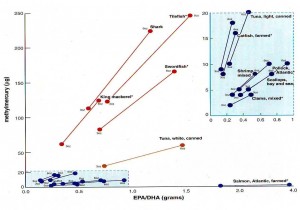
The figure below comes from the Institute of Medicine’s fish report.  It shows that fish highest in omega-3 fatty acids, the ones that are supposed to promote neurological development in the fetus and cognitive development in infants, are also highest in mercury.

fish

White tuna is the line toward the bottom.  The ones in the blue boxes are all much lower in omega-3s and in mercury except for farmed Atlantic salmon (high in omega-3s, very low in mercury).

What’s going on here?

  • Tuna producers know you can’t tell the difference between white and other kinds of tuna and don’t want you to stop eating tuna during pregnancy.
  • The data on the importance of eating fish to children’s cognitive development are questionable (in my opinion).  The studies are short term and it’s difficult to know whether the small gains in early cognitive development that have been reported make any difference a few months later.
  • The FDA must be under intense pressure to promote fish consumption.

I think it is absurd to require pregnant women to know which fish to avoid.  In supermarkets, fish can look pretty much alike and you cannot count on fish sellers to know the differences.

Other dilemmas:

  • Even smaller fish have PCBs, another toxin best avoided by pregnant women, if not everyone.
  • The world’s seafood supply is falling rapidly as a result of overfishing.
  • Half of the mercury in seafood derives from emissions from coal-burning power plants.  The best way to reduce mercury in fish is to clean up the emissions from those plants, but plant owners want to avoid the expense.

That’s fish politics, for you.

The FDA documents:

Navy Seal on changing the world…

According to Admiral William H. McRaven, if you want to change the world you must:

  1. start each day with a task completed
  2. find someone to help you through life
  3. respect everyone
  4. know that life is not fair
  5. know that you will fail often
  6. take some risks
  7. step up when the times are the toughest
  8. face down the bullies
  9. lift up the down trodden
  10. never, ever give up