All posts by blackfriar

Bedroom darkness and obesity

Might be worth having a look at, especially with the Barangaroo building site aspiring to be a night sun at the moment…

http://www.bbc.com/news/health-27617615

Woman asleep

Related Stories

Sleeping in a room with too much light has been linked to an increased risk of piling on the pounds, a study shows.

A team at the Institute of Cancer Research in London found women had larger waistlines if their bedroom was “light enough to see across” at night.

However, they caution there is not enough evidence to advise people to buy thicker curtains or turn off lights.

The study of 113,000 women was published in the American Journal of Epidemiology.

The women were asked to rate the amount of light in their bedrooms at night as:

  • Light enough to read
  • Light enough to see across the room, but not read
  • Light enough to see your hand in front of you, but not across the room
  • Too dark to see your hand or you wear a mask

Their answers were compared to several measures of obesity. Body Mass Index, waist-to-hip ratio and waist circumference were all higher in women with lighter rooms.

Prof Anthony Swerdlow, from the Institute of Cancer Research, told the BBC: “In this very large group of people there is an association between reported light exposure at night and overweight and obesity.

“But there is not sufficient evidence to know if making your room darker would make any difference to your weight.

“There might be other explanations for the association, but the findings are intriguing enough to warrant further scientific investigation.”

Body Clock

One possible explanation is that the light is disrupting the body clock, which stems from our evolutionary past when we were active when it was light in the day and resting when it was dark at night.

Light alters mood, physical strength and even the way we process food in a 24-hour cycle.

Artificial light is known to disrupt the body clock by delaying the production of the sleep hormone melatonin.

Body Clock

Prof Derk-Jan Dijk, from the Surrey Sleep Centre, said there would be no harm in trying to make bedrooms darker.

He told the BBC: “People in general are not aware of the light present in their bedroom, I think people should assess their bedroom and see how easy it would be to make it darker.”

Street lights, some alarm clocks and standby lights on electrical equipment such as televisions could light a room, he said.

“Overall this study points to the importance of darkness,” he concluded.

Cancer

The study was funded by Breakthrough Breast Cancer and the findings emerged from a long-term study to understand the risk factors for breast cancer. Obesity is known to increase the odds of the disease.

Dr Matthew Lam, from the charity, commented: “It’s too early to suggest that sleeping in the dark will help prevent obesity, a known risk factor for breast cancer, but the association is certainly interesting.

“Whilst we are learning more and more each day about the environmental, genetic and lifestyle factors that affect breast cancer risk, it is not yet possible to predict who will get breast cancer, and for women who have been diagnosed with the disease, we can’t yet say what caused it.”

Eating more fruit and veg won’t stop obesity


http://www.theatlantic.com/health/archive/2014/06/eating-more-fruits-and-vegetables-wont-stop-obesity/371992/

Eating More Fruits and Vegetables Won’t Stop Obesity

People have been eating more fresh produce as the obesity epidemic has worsened. They’ve been eating more of everything else, too.

Why are so many people overweight? Part of the reason, some think, is because they don’t have access to, the money to buy, or the desire to eat fresh fruits and vegetables.

That’s the idea behind initiatives like the “One more a day pledge” (whose slogan sounds like the pledge-taker might already be choking on carrots: “I pledge to eat … and help my family eat … at least ONE MORE fruit or veggie every day.”[ellipses sic])

Produce is less calorically dense than grains, meat, and fat, so increasing its consumption might indeed make sense as an obesity-fighting strategy—that is, if eating more fruits and vegetables caused people to compensate by eating fewer cookies and french fries.

Unfortunately, though, we don’t really eat that way. We’ll have a tossed salad—and then a Chipotle Quesarito. At least, that’s what RAND health economist Roland Sturm found in a new paper he co-authored with Ruopeng An, a health policy professor at the University of Illinois at Urbana-Champaign.

“Conventional wisdom is an awful guide for policy,” Sturm told me. “The consumption of fruits and vegetables has increased during the obesity epidemic.”

Differences in diet, such as eating more Cheetos and fewer cucumbers, help explain why some individuals are more obese than others, Sturm said. But they don’t explain why obesity has grown across all populations in nearly all U.S. states over the past few decades.

The study, published in the journal CA: A Cancer Journal for Clinicians, found that while college-educated people are still less likely to be obese than their less-educated counterparts, they’re still fatter than they used to be:

Increase in body mass index over time for people of various levels of education (CA: A Cancer Journal)

And the BMIs of the uber-healthy Coloradans, who regularly appear on “healthiest states” lists, have been rising over time, just like those of Mississippians have:

Prevalence of overweight over time in California, Colorado, and Mississippi. (CA: A Cancer Journal)

Today, people eat about 30 more pounds of vegetables and 25 more pounds of fruit per year than they did in 1970, according to Sturm’s calculations.

Unfortunately, they’re eating more of everything else, too. The average adult consumed about 2,100 calories in 1970, but in recent years that number has risen to more than 2,500.

Average daily per capita calories, adjusted for waste (CA: A Cancer Journal for Clinicians)

Attempts to discourage the consumption of certain macronutrients also don’t seem to work. Historically, people have simply eaten less of the forbidden substance and more of the others. During the low-fat craze of the 90s, for example, fat consumption dipped, but carbohydrate intake skyrocketed. And after the Atkins diet took off in 2000, people simply swapped carbs back in for fat.

Change in macronutrient consumption over time. (CA: A Cancer Journal for Clinicians)

“Preventing obesity is not about eating more food, regardless of how many nutrients it provides,” Sturm and An write, “but consuming less energy or expending more.”

Past research on the produce-obesity issue has been mixed: A 2003 study of a large sample of children found that eating more fruits and vegetables had no significant impact on weight. Around the same time, a different study of middle-aged nurses found those who ate more produce were less likely to become obese.

Sturm emphasized that his study is different because it’s looking at top-level changes over time, not disparities between groups of people.

A recent Lancet study found that rich and poor countries alike are now struggling with obesity, and that there have been “no national success stories” in stemming the epidemic. So while it’s definitely a problem that, say, poor American women tend to be fatter than richer women, another frightening trend is the overall rise of large waistlines over time.

Weekend operations more dangerous


http://www.independent.co.uk/life-style/health-and-families/health-news/death-more-likely-aftera-weekendoperation-weekly-dip-in-recovery-rates-worldwide-proves-need-for-a-sevenday-nhs-9466802.html

Death more likely after a weekend operation: Weekly dip in recovery rates worldwide proves need for a ‘seven-day NHS

Global study involving 55m patients reveals deaths significantly more likely following Saturday surgery

As the NHS prepares to enter an era of seven-day working, data from 72 different research projects covering more than 55 million patients found that the “weekend effect” is international. Researchers from Tohoku University, Japan, who analysed worldwide hospital death rates, said the most likely explanation for the results was poorer quality care at weekends.

Their findings, to be presented today at a meeting of leading European anaesthesia specialists in Stockholm, are supported by another study which discovered similar concerns about mortality levels at Berlin’s hospitals. Researchers at the Charité medical school found death rates can be affected by not only the day of the week, but the time of year and even whether surgery is carried out in the morning or the afternoon. The findings, based on an analysis of nearly 220,000 patients treated at two of the university’s hospitals between 2006 and 2011, show that mortality was higher in the afternoons, at weekends, and peaked in February.

Dr Felix Kork of Charité said the precise causes are unknown. “It is speculation, but in the afternoon it may be that the surgeries are more likely to be urgent than in the morning, although we tried to control for that factor. It may also be that the human immune system reacts differently at different times of the day, but there is not a lot of data supporting that theory. February is usually a time when many people are ill due to viral infections – that may have an influence on the outcomes.”

He also suggested that seasonal hormonal rhythms, for instance of the “sleep hormone” melatonin, might be affecting the performance of staff and surgical responses of patients in February, but said this theory was “speculative”.

NHS England has already acknowledged that hospital care suffers at the weekends, and plans are in train to ensure more senior doctors are available to prevent problems and complications escalating into life-threatening situations. Plans for a “seven-day NHS” are also in place in Scotland and Wales.

Last year, a study in the British Medical Journal provided evidence to support long-standing fears that surgery in the NHS was more dangerous at the weekend. The study, led by Dr Paul Aylin of the Dr Foster Unit, the Imperial College research team which has pioneered the publication of hospitals’ surgical outcomes data, revealed that patients who had an operation on Friday or Saturday were 44 per cent or 82 per cent more likely to die within 30 days than those who had surgery on a Monday.

It also showed the risks of surgery became progressively higher from Monday to Saturday, although only 4.5 per cent of elective procedures are carried out at weekends, and the average mortality risk for such procedures is low – 0.67 per cent. Evidence has also shown patients admitted to NHS hospitals at the weekend, not necessarily for surgery, also have a higher mortality risk.

Commenting on the new studies, Dr Aylin said they added up to “powerful” evidence of a global problem in healthcare. “The German study is interesting in raising afternoon surgery as an issue, but as the authors acknowledge, it may be that ‘the patients treated in the afternoon and on the weekends were more severely ill’,” he said.

“The Japanese study is powerful in that it combines the results of 72 studies from around the world …. Both studies acknowledge the differences could reflect poorer care or simply that patients admitted at these times were more severely ill. More research is needed to find out exactly what contributes to higher mortality at weekends. Is it lack of clinical staff, nursing staff, diagnostic services, other hospital resources?”

NHS England has decided that the numbers and degree of seniority of staff at weekends is to blame. Reforms announced by NHS England’s medical director, Sir Bruce Keogh, at the end of last year could see more consultants, and many other NHS staff, made available at weekends. However, the plans could cost between £1bn and £2bn, and many in the health service have raised concerns that this may be unaffordable, given the huge financial pressure already faced by NHS trusts.

Wired Health – Proteus Digital Pill Presentation

Proteus occupy an interesting position… ingestibles are the ultimate in wearables. It’s smart also to be backed a big flailing incumbent player. It will be interesting to see if this stuff works.

http://www.proteus.com/andrew-thompson-on-transforming-healthcare-at-wired-health-2014/

Andrew Thompson on transforming healthcare at Wired Health 2014

Published On: May 5, 2014

Watch Proteus CEO Andrew Thompson present at Wired Health 2014 on transforming healthcare through digital medicines:  http://bit.ly/1lS7RLe 

WIRED Health is a one-day summit designed to introduce, explain and predict the coming trends facing the medical and personal healthcare industries. The inaugural event was held on Tuesday April 29, at the new home of the Royal College of General Practitioners, 30 Euston Square, London.Andrew Thompson at Wired

Peter Martin nails the daftness of the budget health cuts…

…with some help from SRL. The  last par nails it:

Withdrawing from  measures we know will work in order to fund new measures we think might work seems a daft way to manage our health. But it’ll help cut the deficit.

http://www.smh.com.au/comment/when-deep-cuts-are-not-healthy-20140602-zrukf.html

When deep cuts are not healthy

Date

Economics Editor, The Age

View more articles from Peter Martin

Illustration: Andrew Dyson

Illustration: Andrew Dyson.

It took Mark Latham to say the unsayable. “If a cure to cancer is to be found, most likely it will happen in Europe or the United States,” he wrote in the Weekend Financial Review. Spending scarce funds to find a cure ourselves is a waste of money, a political fig leaf to cover the electoral pain of the GP co-payment.

Anyone who doubts that the Medical Research Future Fund is a fig leaf or an afterthought, needs to only look at the pattern of leaks and speeches leading up to the budget. Ministers spoke often about the need to restrain the cost of Medicare, scarcely at all about the need to boost medical research.

They weren’t able to prepare the way for the medical research future fund because it didn’t come first. It isn’t that pharmaceutical benefits, doctors rebates and future hospital funding are being cut to pay for the fund. It’s that the fund was evoked late in the piece to smooth the edges of the cuts.

Under the descriptions of 23 separate cuts in the budget are  the words: “The savings from this measure will be invested by the government in the Medical Research Future Fund”.

The cuts hit dental health, mental health, funding for eye examinations, measures to improve diagnostic images, research into preventive health, a trial of e-health and $55 billion of hospital funding over the next 10 years.

We’re told the cuts are to build a $20 billion Medical Research Future Fund, but the immediate purpose is to cut the deficit.

The wonders of budget accounting mean that the savings notionally allocated to the fund will actually be used to bring down the budget deficit except for when money is withdrawn from the fund to pay for research.

It’s the same trick Peter Costello pulled with the Future Fund. The government gets two gold stars for the price of one. It can both cut the deficit and build up the funds for medical research. And it isn’t yet too sure about what type of research.

Under questioning by senators on Monday, health department officials revealed that they didn’t even know about the fund until late in the budget process and even then provided no advice on how it would work.

Asked about the kind of things the fund would finance, the department’s secretary Jane Halton said the questions were hypothetical.

Would it include evaluations of potentially life-saving preventive health measures such as SunSmart and anti-tobacco programs? “I think it’s unlikely based on the description I have seen, but again we are in an area that we probably can’t yet answer,” she replied.

A few minutes later she asked for her words to be expunged saying she really didn’t know. “We need to work through this level of detail” she told the senators.

We know that cures for cancer, Alzheimer’s and heart disease will be part of fund’s remit, because the Treasurer told us so. “One day someone will find a cure for cancer,” he said after the budget. “Let it be an Australian and let it be us investing in our own health care.”

Latham’s point is that the idea is silly. By all means contribute proportionately to a global effort to find cures for diseases, but don’t try and lead the pack by taking scarce dollars away from applying the medical lessons we have already learnt.

Small countries like Australia are for the most part users rather than creators of technology, and our funds are limited as Joe Hockey well knows.

The Medical Journal of Australia isn’t fooled. This month’s editorial says a government genuinely concerned about extending the working lives of Australians would be investing more in preventing chronic disease, not less.

“The direct effects of the proposed federal budget on prevention include cuts to funding for the National Partnership Agreement on Preventive Health, loss of much of the money previously administered through the now-defunct Australian National Preventive Health Agency, and reductions in social media campaigns, for example, on smoking cessation,” it says.

“Increased funding for bowel cancer screening, the Sporting Schools initiative, the proposed National Diabetes Strategy and for dementia research are positive developments, but do not balance the losses.”

It’s the indirect effects of the measures the fund seeks to make palatable that have it really worried. The $7 co-payment will work out at $14 for patients with chronic diseases. They’ll pay once to see the doctor and then again to have a test. The editorial quoted four studies which have each found that visits for preventive reasons are the ones co-payments are most likely to cut back.

“The effects of these co-payments on preventive behaviour are greatest among those who can least afford the additional costs,” it observes. Which is a pity because “the potential for prevention is greatest among poorer patients, who are often at a health disadvantage”.

We’ll all suffer if co-payments cut vaccination rates, even those of us who aren’t poor, and even if the Medical Research Future Fund finds a cure cancer.

The journal’s biggest concern is that the cuts to hospital services will hit preventive health measures because they are seen as less urgent.

“The greatest pity of all is that the proposed cuts to funding for health come at the time when the first evidence is at hand of potential benefits of the large-scale preventive programs implemented under the national partnership agreements,” the journal writes. “A slowing in the rate of increase in childhood obesity and reductions in smoking rates among indigenous populations have been hard-won achievements.”

Withdrawing from  measures we know will work in order to fund new measures we think might work seems a daft way to manage our health. But it’ll help cut the deficit.

Peter Martin is economics editor of The Age.

Twitter: @1petermartin

Doggett backs in Professor Halton

In the context of recent experiences, this analysis does not stand up:

Blaming a public servant – even one as senior and reputedly influential as Professor Halton – for a bad Government decision not only lets Minister Peter Dutton off the hook on this issue, it undermines the fundamental accountability of the Government.  Both critics and supporters of the Government and its 2014/15 Budget initiatives should focus on ensuring Ministers are fully answerable to the community for their decisions and not look to public servants as scapegoats.

Also annoying to see Terry continuing to dig a hole:

Former Liberal adviser Terry Barnes took to Twitter over the weekend to publicly criticise Department of Health Secretary Professor Jane Halton for her role in the Government’s GP co-payment Budget initiative.  Among his comments were “Jane Halton was chief designer of the GP co-pay package. Send her to Geneva, not Finance’.


http://blogs.crikey.com.au/croakey/2014/06/02/senate-estimates-what-they-reveal-about-federal-budget-201415/

Senate Estimates – what they reveal about Federal Budget 2014/15

Estimates are an important part of Government accountability and transparency processes and can often reveal some key details of funding measures which may not have been disclosed in the official Budget papers or, through some political ‘oversight’, left out of the Budget night communications.

For example, last week Senator Penny Wong relentless pursued a line of inquiry on the cuts to Indigenous health services – revealing that despite the significantly poorer status of Aboriginal and Torres Strait Islander Australians, services to them were being cut by over half a billion dollars with the future a broad range of health, social welfare and education programmes still in budgetary limbo.

Senator Rachel Siewert has also been active in Estimates on this issue sending out a number of Tweets, including the following:

OMG Govt health ppl responsible for Aboriginal Medical Services haven’t modelled impact of $7 GP co-payment on those services

Govt cutting $165.8m from Aboriginal health to put in Health Research Future Fund – as if the health problems aren’t urgent now
 
Sorry apparently these aren’t cuts to Aboriginal health programmes they are pauses

Due to its potential for ferretting out nuggets of media-friendly and politically damaging information, the Estimates process has become a much more intense and partisan process than perhaps it was ever intended to be.  With politicians interrogating public servants for their own political ends and using the opportunity for some grandstanding of their own, the pressure on bureaucrats to maintain their a-political positions is intense. Surely it can’t be easy for a senior public servant, no doubt impacted themselves by Government cuts to the bureaucracy and worried about their own job security, to have to explain Government policies and funding cuts they often had little influence over and in many cases don’t agree with?

Despite the potential for ‘free and fearless advice’ to be overshadowed by political machinations, it’s important not to blur the lines between the political and bureaucratic processes when looking at the Senate Estimates process.  Former Liberal adviser Terry Barnes took to Twitter over the weekend to publicly criticise Department of Health Secretary Professor Jane Halton for her role in the Government’s GP co-payment Budget initiative.  Among his comments were “Jane Halton was chief designer of the GP co-pay package. Send her to Geneva, not Finance’.

I am not privy to the communications between the Department and the Minister’s Office on the co-payment issue and I am not a fan of this fundamentally flawed policy.  However, regardless of the advice Professor Halton and her Department provided to the Minister, she cannot be held in any way responsible for the Government’s policy decisions on this, or any other, issue.  As an unelected public servant, her role is to give advice and it is the role of the Government to then act on this advice, if it so wishes. Fundamental to our Westminster system of Government is the accountability of Ministers for their decisions and the ability of the public to remove them from office via an election if these decisions prove unpopular. This accountability exists regardless of the quality of the advice they receive on the issue (although it has to be said there were plenty of people around who could have pointed out the problems with the co-payment policy).

Blaming a public servant – even one as senior and reputedly influential as Professor Halton – for a bad Government decision not only lets Minister Peter Dutton off the hook on this issue, it undermines the fundamental accountability of the Government.  Both critics and supporters of the Government and its 2014/15 Budget initiatives should focus on ensuring Ministers are fully answerable to the community for their decisions and not look to public servants as scapegoats.

Dept of Justice on Organised Healthcare Fraud


http://www.fiercehealthpayer.com/antifraud/story/dojs-rebecca-pyne-fighting-fraud-organized-crime/2014-05-25?page=full

http://www.stopmedicarefraud.gov/


DOJ’s Rebecca Pyne on fighting fraud by organized crime

FierceHealthPayer: Anti-Fraud: Why are organized crime syndicates and gangs turning to health insurance fraud, and is this type of criminal behavior the work of American syndicates, international ones or both?

Rebecca Pyne: “Organized crime” is a phrase that can be interpreted in many ways. Our office is interested in international organized crime and traditional mafia/La Cosa Nostra (LCN) organized crime activity. So our office has a more limited focus in the world of healthcare rather than broadly [examining] any organized activity.

There are a number of reasons why organized crime groups would find it attractive to be involved in healthcare fraud. They’re simply following the money, since successful fraudulent billing schemes can generate millions of dollars in a relatively short period. Healthcare fraud is also attractive because once a fraud scheme is perfected, it can be duplicated locally, regionally and even nationwide. This multiplies the profits from a particular scheme.

Also, there may be a belief that there’s a low risk of detection in healthcare fraud. At least when the analysis is done between risk and reward, the analysis may weigh in terms of the reward side. Sophisticated schemes can be layered so that those who mastermind them are removed from actual criminal conduct. They can direct the scheme and profit from it but insulate themselves from directly engaging in the front-line criminal act.

In the past, there was also a perception that punishments for healthcare fraud may be less severe than other crimes, but I think that’s no longer true. Federal statutes and the sentencing guidelines have enhanced enforcement and also increased sentences for healthcare fraud.

FHPAF: What are some typical schemes?

Pyne: With respect to international organized crime groups and LCN involvement in healthcare fraud, we see sophisticated healthcare fraud schemes carried out. For example, one of the largest Medicare fraud  schemes ever perpetrated by a single enterprise was conducted by an international organized crime group with members and associates located in the United States and Armenia. That scheme operated phantom clinics all across the country and drove more than $100 million in bogus bills to Medicare.

That international organization was linked to the highest level of Russian organized crime. It was operated with the assistance of a Russian “vor,” a person high-ranking in criminal leadership in the former Soviet Union.

One of the problems when existing organized crime groups get involved in healthcare fraud is that they can employ their associates and members to carry out the scheme. Often the international organized crime groups draw from ethnic communities for assistance in perpetrating their offenses. We’ve seen this with Armenian and Russian groups. And we’ve also seen leaders overseas and proceeds moving overseas.

The types of schemes we’ve seen with international organized crime involve purely bogus medical claims. Patients were paid bribes for access to their Medicare numbers or for going in for services or testing. Medical claims can be billed under provider numbers stolen from doctors, so criminals combine stolen Medicare patient and provider information to submit fictional claims.

There are variations involving claims for medically unnecessary procedures. There may actually be a patient and a doctor, but the procedures aren’t performed and false bills are generated. And in those types of situations, patients can be recruited or doctors can be bribed or paid kickbacks to participate. So theft of doctor and patient identities is a big factor in some cases we see.

This can occur with durable medical equipment or ambulance companies that bill for transportation of patients that is medically unnecessary or which never occurred. We also see sophisticated schemes where nursing home facilities and hospice facilities billed for services not rendered to patients.

FHPAF: What can you tell us about organized crime’s involvement in staged car accidents?

Pyne: One area that is solely a private insurance matter is the history of Eurasian organized crime involvement in staging auto accidents. In those scenarios, the accident can be purely fictional, or they can recruit people to fabricate a car accident. These patients can be recruited to act as victims and could be paid to participate. And private insurance companies are billed for medical tests that are false and fraudulent or for medically unnecessary treatments. Those schemes can have similarities to Medicare fraud, but they really target private insurers.

FHPAF: What can health insurers do to make it harder for organized criminals to access health insurance identification numbers of patients and providers (and thereby make it harder for criminals to get into Medicare and Medicaid in the first place)?

Pyne: Putting together patient health insurance numbers and provider numbers can facilitate large fraudulent billing schemes. We’ve seen organized crime cases where blocks of patient information have been stolen from hospitals and then used to generate bogus claims.

So insurers could evaluate safeguards they have in their own systems on patient health insurance numbers and provider numbers to protect these from being available through corruption of databases. Educate employees on safeguarding information as well as patients and providers about the importance of protecting those numbers. Both paper and electronic files can fuel fraud schemes if they fall into the wrong hands.

FHPAF: What role does data analytics technology play in this fight?

Pyne: With any healthcare fraud scheme, data analytics can identify unusual billing patterns, which could indicate possible fraud to investigate further. Large fraudulent billing schemes involving purely fictional claims may be picked up through finding unusual billing patterns.

Here are examples: A new provider appears with large volumes of patient claims. Or claims are generated from providers in unusual locations relative to a patient’s home. Or there are unusually large volumes of tests or procedures for a single patient or unusual combinations of procedures for a specific patient.

FHPAF: What’s your best advice for special investigations units to combat fraud by organized crime?

Pyne: Many schemes are difficult to unravel and require extensive federal investigation; but watch for unusual claims or provider conduct, and train employees to report irregularities they see in billings or in their contacts with patients or providers.

Educate patients to report irregular medical claims they see under their name. And refer potentially fraudulent activity to law enforcement investigators early. Sharing information is so important because these schemes can involve multiple insurance companies and Medicare and be widespread, affecting many different entities.

The U.S. Department of Health and Human Services and the DOJ have a public/private insurance initiative underway designed to share information and best practices. The goal is to improve detection and prevent payment of fraudulent healthcare billings by both public and private payers. The Healthcare Fraud Prevention and Enforcement Action Team website is a place to look for information and potentially become involved in that partnership.

But in general, keeping abreast of developments in your state and new schemes reported in the press can certainly be helpful. Even basic practices such as conducting internet research on suspicious providers can be fruitful. We’ve seen insurers discover that they are victims of a targeted billing scheme when they learn that their provider has been indicted on a scheme.

Editor’s Note: This interview has been edited and condensed for clarity.

Story-telling important in anti-fraud efforts

A bit obvious, but should remember to include this in our report

http://www.fiercehealthpayer.com/antifraud/story/storytelling-draws-stakeholders-fraud-fighting-flame/2014-05-26

Storytelling draws stakeholders to the fraud fighting flame

“A rapidly growing number of leading companies have discovered the power of story as a communication tool,” according to Insurance Thought Leadership. “When stories are told consistently and systematically, everyone in the organization works together better, stays focused on the mission and remains productive, ensuring continued success in the midst of change.”

Whether it’s detecting a fraud scheme, preparing a case referral for law enforcement, training staff to recognize and report misconduct, or demonstrating the value of SIU efforts, fraud fighting is a story-rich function. Though proprietary aspects of investigations can’t be shared, here are examples of how SIUs have leveraged the power of stories:

When corporate executives see the value of SIU operations in combating health insurance fraud, they typically support their operations well. “If you do a good job telling your story, it gets the leadership’s attention and they see the importance of having an effective SIU,” consultant Jack Price told FierceHealthPayer: Anti-Fraud.Recognizing this, Harrisburg, Pennsylvania-based United Concordia dedicated awebsite page to success stories of its dental SIU.

Fraud detection requires pattern recognition, and patterns are story forms. “The claims tell a story. The data tell a story. You just have to decipher it,” WellPoint Director of Enterprise Investigations Alanna Lavelle told FierceHealthPayer: Anti-Fraud.

Further, storytelling can be used in anti-fraud staff training programs. One insurer developed training based on fraud schemes portrayed in films, all of which told stories employees remembered long afterward.

It’s a modern application of an old idea: “Stories reach people at deeper level than a litany of facts and figures, and stay with people longer,” the Insurance Thought Leadership article noted. This led Harvard University professor Howard Gardner to conclude that “storytelling is the single most powerful tool in a leader’s toolkit.”

Stories connect employees with corporate culture, the article noted. “By incorporating storytelling as a part of your business practices and regularly including relevant stories on the agenda for meetings …  you will propel your organization toward its goals. Red-hot stories will keep everyone fired up and eager to pass them along to everyone they encounter.”

For more:
– here’s the Insurance Thought Leadership article
– see United Concordia’s list of anti-fraud success stories

Related Articles:     
Jack Price on building a top-notch SIU
Reel value: Use movies for anti-fraud training
How to work effectively with law enforcement to fight fraud
Wellpoint’s Alanna Lavelle on improving witness interviews

Economist: US Medicare Fraud


New word: A Pill Mill

http://www.economist.com/news/united-states/21603078-why-thieves-love-americas-health-care-system-272-billion-swindle

Health-care fraud

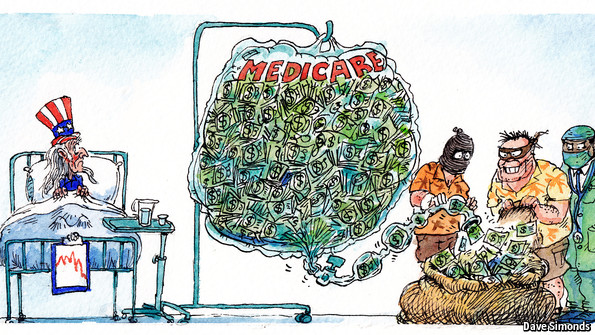
The $272 billion swindle

Why thieves love America’s health-care system

INVESTIGATORS in New York were looking for health-care fraud hot-spots. Agents suggested Oceana, a cluster of luxury condos in Brighton Beach. The 865-unit complex had a garage full of Porsches and Aston Martins—and 500 residents claiming Medicaid, which is meant for the poor and disabled. Though many claims had been filed legitimately, some looked iffy. Last August six residents were charged. Within weeks another 150 had stopped claiming assistance, says Robert Byrnes, one of the investigators.

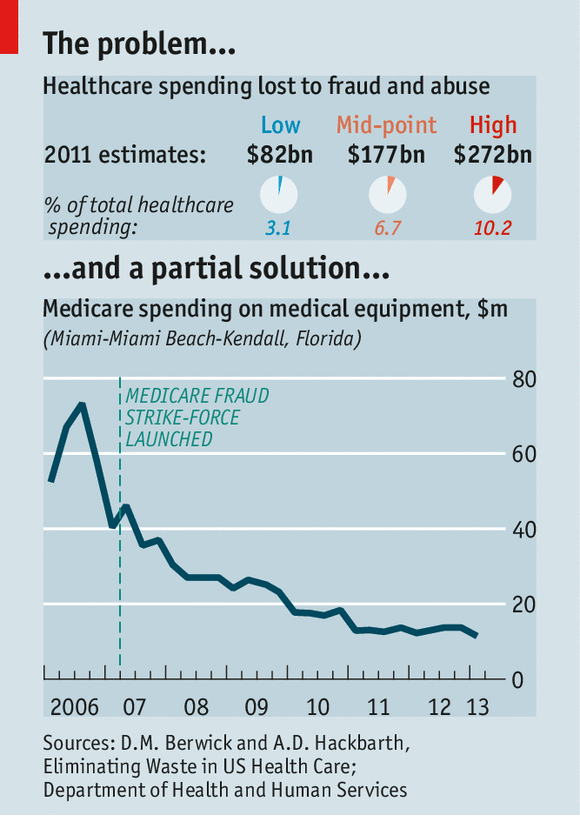
Health care is a tempting target for thieves. Medicaid doles out $415 billion a year; Medicare (a federal scheme for the elderly), nearly $600 billion. Total health spending in America is a massive $2.7 trillion, or 17% of GDP. No one knows for sure how much of that is embezzled, but in 2012 Donald Berwick, a former head of the Centres for Medicare and Medicaid Services (CMS), and Andrew Hackbarth of the RAND Corporation, estimated that fraud (and the extra rules and inspections required to fight it) added as much as $98 billion, or roughly 10%, to annual Medicare and Medicaid spending—and up to $272 billion across the entire health system.

Federal prosecutors had over 2,000 health-fraud probes open at the end of 2013. A Medicare “strike force”, which was formed in 2007, boasts of seven nationwide “takedowns”. In the latest, on May 13th, 90 people, including 16 doctors, were rounded up in six cities—more than half of them in Miami, the capital city of medical fraud. One doctor is alleged to have fraudulently charged for $24m of kit, including 1,000 power wheelchairs.

Punishments have grown tougher: last year the owner of a mental-health clinic got 30 years for false billing. Efforts to claw back stolen cash are highly cost-effective: in 2011-13 the government’s main fraud-control programme, run jointly by the Department of Health and Human Services (HHS) and the Department of Justice, recovered $8 for every $1 it spent.

As fraud-fighting has intensified, dodgy billing has tumbled in areas that were most prone to abuse, such as durable medical kit and home visits (see chart). Home-health fraud—such as charging for non-existent visits to give insulin injections—got so bad that the CMS, which runs the programmes, called a moratorium on enrolling new providers in several large cities last year. Since tighter screening was introduced under Obamacare, the CMS has stripped 17,000 providers of their licence to bill Medicare. Thousands of suppliers also quit after being required to seek accreditation and to post surety bonds of $50,000.

Economist_HealthcareFraud_20140531_USC154

Yet the sheer volume of transactions makes it easier for miscreants to hide: every day, for instance, Medicare’s contractors process 4.5m claims. In this context the $4.3 billion recovered by fraud-busters in 2013, though a record, looks paltry.

Better than cocaine

Fraud migrates. Take one popular scam: overbilling for HIV infusion, an outdated therapy that Medicare still covers despite the existence of cheaper, better alternatives. This scam waned in Florida after a crackdown, only to pop up in Detroit, run by relatives of the original perpetrators.

Fraud mutates, too. As old hustles are rumbled, fraudsters invent new ones. “We’ve taken out much of the low-hanging fruit,” says Gary Cantrell, an investigator at HHS—an example being the thousands of bogus equipment suppliers registered to empty shopfronts. Scams now need to be more sophisticated to succeed, he argues. Doctors, pharmacies, and patients act in league. Scammers over-bill for real services rather than charging for non-existent ones. That makes them harder to spot.

Some criminals are switching from cocaine trafficking to prescription-drug fraud because the risk-adjusted rewards are higher: the money is still good, the work safer and the penalties lighter. Medicare gumshoes in Florida regularly find stockpiles of weapons when making arrests. The gangs are often bound by ethnic ties: Russians in New York, Cubans in Miami, Nigerians in Houston and so on.

Stealing patients’ identities is lucrative. Medical records are worth more to crooks than credit-card numbers. They contain more information, and can be used to obtain prescriptions for controlled drugs. Usually, it takes victims longer to notice that their details have been pinched. The Government Accountability Office has recommended that the CMS remove Social Security numbers from Medicare cards to prevent fraud. It has yet to do so.

In one fast-growing area of fraud, involving pharmacies and prescription drugs, federal investigators have seen caseloads quadruple over the past five years. Elderly patients may receive kickbacks to sell their details to a pharmacist. He will then provide them with drugs they need while billing Medicare for costlier ones.

Paid recruiters scour nursing homes for accomplices. Some pharmacies also pay wholesalers to produce phoney invoices. Others bribe medical workers for leftover pills: in April a pharmacy-owner in Louisiana admitted to paying nursing-home staff a few hundred dollars a time to bring her unused drugs, which she repackaged and sold as new, billing Medicare $2.2m for the recycled meds between 2008 and 2013.

Another scam is to turn a doctor’s clinic into a prescription-writing factory for painkillers (or “pill mill”) and resell them on the street. A clinic in New York was recently charged with fraudulently producing prescriptions for more than 5m oxycodone tablets, which were sold locally for $30-$90 each. The alleged conspirators included doctors and traffickers who ran crews of “patients” so large that long queues sometimes formed outside the clinic. The doctors charged $300 per large prescription. One raked in $12m. To cover their backs they would ask for scans or urine samples purporting to show injuries. The fake patients typically obtained these from the traffickers at the clinic door.

False billing by pharmacies is rife. New York’s Medicaid sleuths have stepped up spot checks to see if the drugs in the back room square with invoices. But this is a lot of work, so most outlets are never checked.

Dozens of operators of ambulances and ambulettes (vans designed to take wheelchairs) have been caught offering kickbacks to patients to pretend they can’t walk. This lets them qualify for “emergency” pick-ups, for which the company can charge $400 per patient. New York has clamped down with roadside checks. But in one case, word that a checkpoint had been set up spread so quickly—as drivers called each other and a local Russian-language radio station put out a warning—that the number of ambulettes on the main street “went from several to none in a few minutes as they re-routed down side streets”, says Chris Bedell, who took part.

This sort of pavement-pounding investigative work remains important. Another approach is the “desk audit”, where possible overpayment is identified but the only way to ascertain losses is to sift through heaps of records manually. Florida’s Agency for Health Care Administration (AHCA) has recovered up to $50m a year solely from hospitals billing for treatment of illegal aliens that is wrongly coded as “emergency care”. But the work is labour-intensive. Data-crunching technologies are increasingly being used to complement the human eye. “When I started in 1996 we had little access to data,” says HHS’s Mr Cantrell. “It had to be requested ad hoc from CMS contractors.” Now a central database houses near-real-time information for Medicare. This helps the 300 workers at the inspector-general’s office who are trained in data analytics to “triage” the tips that flow in. “We receive far more than we can investigate closely,” says Mr Cantrell.

The CMS is still getting to grips with a new predictive-analysis system, which was introduced in 2011 to catch Medicare fraud earlier and is modelled on tools used by credit-card firms. This identified $115m of dodgy payments in 2012, its first full year. (The number for the second year has yet to be released.) Another useful tool is voice-recognition technology. In Florida, health workers who conduct home visits have to call in from the patient’s phone during each appointment to have their voice pattern matched against the one stored electronically. This has greatly reduced billing for non-visits.

Technology is no panacea, however. Medicare’s computers were pumping out thousands of payments a year for patients who had been struck off the programme before receiving their treatment, until human hands began to intervene this year. The electronification of patient records can allow “cloning”, in which treatments automatically trigger excessive billing codes by defaulting to set templates.

This is the medical world’s “dirty secret”, says John Holcomb of the Texas Medical Association. Everyone talks about it in the doctor’s lounge, but few complain. (What doctors do complain about is the complexity of the bill-coding system: see article.) Moreover, there are gaps in the data picture—some of which could grow. Federal investigators complain that there is no proper national repository for Medicaid information, which is held state-by-state.

A bigger worry is that, as ever more Medicare and Medicaid beneficiaries move to “managed  care” (privately administered) plans, government sleuths will have access to less data. This could lead to lower fraud-related recoveries.

Efforts have been made to improve information-sharing between government and private insurers, including the creation of a public-private forum, the National Health Care Anti-Fraud Association (NHCAA). But some insurers are reluctant to take part, fearing that being too open with their data would invite lawsuits over privacy. Fraudsters bank on public and private payers not working together to connect the dots, said Louis Saccoccio, the head of the NHCAA, at a recent hearing.

The NCHAA is pushing for federal immunity guarantees for insurers that share fraud-related information. On May 20th a bipartisan group of senators introduced a bill to make it easier for insurers to share data with Medicare. It would also require Medicare to check new providers for links to firms that have previously swindled the taxpayer (which you might have thought it was already doing).

Obamacare has had a big impact, says Shantanu Agrawal of the CMS. One thing it requires is that when a state kicks out a dodgy Medicaid provider, it shares that information with Medicare, and vice versa. Previously there were legal impediments to doing this, for some reason.

Resources are tight for investigators. New York has a Medicaid investigations division of 110 souls (including support staff) to scrutinise $55 billion of annual payments and 137,000 providers. Gloria Jarmon, an auditor with the HHS, told a recent hearing that budget cuts will probably force it to cut its oversight of Medicare and Medicaid by 20% in this fiscal year. “Everyone [in Congress] is excited that we bring in eight times more than we cost, but that hasn’t translated into more funding,” laments Mr Cantrell.

This squeeze makes it all the more important to enlist help. More than 5,000 old folk have joined “Medicare patrols”, which hold local meetings to raise awareness of common scams. A crucial part of the anti-fraud effort is the new, simpler Explanation of Benefits (summary statement) that lets recipients see who has billed the programme with their identification numbers. This is “a landmark change”, a CMS executive told Congress last year, adding: “Our best weapon in fighting fraud is our 50m Medicare beneficiaries.”