All posts by blackfriar

Greg Ellis (ex-REA CEO) leaving for Germany

http://www.abc.net.au/radionational/programs/saturdayextra/growing-aust-business/5364200

Growing Australian business

Saturday 5 April 2014 8:05AM

One of Australia’s most creative businessmen has joined a small but definitely growing critique of our national business culture.

Greg Ellis, the outgoing Chief Executive of the REA Group – the online real estate classified business, that’s rapidly increased in value under his leadership – strongly believes that Australian business needs a lot more fresh ideas.

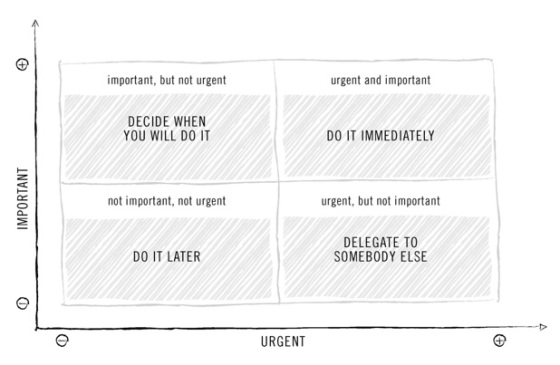
The Eisenhower Matrix

Bang on.

http://time.com/46738/supreme-court-mccutcheon-campaign-finance-law/

eisenhower-matrix


How to Achieve Work-Life Balance in 5 Steps

Achieving work-life balance can look impossible. And, frankly, it seems like it’s getting harder.

In the ten years from 1986 to 1996 work-life balance was mentioned in the media 32 times.

In 2007 alone it was mentioned 1674 times.

Via The ONE Thing:

A LexisNexis survey of the top 100 newspapers and magazines around the world shows a dramatic rise in the number of articles on the topic, from 32 in the decade from 1986 to 1996 to a high of 1674 articles in 2007 alone.

The Onion jokingly implies that the only way to achieve effective work/life balance is to not have a job:

That’s hysterical — because it’s not remotely realistic. So what actually works?

You Need To Draw A Line

I’ve posted plenty of research on productivitytime management and procrastination – but that’s not the issue here. Not at all.

Those are hacks that help you be more efficient but in the modern world you are getting 25 hours of to-do’s thrown at you every 24 hours.

Thinking that if you spend enough time you will “get everything done” is an illusion. You will never be “done.”

The happiest people are not people who don’t have a care in the world. Those people are bored.

Research shows the happiest people are busy — but don’t feel rushed.

Anxiety is reduced by a feeling of control. And what do studies say about work-life balance? Same thing — a feeling of control is key.

You have to draw a line. You must decide what is important and what isn’t.

How do you draw that line? By asking yourself one simple question a few times a day.

“What’s The Most Important Thing For You To Do Right Now?”

The main problem people have is they try to do it all and treat everything as important.

You can’t do it all and everything is not equally important.

So how do you determine the most important thing for you to do right now?

1) What Are Your Values?

Clay Christensen, Harvard Business School professor and author of How Will You Measure Your Life?, knows what he values.

Watch from 34:55 to 38:50:

He works Monday to Friday. Saturday is for family and Sunday is for God. Period. No work on the weekends. No exceptions. No matter what.

Clay knows what’s important to him, drew a line and probably doesn’t suffer from many work-life balance worries.

Is this effective for everyone at every company? No. But you have to start with knowing what matters most to you and drawing a line.

2) What gets you disproportionate results?

Face it: often you start by doing whatever happens to be in front of you. But proximity does not equal priority.

In his book The ONE Thing, Gary Keller applies the “Pareto principle” to the workday:

Most of us get 80% of results from 20% of the work we do. So focus on that 20%.

What really creates progress vs treading water? What gives disproportionate results? Do that first and most frequently.

3) What’s the thing only *you* can do well?

If someone else can do the laundry at home, let them do it. If someone else can do the filing at work, let them do it.

But if you’re the parent, you need to be at the parent-teacher conference and if you’re the sales lead you need to be at the sales meeting.

Via The Effective Executive: The Definitive Guide to Getting the Right Things Done:

All in all, the effective executive tries to be himself; he does not pretend to be someone else. He looks at his own performance and at his own results and tries to discern a pattern. “What are the things,” he asks, “that I seem to be able to do with relative ease, while they come rather hard to other people?”

Management guru Pete Drucker says focus on the things that only you can do. Delegate, outsource or neglect the rest.

4) What’s most important right now?

You feel good when you check a lot of things off your to-do list. But were they things that are most important and urgent?That’s what matters.

Via The Decision Book: 50 Models for Strategic Thinking:

The Decision Book: 50 Models for Strategic Thinking

As the Eisenhower Matrix above reveals, just because something is urgent doesn’t mean it’s important.

And being important doesn’t necessarily mean it’s urgent.

And as Clay Christensen points out, it’s all too easy to put off important family time for urgent work deadlines.

If you’ve been neglecting your loved ones recently, work might be urgent but not important while family is both importantand urgent.

Sum Up

So how do you deal with work/life balance? Here are some key ideas:

  1. Everything is not equally important. Do fewer things and do them well.
  2. Decide what your values are — and which ones take precedence.
  3. Do the things that get disproportionate results.
  4. Focus on the things only you can do.
  5. Do the important things which must be done now.

It’s not simple and it won’t be resolved tomorrow but you can get much, much better at this with time.

What’s the most important thing to remember?

You can do anything once you stop trying to do everything.

UCL: Vegetable > Fruit and 7 portions a day…


Eating at least seven portions of fresh fruit and vegetables a day was linked to a 42% lower risk of death from all causes. It was also associated with a 25% lower risk of cancer and 31% lower risk of heart disease or stroke. Vegetables seemed to be significantly more protection against disease than eating fruit, they say.

There was a surprise finding – people who ate canned or frozen fruit actually had a higher risk of heart disease, stroke and cancer.

Oyebode and colleagues took into account the socio-economic background, smoking habits and other lifestyle factors that affect people’s health. What they have found, they say, is a strong association between high levels of fruit and vegetable consumption and lower premature death rates – not a causal relationship.

http://www.theguardian.com/uk-news/2014/apr/01/fruit-and-vegetables-seven-portions-ucl-study

Fruit and vegetable intake: five a day may not be enough, scientists say

UCL study suggests increase in daily fruit and veg intake linked to lower chance of death from stroke and cancer
Britain Continues To Use Metric Measurements

Eating at least seven portions of fresh fruit and vegetables a day was linked to a 42% lower risk of death from all causes. Photograph: Jeff J Mitchell/Getty Images

Five portions of fruit and vegetables a day – a familiar mantra for those concerned about their own and their children’s health – may not, after all, be enough, according to a new report by scientists, who suggest we should instead be aiming for seven a day, and mostly vegetables at that. Alarmingly for some who thought they were doing the right thing, tinned and frozen fruit may not be helpful at all.

The latest wisdom – guaranteed to raise a groan from those already perplexed over stories of suspect sugars and dodgy fats – arises from a study carried out by experts at University College London, who analysed the eating habits of 65,000 people, revealed through eight years of the Health Survey for England, and matched them with causes of death.

The clear finding was that eating more fresh fruit and vegetables, including salads, was linked to living a longer life generally and in particular, to a lower chance of death from heart disease, stroke andcancer.

Eating at least seven portions of fresh fruit and vegetables a day was linked to a 42% lower risk of death from all causes. It was also associated with a 25% lower risk of cancer and 31% lower risk of heart disease or stroke. Vegetables seemed to be significantly more protection against disease than eating fruit, they say.

There was a surprise finding – people who ate canned or frozen fruit actually had a higher risk of heart disease, stroke and cancer.

The authors, Dr Oyinlola Oyebode and colleagues from the department of epidemiology and public health at UCL, said they were unsure how to interpret the findings on canned or frozen fruit . It could be that people eating canned fruit may not live in areas where there is fresh fruit in the shops, which could indicate a poorer diet.

Alternatively, they could be people who are already in ill-health or they could lead hectic lifestyles. There is also another possibility: frozen and tinned fruit were grouped together in the questions, but while frozen fruit is considered to be nutritionally the same as fresh, tinned fruit is stored in syrup containing extra sugar. More work needs to be done to see whether sweetened, tinned fruit is in fact the issue, the researchers say.

Oyebode and colleagues took into account the socio-economic background, smoking habits and other lifestyle factors that affect people’s health. What they have found, they say, is a strong association between high levels of fruit and vegetable consumption and lower premature death rates – not a causal relationship.

But the strength of the study, published in the Journal of Epidemiology and Community Health, is in the big numbers and the fact that the data comes from the real world – not a collection of individuals who had a particular health condition or occupation, but a random selection.

The “five a day” advice was launched by the government in 2003, after the World Health Organisation advised in 1990 that our minimum daily intake of fruit and vegetables should be 400g a day.

France and Germany also recommend five a day, while the US abandoned the numbers in favour of a “fruit and veggies – more matters” campaign in 2007. But Australia advises people to eat substantially more. In 2005, the Australian government launched “Go for 2+5”, meaning two 150g portions of fruit and five 75g portions of vegetables. That is 675g, the equivalent in the UK of 8.5 portions.

Oyebode said she thought the Australian example was probably the one to follow. “I think it makes a lot of sense,” she said. “It is aiming for more and the balance is two fruit and five veg. From our study it looks like vegetables are better than fruit. But I don’t feel very strongly that the guidelines should be changed because the majority of people know they should eat five a day and only 25% manage that.”

Changes in policy, she said, would be needed to improve the UK score. “Anything that could increase the accessibility and affordability of fruit and vegetables would be very helpful, such as working with corner shops to make sure they stock them,” she said. Petrol stations could also offer fruit and vegetables and maybe the Healthy Start scheme – which gives families on less than £16,000 vouchers for fruit and vegetables – could be extended.

Other experts agreed that the study was sound and representative of the population, but cautioned that in a study of the habits of people in the real world, it is hard to take full account of complications, such as education, smoking habits and people failing to tell the exact truth about their diet. “A key outstanding question is whether this [reduced risk of disease] is entirely attributable to these specific foods, or whether they are acting as a marker of a broader dietary pattern associated with improved health,” said Professor Susan Jebb of the Nuffield department of primary care health sciences, University of Oxford.

Illumina’s $1000 genome

This article nice frames the immaturity of the technology in the context of population health and prevention (vs. specific disease management), and even references the behaviour of evil corporations in its final paragraphs.


Cost breakdown for Illumina’s $1,000 genome:

Reagent* cost per genome — $797

Hardware price — $137**

DNA extraction, sample prep and labor — $55-$65

Total Price = $989-$999

* Starting materials for chemical reactions

** Assumes a four-year depreciation with 116 runs per year, per system. Each run can sequence 16 genomes.

http://recode.net/2014/03/25/illuminas-ceo-on-the-promise-of-the-1000-genome-and-the-work-that-remains/

Illumina’s CEO on the Promise of the $1,000 Genome — And the Work That Remains

March 25, 2014, 2:18 PM PDT

By James Temple

Illumina seized the science world’s attention at the outset of the year by announcing it had achieved the $1,000 genome, crossing a long-sought threshold expected to accelerate advances in research and personalized medicine.

The San Diego company unveiled the HiSeqX Ten Sequencing System at the J.P. Morgan Healthcare Conference in January. It said “state-of-the art optics and faster chemistry” enabled a 10-fold increase in daily throughput over its earlier machines and made possible the analysis of entire human genomes for just under $1,000.

Plummeting prices should broaden the applications and appeal of such tests, in turn enabling large-scale studies that may someday lead to scientific breakthroughs.

The new sequencers are making their way into the marketplace, with samples now running on a handful of systems that have reached early customers, Chief Executive Jay Flatley said in an interview with Re/code last week. Illumina plans to begin “shipping in volume” during the second quarter, he said.

The Human Genome Project, the international effort to map out the entire sequence of human DNA completed in 2003, cost $2.7 billion. Depending on whose metaphor you pick, the $1,000 price point for lab sequencing is akin to breaking the sound barrier or the four-minute mile — a psychological threshold where expectations and, in this case, economics change.

Specifically, a full genomic workup of a person’s three billion DNA base pairs starts to look relatively affordable even for healthy patients. It offers orders of magnitude more information than the so-called SNPs test provided by companies like 23andMe for $99 or so, which just looks at the approximately 10 million “single-nucleotide polymorphisms” that are different in an individual.

With more data, scientists expect to gain greater insights into the relationship between genetic makeup and observable characteristics — including what genes are implicated in which diseases. Among other things, it should improve our understanding of the influences of DNA that doesn’t directly code proteins (once but no longer thought of as junk DNA) and create new research pathways for treatments and cures.

“The $1,000 genome has been the Holy Grail for scientific research for now over a decade,” Flatley said. “It’s enabled a whole new round of very large-scale discovery to get kicked off.”

Cost breakdown for Illumina’s $1,000 genome:

Reagent* cost per genome — $797

Hardware price — $137**

DNA extraction, sample prep and labor — $55-$65

Total Price = $989-$999

* Starting materials for chemical reactions

** Assumes a four-year depreciation with 116 runs per year, per system. Each run can sequence 16 genomes.

Source: Illumina

Some have questioned the $1,000 claim, with Nature noting research centers have to buy 10 systems for a minimum of $10 million — and that the math requires including machine depreciation and excluding the cost of lab overhead.

But Flatley defended the figure, saying it’s impossible to add in overhead since it will vary at every research facility.

“Our math was totally transparent and it is exactly the math used by the (National Human Genome Research Institute),” he said. “It’s a fully apples-to-apples comparison to how people have talked historically about the $1,000 genome.”

He also questioned the conclusions of a recent study published in the Journal of the American Medical Association, where researchers at Stanford University Medical Center compared results of adults who underwent next-generation whole genome sequencing by Illumina and Complete Genomics, the Mountain View, Calif., company acquired last year by BGI.

They found insertions or deletions of DNA base pairs only concurred between 53 percent and 59 percent of the time. In addition, depending on the test, 10 percent to 19 percent of inherited disease genes were not sequenced to accepted standards.

“The use of [whole genome sequencing] was associated with incomplete coverage of inherited disease genes, low reproducibility of detection of genetic variation with the highest potential clinical effects, and uncertainty about clinically reportable findings,” the researchers wrote.

Or as co-author Euan Ashley put it to me: “The test needs some tough love to get it to the point where it’s clinical grade.”

Flatley responded that the sample size was small and that the sequencing platforms were several years old. But he did acknowledge they are still grappling with technology limitations.

“What’s hard is to determine whether there’s a base inserted or deleted,” he said. “That’s abioinformatics problem, not a sequencing problem. That’s a software issue that we and others and the whole world is trying to work on.”

But, he stressed, that shortcoming doesn’t undermine the value of what the tests doread accurately.

“There are many, many, many things where it’s clinically useful today,” he said.

Flatley pointed to several areas where we’re already seeing real-world applications of improving sequencing technology, including cancer treatments targeted to the specific DNA of the tumor rather than the place where it shows up in the body. There are also blood tests under development that can sequence cancer cells, potentially avoiding the need for biopsies, including one from Guardant Health.

Another promising area is noninvasive prenatal testing, which allows expecting parents to screen for genetic defects such as Down syndrome through a blood draw rather than an amniocentesis procedure.

The technology can delineate the DNA from the fetus circulating within the mother’s bloodstream. It’s less invasive and dangerous than amniocentesis, which involves inserting a needle into the amniotic sac and carries a slight risk of miscarriage. Because of that risk it’s generally reserved for high-risk pregnancies, including for women 35 and older.

Illumina, which offers the blood screening for out-of-pocket costs of around $1,500, recently funded a study published in the New England Journal of Medicine that found the so-called cell-free fetal DNA tests produced more accurate results than traditional tests for Down syndrome and Trisomy 18, a more life-threatening condition known as Edwards syndrome.

“It gives some earlier indicators to women in the average risk population if their babies have those problems,” Flatley said. “I think that it will broaden the overall market, and there are other tests that can be added over time.”

But there are ethical issues that arise as prenatal genetic tests become more popular and revealing, including whether parents will one day terminate pregnancies based on intelligence, height, eye color, hair color or minor diseases.

For that reason, Illumnia refuses to disclose those traits that are decipherable in the genome today.

But Flatley said they couldn’t stop purchasers of its machines from doing so, nor competitors like BGI of China (for more on that issue see Michael Specter’s fascinating profile of the company in the New Yorker ). Flatley said there needs to be a public debate on these issues, and he expects that new laws will be put into place establishing commonsense boundaries in the months or years ahead.

“This isn’t something we think we can arbitrate,” he said. “But we won’t be involved directly in delivering [results] that would cross those ethical boundaries.”

A public health policy disgrace…

A tale of public health advocates double-crossed by big food. Not for the first time, nor will it be the last…

In a sense, this is a battle between altruism and profit. Hardly a fair fight really?

http://www.abc.net.au/radionational/programs/backgroundbriefing/2014-03-30/5350092

Big food fight continues after Senator Fiona Nash controversy

Sunday 30 March 2014 8:05AM


The controversy surrounding a plan to put nutrition rating labels on processed foods has already claimed the job of the Assistant Minister for Health’s chief of staff. The stoush has revealed the deep links between ‘big food’ and the government, writes Ann Arnold.

Related story: RN Breakfast report (6 mins)

It sounds innocuous enough—a plan to have clear labelling about the health qualities of processed foods, so that consumers have a better sense of what they’re buying.

But a system that would see star ratings on the front of most edible items on supermarket shelves hit a spectacular hurdle in Parliament House last month.

In what became one of the biggest parliamentary stoushes so far this year, Senator Fiona Nash was forced to defend her chief of staff, Alastair Furnival, after he rang the Department of Health and ordered it to take down a new website that was to be part of the health star ratings system.

We put in a huge amount of time and effort, and did it in good faith, and dealt with this particular section of industry in good faith. Now we see a turning away from that and the use of that standard political tactic when you don’t want something to happen, of delay.

MICHAEL MOORE, AUSTRALIAN PUBLIC HEALTH ASSOCIATION CEO

Alastair Furnival was quickly exposed as a lobbyist for the food industry who had not resigned as a director from his lobbying company, Australian Public Affairs, nor sold his half share in it, while he worked for the Assistant Minister for Health. He subsequently resigned from his job and Senator Nash was censured in the Senate by Labor and the Greens for misleading Parliament.

That whole episode, however, was just the tip of an iceberg. For two years there has been a battle fought out over front of pack labelling. It’s a tale of industry and political connections, expectations dashed and influence wielded.

In one camp are health and consumer advocates concerned about the fact that diet-related illness—or dietary risk—is now the leading cause of death in the world.

In the other camp are some sectors of the food industry: mainly the larger, multinational companies, or ‘big food’, who say the expense of changing their packaging is onerous and business should not have to bear the brunt of it.

The traditionally warring groups were brought together by the federal Labor government in 2012 to thrash out a new labelling system. It was a revolutionary move. Food enemies were sitting at the same table.

Michael Moore, chief executive officer of the Australian Public Health Association, recalls: ‘Actually at the start of the process I think there was quite a lot of trepidation. As the process went on through the first year, I think we all grew in confidence, a great deal of confidence, because we really were working hard to try and find a compromise that would work.

‘When we came up with the star labelling system, because it works on white goods, because it works on movies, because it works on hotels, it would be easy to understand. It would give an overview of the healthiness of the food. I think our optimism grew.’

Soon, his view would change. The Australian Food and Grocery Council, the powerful peak body for the manufactured food industry, had been involved in developing the scheme.

But around the middle of last year, the council started to publicly criticise it. Various anomalies were raised about how particular foods were rated—issues which Mr Moore said were being dealt with by the committees in which the council was represented.

The AFGC also wanted a cost benefit analysis, and ‘more work’ to be done.

Mr Moore told Background Briefing he felt betrayed. ‘We put in a huge amount of time and effort, and did it in good faith, and dealt with this particular section of industry in good faith. Now we see a turning away from that and the use of that standard political tactic when you don’t want something to happen, of delay.’

How does he feel about that whole process now? ‘Oh well, shafted of course.’

This article represents part of a larger Background Briefing investigation. Listen to Ann Arnold’s full report on Sunday at 8.05 am or use the podcast links above after broadcast

The apparent change of heart by the AFGC came after a meeting in June last year of the nation’s health ministers, which, by vote, approved the star rating system. Big business was spooked by the health ministers’ surprise decision to make the voluntary system mandatory within two years if not enough companies had taken it up.

In an interview recorded by ABC TV’s 7.30 in February, Gary Dawson, the AFGC’s CEO, said: ‘It’s a voluntary start up, but it’s a clear threat to force this on food companies from June next year. That’s written up in the decision and so the cost impact is real.’

Processed food is Australia’s largest manufacturing industry, and it’s growing. A Deloitte report released this week forecasts food processing as one of the future growth waves for Australia. Although hit at the moment by a strong Australian dollar, it is poised to make a big impact on the Asian market.

‘We know it [health star labelling] will cost individual companies millions of dollars and of course the industry; we’d estimate around $200 million industry-wide,’ Mr Dawson said.

‘So it’s a significant cost, particularly on an industry that’s in a financial squeeze at the moment. Profits are declining. Companies like SPC or Simplot can hardly afford spending millions of dollars on a scheme where the benefits are far from well understood or proven.’

The managing director of Simplot Australia is Terry O’Brien, who became the chair of the AFGC in February last year. He is a veteran of the Australian food industry, and was previously employed by Cadbury-Schweppes.

Simplot is an American-owned private company whose Australian brands include Edgell, Leggo’s and Chiko (as in Chiko Roll). Background Briefing sought an interview with Mr O’Brien, but he declined.

He was quoted in The Australian in December citing the cost of the new labelling to hiscompany at an estimated $2.5 million.

Simplot was at that stage faced with closing its factory at Bathurst, in NSW. The company has since announced nearly 300 jobs will be cut from Bathurst and another base at Devonport, Tasmania, over the next few years.

The Australian reported that late last year, the AFGC was actively lobbying National Party MPs about the star ratings system.

The former chief of staff to Senator Fiona Nash, Alastair Furnival, was well connected to the AFGC. He had previously worked with at least two companies—Cadbury and Mondelez—whose leaders are on the board of the council.

Gary Dawson, the council’s CEO, had been a senior member of John Howard’s staff.

‘So he would have dealt very regularly with many, many of the members of Parliament who were likely to be ministers, and who have become ministers,’ says Michael Moore.

Mr Dawson told the 7.30 program in February that he did phone Senator Nash’s office on the day the health star ratings website came down.

‘We’ve been in contact with them regularly over a considerable period … so on the day, yes, we expressed the view that it was premature…. we thought it was a sensible decision to take it down while the work is done.’

Mr Dawson said the website should never have gone up without the industry having prior notice. ‘This is a process that has been running for the best part of two years, and to launch the website without any notification of industry we thought was very odd,’ he said.

In fact all parties involved were notified at the same time—the day the website went up and came down. Background Briefing has seen the email from the Department of Health announcing that the new site was now live. Among the 81 addresses are Gary Dawson, Geoffrey Annison; the Food and Grocery Council’s deputy CEO, and others in the industry people who had been involved in the planning.

Mr Dawson, in a part of his recorded interview with 7.30 that was not broadcast, said too much fuss was made about Mr Furnival’s role in taking the website down.

‘Well I think that was a bit of confected outrage, to be honest. People move in and out of political jobs from all sorts of backgrounds. It was a political overreaction. It underlined to me how quickly commonsense can be lost in these food fights.’

The Australia Food and Grocery Council declined to speak to Background Briefing, because, a spokesman said, Gary Dawson is a member of the food labelling oversight committee, where there was agreement at a meeting several weeks ago to limit media debate on this issue.

Food labelling ‘more important than ever’

Honest, simple healthy food labelling is more important than ever, according to veteran nutritionist, educator and campaigner Rosemary Stanton.

‘Australians are not eating well at the moment,’ she said. ‘And whereas when I started working back in the 1960s we had between 600 and 800 foods available, the average supermarket now stocks something in the order of 30,000 different foods, including almost 2,000 snack foods.

‘So, whereas people used to be able to find out very easily what was in their food, and there wasn’t such a huge array to choose from; these days there are so many foods that nobody is going to be able to go around the supermarket and have the time to read the back of the pack.’

Senior South Australian health bureaucrat Kevin Buckett, the current chair of the labelling oversight committee, gave some examples of how foods would fare under the star rating system at a recent food policy forum organised in Sydney by NSW Health.

‘Amongst yoghurts and other cheeses, you’ve got low-fat yoghurt at five stars. And 98% fat-free yoghurt gets two stars, which tells you something about the sugar that is being added there.’

‘And one of the reasons that you do need this sort of system is to cut through some of the marketing hype that would indicate a food is healthy when perhaps it might not be as healthy as you think.’

Business, he says, should not feel threatened.

‘Because if your food is healthy you will get a star rating system with a highly credible government sanctioned label on it, which will be accepted and trusted by the consumer to indicate that the product actually is healthy. If it isn’t a healthy product, stop telling people it is.’

Ann Arnold


Transcript

Show

Credits

Reporter
Ann Arnold
Researcher
Anna Whitfeld
Supervising Producer
Linda McGinness
Sound Engineer
Leila Shunnar
Executive Producer
Chris Bullock

Benefits of Intermittent Fasting

– weight loss
– postponement of dementia (eq. of 10 yrs)

http://www.nutritionaction.com/daily/diet-and-weight-loss/are-there-benefits-of-intermittent-fasting/

Are There Benefits of Intermittent Fasting?

Here is what researchers have discovered about fasting some days per week

 • March 24, 2014

“We’ve known for a long time that if you reduce the calorie intake of rats or mice, they live much longer,” says Mark Mattson, chief of the laboratory of neurosciences at the National Institute on Aging (NIA) in Baltimore.

What happens in species closer to humans is more complicated. Rhesus monkeys fed 30 percent fewer calories lived longer in a study at the University of Wisconsin, but not in a study at the NIA.

Act now to download your FREE copy of Diet and Weight Loss: Trim Calories Per Bite to Trim Pounds without cost or obligation.

Why the different results? One possibility: The Wisconsin monkeys were fed fewer calories than monkeys fed as much high-sugar, high-fat food as they wanted. In contrast, the NIA monkeys were fed fewer calories than monkeys fed as much (low-sugar, low-fat) food as they needed to maintain their weight.

“One take-home message is that if you are an overweight monkey like those in Wisconsin, cutting back on calories will extend your lifespan,” says Mattson. “Whereas if you are eating a healthy diet and not overweight like the NIA monkeys, cutting back on calories may not extend your life, although you may experience some health benefits.”

What if you’re human? In the first good study in normal-weight or slightly overweight (but not obese) people, researchers asked roughly 150 men and women to consume 25 percent fewer calories at each meal than they needed to maintain their weight, and 75 similar people to follow their normal diet, for two years.

The calorie cutters managed to eat 12 percent fewer calories, and they lost 10 percent of their body weight. That may explain why their blood pressure was lower and their insulin worked better than those who ate their normal diets.

“They lowered their risk factors for heart attack, stroke, and diabetes,” says Eric Ravussin, director of the Nutrition Obesity Research Center at the Pennington Biomedical Research Center in Baton Rouge, Louisiana. The study hasn’t yet been published.

Why didn’t the calorie cutters cut more? “Eating less than you would like to every day is a struggle,” says Ravussin. “Some people can do it, but many cannot.”

But cutting calories only on some days may be easier.

Mon, Tues, Weds, ThursFriSatSun

“There’s the alternate-day modified fast,” says Ravussin. “Every other day you eat only one meal with maybe 30 percent of your normal daily calorie intake.”

And there’s the 5:2 diet, in which you eat a normal diet five days of the week, and only 30 percent of what you would normally eat on the other two days.

“Whichever it is, you have to make sure you don’t overeat on the normal days,” cautions Ravussin.

So far, intermittent fasting shows promise in both animals and people.

“Laboratory animals that get no food at all on alternate days live about 30 percent longer than animals that eat their regular diets every day,” says Mattson.

In humans, the 5:2 plan seems to hold an edge over fasting every day.

In two of the best studies, Mattson and colleagues divided 166 overweight middle-aged women into two groups. Both were told to cut calories by 25 percent—one by trimming the calories in each meal, the other by following a 5:2 plan.

In both studies, the women were told to eat a high-protein “Mediterranean-type” diet with fruits, vegetables, whole grains, nuts, seafood, and olive oil, and only moderate amounts of dairy, poultry, eggs, and lean red meat.

On the two fasting days of the 5:2 diet, one study prescribed just four cups of low-fat milk, four servings of vegetables, and one serving of fruit. The other study prescribed about 9 oz. of lean protein, 3 servings of low-fat dairy, 4 servings of low-carb vegetables, and a low-carb fruit. Both also recommended low-calorie drinks and a multivitamin-and-mineral.

In each study, both calorie-cutting groups lost about the same weight. “But insulin resistance declined more in the 5:2 groups than in those who cut calories daily,” says Mattson. And in the three-month trial (the other trial lasted six months) the women on the 5:2 regimen lost more body fat.

Why did the 5:2 dieters do better? They were more likely to stick to their plan. “And on the two days that they ate only 500 to 600 calories, their metabolism shifted to burning fat,” says Mattson.

Brain Diet?

Middle-aged rats, after being deprived of all food every other day for three months, lost 23 percent of their body weight and had better motor coordination and cognitive skills than similar rats who could eat all they wanted.

One possible reason: “Intermittent fasting increases brain levels of a protein that stimulates the growth of new brain cells and the connections between them,” says Mattson.

“We think what’s happening is that when you’re hungry, your brain cells are more active so you can figure out how to find food,” he explains. “During evolution, those who were able to figure out how to get food were the ones who survived.”

Today, our brain cells may respond in a similar way when we’re hungry.

Intermittent fasting also seems to postpone dementia, at least in animals. In mice bred to show signs of Alzheimer’s disease by middle age, eating only every other day delays the onset of dementia by the human equivalent of about 10 years.

“That’s a big effect,” says Mattson. “But we’re nowhere near being able to say the same about humans.”

The bottom line: Cutting calories may not prolong your life, but it may lower your blood pressure and make your insulin work better.

Sources: Science 325: 201, 2009; Nature 489: 318, 2012; Mech. Ageing Dev. 55: 69, 1990; Int. J. Obes. 35: 714, 2011; Br. J. Nutr. 110: 1534, 2013; Age 34: 917, 2012; Endocrinology 144: 2446, 2003; Neurobiol. Dis. 26: 212, 2007.

Raising successful children…

Interesting insights into what helps children succeed… it’s about developing grit and character, not just smarts.

Author calls for focus on character over homework for kids

Friday 28 March 2014 6:31PM

Many self-help parenting books seem to do little to reduce either the anxiety or fear that many feel about the important job of raising children to become successful members of society.

In contrast, American author Paul Tough argues that the way to happiness and success in children is not to be found through an increased focus on homework or after-school tutoring.

Instead, Tough’s new book How Children Succeed talks up the need for a greater focus on building character traits like like grit, social intelligence and gratitude.

Guests

Paul Tough
Author of How Children Succeed

Credits

Producer
Ali Benton