All posts by blackfriar
NHS data might save lives
Numbers in medicine are not an abstract academic game: they are made of flesh and blood, and they show us how to prevent unnecessary pain, suffering and death.
Tim Kelsey is the man running the show: an ex-journalist, passionate and engaging, he has drunk more open-data Kool-Aid than anyone I’ve ever met. He has evangelised the commercial benefits of sharing NHS data – perhaps because he made millions from setting up a hospital-ranking website with Dr Foster Intelligence – but he is also admirably evangelical about the power of data and transparency to spot problems and drive up standards. Unfortunately, he gets carried away, stepping up and announcing boldly that no identifiable patient data will leave the Health and Social Care Information Centre. Others supporting the scheme have done the same.
This is false reassurance, and that is poison in medicine, or in any field where you are trying to earn public trust. The data will be “pseudonymised” before release to any applicant company, with postcodes, names, and birthdays removed. But re-identifying you from that data is more than possible. Here’s one example: I had twins last year (it’s great; it’s also partly why I’ve been writing less). There are 12,000 dads with similar luck each year; let’s say 2,000 in London; let’s say 100 of those are aged 39. From my brief online bio you can work out that I moved from Oxford to London in about 1995. Congratulations: you’ve now uniquely identified my health record, without using my name, postcode, or anything “identifiable”. Now you’ve found the rows of data that describe my contacts with health services, you can also find out if I have any medical problems that some might consider embarrassing: incontinence, perhaps, or mental health difficulties. Then you can use that information to try and smear me: a routine occurrence if you do the work I do, whether it’s big drug companies, or dreary little quacks.
http://www.theguardian.com/society/2014/feb/21/nhs-plan-share-medical-data-save-lives
The NHS plan to share our medical data can save lives – but must be done right
Care.data, the grand project to make the medical records of the UK population available for scientific and commercial use, is not inherently evil – far from it – but its execution has been badly bungled. Here’s how the government can regain our trust

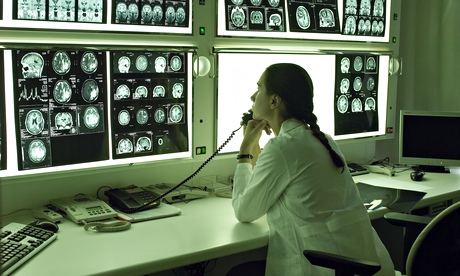
‘If the government gets it right, they can save a vital data project, and allow medical research that saves lives on a biblical scale to continue,’ writes Ben Goldacre. Photograph: Hans Neleman/Getty Images
Everything would be much simpler if science really was “just another kind of religion”. But medical knowledge doesn’t appear out of nowhere, and there is no ancient text to guide us. Instead, we learn how to save lives by studying huge datasets on the medical histories of millions of people. This information helps us identify the causes of cancer and heart disease; it helps us to spot side-effects from beneficial treatments, and switch patients to the safest drugs; it helps us spot failing hospitals, or rubbish surgeons; and it helps us spot the areas of greatest need in theNHS. Numbers in medicine are not an abstract academic game: they are made of flesh and blood, and they show us how to prevent unnecessary pain, suffering and death.
Now all this vital work is being put at risk, by the bungled implementationof the care.data project. It was supposed to link all NHS data about all patients together into one giant database, like the one we already have for hospital episodes; instead it has been put on hold for six months, in the face of plummeting public support. It should have been a breeze. But we have seen arrogant paternalism, crass boasts about commercial profits, a lack of clear governance, and a failure to communicate basic science properly. All this has left the field open for wild conspiracy theories. It would take very little to fix this mess, but time is short, and lives are at stake.
The care.data project was promoted in two ways: we will use your data for lifesaving research, and we will give it to the private sector for commercial exploitation, creating billions for the UK economy. This marriage was a clear mistake: by and large, the public support public research, but are nervous about commercial exploitation of their health data.
Now the teams behind care.data are trying to row back, explaining that access will only be granted for research that benefits NHS patients. That is laudable, but potentially a very broad notion. It’s one we would want to unpack, with clear, worked examples of the kind of things they would permit, and the kind of things they would refuse. But that’s not possible because, bizarrely, the specific principles, guidelines, committees and regulations that will determine all these decisions have not yet been clearly set out. This poses several difficulties. Firstly, the public are being asked to support something that feels intuitively scary, about the privacy of their medical records, without being told the details of how it will work. Secondly, the field has been left open to conspiracy theories, which are hard to refute without concrete guidance on how permissions for access really will work.
That said, many criticisms have been absurd. There has been endless discussion around the idea of health insurers buying health records, for example, and using them to reject high-risk patients. Call an insurer right now and see how you get on: within minutes you will be asked to declare your full medical history, waive confidentiality and grant access to your full medical notes anyway.
Many have complained about drug companies getting access to data, and this is more complex. On the one hand, arrangements like these are longstanding and essential: if medicines regulators get a few unusual side-effect reports from patients, they go to the drug company and force them to do a big study, examining – for example – 10,000 patients’ records, to find out if people on that drug really do have more heart attacks than we’d expect. To do this, the UK health regulator itself sells industry the data, in the past from something called the GP Research Database, which holds millions of people’s records already. This needs to happen, and it’s good. But equally, people know – I’ve certainly shouted about it for long enough – that the pharmaceutical industry also misuses data: they hide the results of clinical trials when it suits them, quite legally; they monitor individual doctors’ prescribing patterns to guide their marketing efforts, and so on. The public don’t trust the pharmaceutical industry unconditionally, and they’re right not to.
Trust, of course, is key here, and that’s currently in short supply. The NSA leaks showed us that governments were casually helping themselves to our private data. They also showed us that leaks are hard to control, because the National Security Agency of the wealthiest country in the world was unable to stop one young contractor stealing thousands of its most highly sensitive and embarrassing documents.
But there is a more specific reason why it is hard to give the team behind care.data our blind faith: they have been caught red-handed giving false reassurance on the very real – albeit modest – privacy threats posed by the system.
Tim Kelsey is the man running the show: an ex-journalist, passionate and engaging, he has drunk more open-data Kool-Aid than anyone I’ve ever met. He has evangelised the commercial benefits of sharing NHS data – perhaps because he made millions from setting up a hospital-ranking website with Dr Foster Intelligence – but he is also admirably evangelical about the power of data and transparency to spot problems and drive up standards. Unfortunately, he gets carried away, stepping up andannouncing boldly that no identifiable patient data will leave the Health and Social Care Information Centre. Others supporting the scheme have done the same.
This is false reassurance, and that is poison in medicine, or in any field where you are trying to earn public trust. The data will be “pseudonymised” before release to any applicant company, with postcodes, names, and birthdays removed. But re-identifying you from that data is more than possible. Here’s one example: I had twins last year (it’s great; it’s also partly why I’ve been writing less). There are 12,000 dads with similar luck each year; let’s say 2,000 in London; let’s say 100 of those are aged 39. From my brief online bio you can work out that I moved from Oxford to London in about 1995. Congratulations: you’ve now uniquely identified my health record, without using my name, postcode, or anything “identifiable”. Now you’ve found the rows of data that describe my contacts with health services, you can also find out if I have any medical problems that some might consider embarrassing: incontinence, perhaps, or mental health difficulties. Then you can use that information to try and smear me: a routine occurrence if you do the work I do, whether it’s big drug companies, or dreary little quacks.
This risk isn’t necessarily big, but to say it doesn’t exist is crass: it’s false reassurance, which ultimately undermines trust, but it’s also unnecessary, and counterproductive, like hiding information on side-effects instead of discussing them proportionately. To the best of my knowledge, we’ve never yet had a serious data leak from a medical research database, and there are plenty around already; but then, we are standing on the verge of a significant increase in the number of people accessing and using medical data. There are steps we can take to minimise the risks: only release a subset of the 60 million UK population to each applicant; only give out the smallest possible amount of information on each patient whose records you are sharing; suggest that people come to your data centre to run their analyses, instead of downloading records, and so on. But, while the care.data project might be planning to do some of those things, the ground rules haven’t been properly written out yet.
In any case, even safeguards such as these can be worked around. There are companies out there operating in the grey areas of the law, aggregating data from every source and leak they can find, generating huge, linked datasets with information from direct marketing lists, online purchases, mobile phone companies and more. Who’s to know if someone will start quietly aggregating all the small chunks of our health data?
This, of course, would be illegal. As Tim Kelsey and others are keen to point out, re-identifying or leaking data in any way would be a “criminal offence”. But as this project lands, we’re all becoming rapidly aware that incompetence, malice and creepiness around confidential data is policed with a worryingly light touch. Private investigators have little trouble obtaining confidential data from staff in the police force, banks and tax offices, for example.
Here’s why: it took a long time for anyone to realise that Steve Tennison, a finance manager in a GP practice, had accessed patients’ records on 2,023 occasions over the course of a year, although this was relevant to his work on only three occasions. The majority of records he snooped on belonged to young women: he repeatedly accessed the record of one woman he had gone to school with, and that of her son. The maximum penalty for this is a fine, with a ceiling of £5,000 in magistrates courts. Tennison was fined £996, in December 2013. This is why the public feel nervous, and this is what we need to fix.
It’s painful for me to write critically about a project like care.data, because I love medical data, and I know the good it can do. We have a golden opportunity in the UK, with 60 million people cared for in one glorious NHS. Opt-outs would destroy the data, and the growing calls for an opt-in system would be worse: opt-in killed people by holding back organ donation, and more than that, it would exacerbate social inequality around data, because the poorest patients, those most likely to be unwell, are also the least engaged with services, the least likely to opt in. They would become invisible.
So here’s my advice: if you’re thinking of opting out – wait. If you run care.data – listen. There are three things the government can do to rescue this project.
Firstly, make a proper announcement about what you will do in the six-month delay. You cannot rely on blind trust when it comes to sharing private medical records, so explain that you’ll be coming back soon with a clear story. Sort out the governance framework, present unambiguous rules and principles explaining how data will be shared, list the specific clinical codes you’re proposing to upload, then give real-world examples of the kind of access applications that would be approved, and the kind that would be rejected. This is fair, and sensible.
Secondly, show the public how lives are saved by medical research. This needs examples, from the vast archives of medical research on cancer, heart disease and more. Alongside that, give a clear nod to the small risks, and an explanation of how they will be mitigated. Never be seen to give false reassurance on these risks; if you do, you will lose patients’ trust for ever.
Lastly, we need stiff penalties for infringing medical privacy, on a grand and sadistic scale. Fines are useless, like parking tickets, for individuals and companies: anyone leaking or misusing personal medical data needs a prison sentence, as does their CEO. Their company – and all subsidiaries – should be banned from accessing medical data for a decade. Rush some test cases through, and hang the bodies in the town square.
If the government do all this, they have a good chance of saving a vital data project, and permitting medical research that saves lives on a biblical scale to continue. If the government try to fudge – with half measures, superficial PR and false reassurance – then care.data will fail, and it might well bring down other sensible public health research with it. Lives are at stake. This cannot be left to the last minute in the six-month pause, and time is precious. It’s February. If you’re thinking of opting out, please don’t. But mark your diary for May.
I should warn you, I’m expecting a call
I should warn you, I’m expecting a call
I found your other shoulder pad
 I
I
I found your other shoulder pad
Well, your quantum computer is broken in every way possible simultaneously
Well, your quantum computer is broken in every way possible simultaneously
A clear head shot from Jeffrey…
Not one stakeholder group left untrashed…
Great Einstein quote – the original definition of insanity presumably:
‘The significant problems we face cannot be solved at the same level of thinking we were at when we created them’
PDF: Braithwaite Delusions of health care JRSM 2014
The medical miracles delusion
Army ants subscribe to a simple rule: follow the ant
in front. If the group gets lost each ant tracks
another, eventually forming a circle. According to
crowd theorist James Surowiecki, one circle 400m
in circumference marched for two days until they
all died.1
Humans are not ants, but we often trudge together
along the same trail, neglecting to look around for
alternatives. Mass delusions involve large groups
holding false or exaggerated beliefs for sustained periods.
Humanity has a long, sorry list of these shadowthe-
leader epidemics of collective consciousness which
appear obviously wrong only in hindsight. Some last
for centuries: early alchemists intent on transmuting
base metals into gold and the Christian Crusades of
Europe’s middle ages, for example. Others have correlates
which resurface decades or centuries later:
McCarthy’s persecution of alleged communists in
the 1950s harked back to the Salem Witch hunts of
16th century America just as the 2008 Global
Financial Crisis had much in common with the
‘South Sea Bubble’ which slashed 17th century
Britain’s GDP.
In the educated 21st century, too, we blithely trust
in economic and political systems which are stripping
the earth’s resources, altering the climate and facilitating
wars. Are we then similarly mistaken, en masse,
about the capabilities of the health system?
Most of us believe in the miracles of modern medicine.
We like to think that the health system is
increasingly effective, that we are implementing
better treatments and cures with rapid diffusion of
new practices and pharmaceuticals and that there is
always another scientific or technological breakthrough
just around the corner promising to save
even more lives; all at an affordable price.
We maintain the faith despite multiple contraindications.
Modern health systems consistently deliver
at least 10% iatrogenic harm.2 Despite very large
investments and intermittent but important interventional
successes, such as checklists in theatres3 and
clinical bundles in ICU,4 there is no study showing
a step-change reduction in this rate, systems-wide.
Only half of care delivered is in line with guidelines,5
one-third is thought to be waste,6 and much is not
evidence-based,7 notwithstanding concerted efforts to
optimise that evidence and incorporate it into routine
practice.8
The reality is that progress is slowing, and medicine
seems to be reaching the limits of its capacities.
The potentially disastrous problems of antibiotic
resistance, for example, are yet to play out. This is
only one point among many. New technologies such
as the enormously expensive human genome project
have provided only marginal benefits to date. We still
do not have the answers to fundamental questions
about the causes of common diseases and how to
cure them. Many doctors are dissatisfied and increasingly
pessimistic.9,10 It must also be remembered that
although death is no longer seen as natural in the
modern era, everyone must die. Yet, we inflict most
of our medical ‘miracles’ on people during their last
six months of life. Le Fanu describes this levelling off
and now falling away of health care progress in The
Rise and Fall of Modern Medicine.11
Every major group of stakeholders has its own
specific delusion which acts to augment the metalevel
medical miracles delusion. Thus, the overarching
delusion is buttressed by a set of related ‘viruses
of the mind’, to borrow Richard Dawkins’ evocative
phrase.12
Although politicians think and act as if they are
running things, modern health systems are so complex
and encompass so many competing interests that no
one is actually in charge. Then, bureaucrats – acting
under their own brand of ‘groupthink’ – assume their
rules and pronouncements provide top-down stimulus
for medical progress and improved clinical performance
on the ground. Yet coalface clinicians are relatively
autonomous agents, so there can only ever be
modest policy trickle down.13,14
Researchers, too, support the medical miracles
industrial complex. The electronic database
PubMed holds some 23 million articles and is growing
rapidly. Every author hopes it will be his or her
results that will make a difference, yet there is far less
take up than imagined and comparatively little
investment in the science of implementation8 – translating
evidence into real life enhancements.
Nor are clinicians or the patients they serve
immune. While frontline clinicians strive to provide
good care, many myopically assume their practice is
above average; the so-called Dunning-Kruger
effect.15,16 Of course, statistically, half of all care clinicians
provide is below average. And notwithstanding
decades of public awareness, patients believe modern
medicine can repair them after decades of alcohol,
drugs, sedentary lives and dietary-excesses, despite
evidence to the contrary.
Meanwhile, the media’s unremitting propensity to
lend credibility to controversial views and to hone in
on ‘gee whiz’ breakthroughs – while ignoring the
incremental and the routine – fuels unrealistic expectations
of what modern medicine can deliver.
Throughout history, mass delusions have been
aligned with mass desires for favourable outcomes.
In the pursuit of medical miracles all of our interests
line up in a perfect circle. We seem more like army
ants than we think.
Just as the Global Financial Crisis was a wake-up
call for the serious consequences of blind fiscal faith
we must begin to manage our expectations of the
health system. Progress is always in jeopardy when
the real problems are obscured.
The challenge is to harness the tough-minded
scepticism needed to tackle this widely held ‘received
wisdom’. One realistic way forward is to encourage
stakeholders – politicians, policymakers, journalists,
researchers, clinicians, patients – to first consider
that their own and others’ perspectives are simply not
logically sustainable. This may be achieved through
genuine inter-group discourse about the health
system, where it is at, and its limitations.
As is so often the case, Albert Einstein said it best,
in a typically neat aphorism: ‘The significant problems
we face cannot be solved at the same level of
thinking we were at when we created them’.17 If we
can humbly accept that we need new perspectives
for healthcare – and radically different ways of
thinking – we will be better placed to free ourselves
from the hold of these peculiar viruses of the mind.
Rock Health visits Australia – preview
FUELLING CHANGE IN AUSTRALIA’S HEALTHCARE THROUGH TECHNOLOGY; LESSONS FROM ROCK HEALTH
By Melia Rayner | February 27th, 2014 in Intelligent Thinking First, Technology Second

Above: Rock Health funded startup CellScope are reinventing the otoscope (image courtesy of Yahoo)
Social change through technology is all around us, in the way we shop, communicate, pay bills and arrange services. So why has the incredibly important area of health been so slow to move in line with the digital economy? Australia has led medical breakthroughs in the past; from the implementation of the first bionic ear in 1982 to the cervical cancer (HPV) vaccine in 2007, but the past few years have seen our healthcare landscape struggling to get further than the ‘middle of the pack’.
Elsewhere, the digital health movement is growing rapidly. In Washington, a startup called KitCheck helps hospital pharmacies process medication kits faster and without error, whilst in San Francisco CellScopehas built a smartphone-enabled diagnostic toolkit, including a digital otoscope. Even global magnates have put resources and teams into developing health innovation, such as General Electric’s Logiq; which is an ultrasound for the whole body, and Walgreens’ Pill Reminder app and Find Your Pharmacist web tool.
All the companies above have capitalised on the need for social change in healthcare through the vehicle of technology. Utilsing innovations in technology to solve human problems is behind everything we do at Portable. The point at which culture and technology meet is where social change can really happen. It’s in this mission that our maxim ‘Intelligent thinking first, technology second’ hits home; in the utilisation of technology to support social change rather than commandeer it.
This is why we’re bringing out a digital health innovator like Dr. Nate Gross as part of our Portable Talksseries. Nate’s company Rock Health provides startups (such as KitCheck and CellScope) with funding and full service support to advance the healthcare industry through technology. Their partnerships across the industry – from medical institutions to venture capital firms and corporates – give them unparalleled knowledge of how to innovate change in a highly regulated industry. In addition, Nate’s successful development of healthcare game changers such as Rock Health and Doximity makes him uniquely qualified to present to Australian audiences on lessons in innovation from Silicon valley and how to break down barriers to entrepreneurship and communication in this sector.
We spoke to Nate about the importance of change in healthcare and some of his other key maxims in advance of his recently announced tour for Portable Talks in May.
https://www.youtube.com/watch?v=V7Q9y1zRdXQ
Above: Nate speaks briefly about the story of Rock Health.
Why did you decide to come all the way to Australia for Portable Talks?
Well, that’s easy: Australia and Portable Talks. It seems to be a very exciting time in Australia, where the next engine of growth could be technology, healthcare, or both — and the [Australian] people are consistently applauded for living healthy lives. And of course, Portable’s reputation preceded itself as I had watched several previous [Portable Talks] series online, thus knowing there were amazing and in-depth conversations to be had.
How can the USA learn from Australia’s approach to health innovation, and vice versa?
I think we can learn from the approaches and we can learn from the businesses themselves. The startup community in Australia is smaller but accelerating, and most importantly the quality is high, a recipe for wins that will attract more entrepreneurial ideas and capital.
We can also learn from the businesses themselves — many successful concepts may be translated or shared due to some similarities between the mixed private and public components of our healthcare systems. That’s not to call our systems too similar, of course, as there is much to learn from Australia about accessibility and affordability.
In your opinion, what are the three biggest hurdles facing digital health innovation internationally?
Differences in incentives is often at the top of the list, which can make cost a barrier to different parties in different healthcare systems.
The funding environment is another. I think many cities and countries are ready to scale up their innovation efforts, but it can be a chicken-and-egg problem where some local wins are first required to attract capital to the area.
Language itself is a barrier, which Australia is perhaps more cognizant of than Silicon Valley, as it’s a leader in the Asia Pacific region. And there are many other hurdles that may become more relevant depending on the venture: market size, privacy, interoperability, the US regulatory process, infrastructure, consumer readiness.
Health is often perceived to be a topic that individuals outside the industry don’t actively engage with. Why should individuals from outside health and medical fields engage with in this industry?
Two reasons: First, because you don’t want to wait until you get sick to start solving these problems. And second, healthcare is an entrenched industry, which means there’s a lot of entrenched thinking. Outside perspective can lead to fantastic innovation, and many of the startups that have come through Rock Health have been founded by “outsiders”.
What is the key message you’d like to bring to your talks in Australia?
It’s the right time to get involved in digital health. There has never been a better time to be a health entrepreneur, and there are many ways you can get involved to transform the healthcare sector.
Nate will be discussing topics such as trends in digital health, innovation in heavily regulated industries and breaking down barriers to entrepreneurship and communication in healthcare throughout his Portable Talkstour in early May. This event is a must-see for those working in digital innovation, healthcare, technology, startups, or high-tech funding. The tour will cover Melbourne and Sydney with tickets available here – be quick to secure an earlybird discount. Nate will also spend a day as Portable’s ‘Entrepreneur in Residence’, delivering a new agenda with the team to help encourage innovation and creative thinking in cross disciplinary fields.
To find out more about the Rock Health Portable Talks tour or to enquire after a private company consultation with Dr. Nate Gross, please contact Kate at kate(at)portablestudios.com.au
For all other tour enquiries please contact Mikala Tai at mikala(at)portablestudios.com.au
Fashionable wearables…
Where tech meets fashion…
Classy photos of integrated wearables in this story.
http://www.wired.com/design/2014/02/can-fashion-tech-work-together-make-wearables-truly-wearble/
What’s the Secret to Making Wearables That People Actually Want?
- BY LIZ STINSON
- 02.27.14

Misfit Wearables launched the Shine, an activity tracker that can be worn almost anywhere on your body. Image: Misfit Wearables
Last September, right around spring/winter Fashion Week, an unexpected group of people gathered for a round table discussion at the main offices of the Council of Fashion Designers of America in New York City. Present was Steven Kolb, the CFDA’s CEO, a few higher-ups from Intel and a handful ofCFDA members who also happen to be big names in fashion and accessory design.
Intel had called the meeting to discuss the idea of starting a collaboration between the company and the fashion industry at large, with the ultimate goal of figuring out a way turn their decidedly unwearable technology into something people—fashionable people—might actually want to put on their bodies.
‘Tech companies know what is useful, but do we know how to make something desirable?’
Earlier in the summer, Intel, like most every other big technology company out there, had started a division to explore the future of wearable technology. Best known for supplying the processor chips you find in your computer’s guts, Intel has the technology to build what could eventually be a very smart device. They did not, however, have the design and fashion expertise to create stylish hardware.
“Technology companies know what is useful, but do we know how to make something desirable?” says Ayse Ildeniz, Intel’s vice president of business development and strategy for new devices. “We have thousands of hardware and software engineers looking at sensors, voice activation and how to build smart devices, but we wanted to create a platform where they can meet with the aesthetic gurus. There needs to be an alignment and discussion, so breakthroughs can actually come about and flourish.”
Enter the Hipsters
During CES this year, Intel announced the formalization of its partnership with the CFDA, Barney’s and Opening Ceremony, an ultra-hip fashion company tasked with designing the first wearable product to be born from the collaboration. If that wasn’t proof enough that Intel was taking wearables seriously, the company also announced its Make It Wearable competition, which will award $1.3 million in prize money ($500,000 for the grand prize) for whoever who comes up with the most promising design in wearable tech this year. Those are some pretty good incentives.

Netatmo’s June is a UV tracker that takes the form of a jewel designed by French jewelry designer Camille Toupet. It syncs up with your smartphone to help keep track of your skin health. Image: Netatmo
We’ve only recently begun to see technology and fashion take each other seriously. A few months ago, Apple hired Angela Ahrendts, Burberry’s former CEO, and before that they poached Paul Deneve, Yves Saint Laurent’s CEO. Given the optimistic projections for wearable tech’s influence, the union between these two worlds seems inevitable. If wearable technology makers have learned one thing so far, it’s that just because you make something, it doesn’t mean people are actually going to wear it. Adoption of wearable tech depends on striking a delicate balance between style and functionality, and no one has leveled that see-saw quite yet. And the fashion crowd, as progressive as they are, have never been trained to think through the rigors of product design, ranging from use cases to demographics.
“Products are often made with good intentions, but in a vacuum,” says Kolb. “You have programming people thinking about wearable technology but not necessarily, and I don’t mean this with disrespect, thinking about the aesthetic. Then you’ve got fashion people who are very much focused on the overall look but don’t have the technological language or vocabulary.”
Kolb explains that oftentimes, fashion people have a sci-fi understanding of what technology can do. On the flip side, technologists and even industrial designers have a difficult time grasping what it means to create something people feel good wearing. “Fashion designers are always thinking about things like, how does that clasp close, how does this leather feel?” he says. “That element might not necessarily be on the radar of a tech person, but it’s definitely on the radar of a fashion person.”

Image: Misfit Wearables
Up to this point, technology companies have approached wearables with a one-size-fits-all mentality. Even Google Glass’ Titanium Collection, while certainly more stylish than the original, hasn’t gotten it quite right. A choice of frames that say, “I write code and like to shop” is a start, but in order for people to really want to wear Glass, we have to be able to seamlessly integrate them into our own very personal style. We have to feel like we’ve had more of a choice in the matter.
The Missing Link: Modularity
“I think fashion and accessory brands in the near future will make glasses that work with Glass in the same way we have accessories and covers for our mobile phones,” explains Syuzi Pakhchyan, accessories lead at Misfit Wearables. “The key here is to design technology that can be modular and allow others to develop an ecosystem of products that work with your technology.”
Misfit is the maker of the Shine, a pretty, smoothed-over disc that acts as an activity tracker. As far as wearable tech goes, the Shine is actually quite lovely. Misfit’s offering is part of an increasing number of wearables that make an honest effort to look good. There are others like Netatmo’s June, a UV tracker disguised as a sparkling rhinestone that can be worn as a broach or on a leather band around a wrist, and the collaboration between Cellini and CSR to create a Bluetooth-enabled pendant.
Working Together Earlier
The intentions are good, but they all fall a little short, as though the styling was a last minute gloss instead of baked into the actual product. In order for wearables to feel authentically cool, fashion and technology need to begin working together from the earliest moments of product development, discussing what current technology enables and having an an open-minded conversation about how it could be worn.
‘Products are often made with good intentions, but in a vacuum,’ says Kolb.
As Pakhchyan points out, much like our clothes, not everyone wants or needs to wear the same piece of technology, and we don’t necessarily have to wear it all the time either. Tech companies have been chasing the elusive silver bullet smartwatch, but maybe it’s not such a bad thing to treat wearables like the other wearables in our life: As separate, individually-valuable pieces of clothing that can work together to ultimately create the perfect outfit. Staying focused, at least while we’re figuring out what form and functionality works and what doesn’t, might not be such a bad thing.
Right now, the collaboration between Intel and the CFDA is just getting started. How it will shape up depends on what each organization is trying to achieve. But at least by beginning to build a real bridge between the fashion and technology worlds, we’re opening up discussion about how these industries can benefit each other, which hopefully will lead to some great innovations.
For what it’s worth, Pakhchyan figures it’s only a matter of time before the parallel paths of technology and fashion intersect for good. And when they do? We’ll probably be seeing a lot more people actually wearing wearables. “I think we’re going to see a lot more beautiful and interesting wearables coming out in the next few years,” she says. “I have a feeling we’re going to look back at these plastic wrist-worn things and be like, ‘Oh, that was kind of an awkward stage.’”

This pendant prototype, a collaboration between CSR (developers of Bluetooth Smart and jewelry designers Cellini), communicates phone alerts via the glowing green light. Image:CSR

Liz is a Brooklyn-based reporter for Wired Design. She likes talking to people about technology, innovation and pretty things.
Follow @lizstins on Twitter.
Physicians coy on apps…
Physicians won’t prescribe apps because there’s no regulatory oversight…
http://www.fiercemobilehealthcare.com/story/physicians-split-use-mhealth-apps/2014-02-24#ixzz2uTHTX4hO%20
Physicians split on use of mHealth apps
February 24, 2014 | By Ashley Gold
An additional poll of 250 physicians found:
- Forty-two percent won’t prescribe apps because there is no regulatory oversight of them
- Thirty-seven percent have no idea what apps are out there
- Twenty-one percent never recommend apps to patients
- Twenty-one percent won’t prescribe apps because there’s no longitudinal data on apps’ effectiveness
- Another 21 percent won’t prescribe apps because it would generate an overwhelming amount of patient data
Mike Paskavitz of Quantia, Inc. compared the effectiveness of medical apps to prescription drugs, which have roughly seven years of data about their effectiveness and safety giving physicians assurance when prescribing them to patients. Medical apps have no history of this sort, he pointed out, which is important to keep in mind this week at the Healthcare Information and Management Systems Society (HIMSS) Conference in Orlando, Fla.
“So as hundreds of medical app developers gather in Orlando for HIMSS, it’s important to note that physicians are still split in opinion on whether they should ‘prescribe’ medical apps to their patients–the main reason being the lack of regulation, especially as the movement to enable self-care is advanced through tools such as medical apps,” Paskavitz said in the announcement.
The regulation of mHealth apps has been contentious for a while now–asFierceMobileHealthcare reported last week, the PROTECT Act, a bill introduced in the Senate, removes Food and Drug Administration regulation from some high-risk clinical decision support (CDS) software, mobile medical apps and other medical device functionality.
FierceMobileHealthcare Editor Greg Slabodkin argued that the PROTECT Act was too dangerous in an editorial last week.
“Patient safety must always come first,” Slabodkin wrote. “In the end, the so-called PROTECT Act would only serve to protect app developers in their zeal to make a quick buck free of government regulation.”
Nonetheless, while regulation is debated in Washington, mobile medical apps continue to emerge daily. Just last week, the American College of Cardiology and the American Heart Association announced a mobile and web-based app for healthcare professionals to use with their patients in determining risk for developing atherosclerotic cardiovascular disease (ASCVD), a major cause of heart attack and ischemic stroke.
To learn more:
– read the announcement
Global solar vs standard time deltas
How cool is this map. OMG. Everything explained…. and east coast Australia on time.
Solar time versus standard time around the world
MARCH 3, 2014 | MAPPING

After noting the later dinner time in Spain, Stefano Maggiolo noted relatively late sunsets for one of the possible reasons, compared to standard time. Then he mapped sunset time versus standard time around the world.
Looking for other regions of the world having the same peculiarity of Spain, I edited a world map from Wikipedia to show the difference between solar and standard time. It turns out, there are many places where the sun rises and sets late in the day, like in Spain, but not a lot where it is very early (highlighted in red and green in the map, respectively). Most of Russia is heavily red, but mostly in zones with very scarce population; the exception is St. Petersburg, with a discrepancy of two hours, but the effect on time is mitigated by the high latitude. The most extreme example of Spain-like time is western China: the difference reaches three hours against solar time. For example, today the sun rises there at 10:15 and sets at 19:45, and solar noon is at 15:01.