
I created this conceptual infographic illustrating the increasing health benefits achievable with digital health with the great team at Misfit Wearables. You can download a high-resolution version by clicking on the image.
References:
Number of people sequenced
“250,000 human genomes will be fully sequenced by the end of 2012, 1 million by 2013, and 5 million by 2014″ -Topol, Eric (2011-12-02). The Creative Destruction of Medicine: How the Digital Revolution Will Create Better Health Care (p. 102). Perseus Books Group. Kindle Edition.
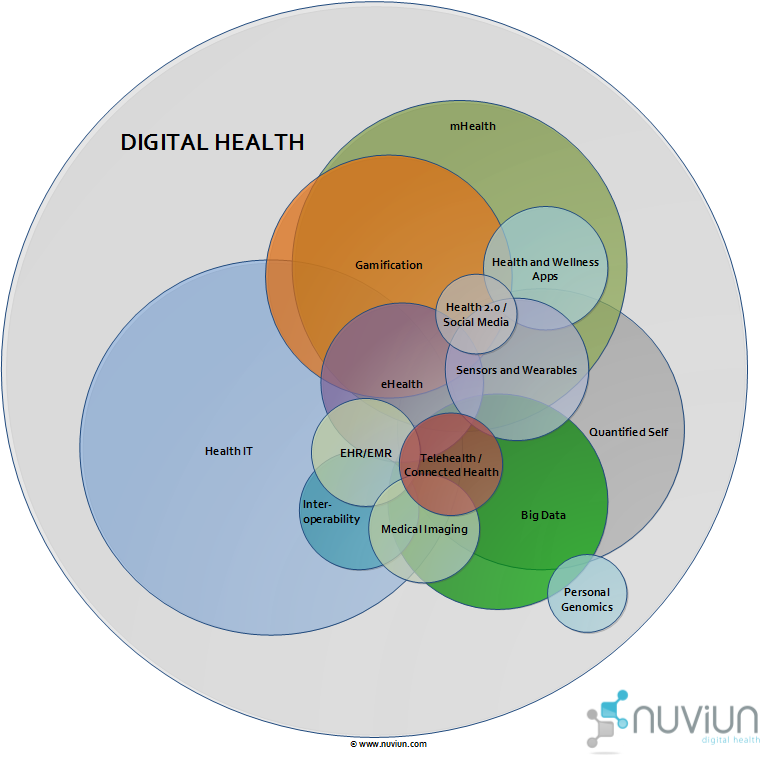
Also, compliments of Story of Digital Health strategic partner nuviun, there’s this interactive diagram of the digital health landscape…
The tale of aristocratic indifference on the part of Marie Antoinette, Queen of France at the time of the French Revolution, wife of Louis XVI, is, we now know, likely apocryphal. Still, like many historical distortions, this one reverberates through modern culture just the same, and harbors meaning as archetype, if not as reliably archived fact. You no doubt know the tale:
The peasants were starving and had no bread. Marie allegedly suggested: “let them eat cake!”
We find a modern day analogue in the advice dispensed by foodie elite who suggest that the masses should just eat “real” food. The definition of “real” is generally left open to interpretation- but of course, Marie never said what kind of cake, either.
The connotations of “real” are clear enough: pure, unpackaged foods; those icons of nutritional virtue about which the wholesome truth is so self-evident that ingredient lists and nutrition fact panels are superfluous. Wild salmon comes to mind. And broccoli, presumably organic. And fresh berries.
In other words, since the people have no whole-grain bread: let ‘em eat kale!
Now, frankly, I’m quite partial to kale. And, for that matter, the potentially even more nutritious fiddlehead ferns. But I have a real antipathy for fiddling around, or issuing jejune exhortations, while Rome is burning. And burning, it is.
Fundamentally, this means that it may no longer help us much to ask and answer: how many Americans are overweight or obese? That number, or percentage, may now be level and rather uninteresting, if only because it is pressed up against the ceiling. To gauge the severity of hyperendemic obesity in our culture, we may now need to ask: how overweight and obese are the many?
The answer, ever more often, is: severely.
That severe obesity rates are rising steadily and perhaps steeply has two flagrant implications. The first is that we are not doing nearly enough at the level of our culture to make eating well, being active, and thereby controlling weight the prevailing norm. These two behaviors and one outcome remain exception rather than rule, costing us dearly- in every currency that matters, human potential above all.
The second implication is that we need good treatments for severe obesity, since it is already well established among us.
I have first hand experience with severe obesity, in adults and kids alike. Unlike garden-variety weight gain, severe obesity generally occurs in the context of diverse hardships. Sometimes, there is the duress of a dysfunctional family dynamic. Sometimes there is an underlying mental health problem. Sometimes the propagating factors are preferentially, if not exclusively, socioeconomic: a rough neighborhood, with lack of access to “real” food and recreational opportunities, and the inevitable clustering of fast food franchises. That latter peril makes me think of wolves surrounding the most vulnerable member of a herd. Almost inevitably, there is ridicule, disparagement, and disadvantage; the literal, daily addition of insult to injury.
Bariatric surgery is effective treatment for severe obesity, and I have long advocated strenuously that it should be available, and reimbursable, for all who truly need it. But meaning no disrespect to the surgeons who provide or patients who receive it, it’s a rather poor option and should be a last resort, not a first, especially for children. The surgery is potentially major, and thus encumbered by all of the customary risks. The long-term effects are far from perfect, and substantially unknown for children. The monetary costs are apt to be unmanageable if this becomes the “go to” solution for an increasingly prevalent problem.
And most importantly: nobody learns anything under general anesthesia. The root causes of severe obesity are not addressed with scalpels. There is no way to share the benefits of a redirected gastrointestinal tract. In contrast, “skillpower” can be shared. A systematic effort to empower those most in need with the skills and resources needed to eat well, be active, lose weight, and find health- physical and mental- would allow for paying it forward, to family and friends, and the next generation. The good of surgery is contained within a body. The good of propagating skills and resources for healthy living reverberates throughout the body politic.
My friend David Freedman, the highly accomplished health journalist, and I have had a spirited and fairly public exchange on the topic of “getting there” from here. When Mr. Freedman suggested that better junk food could be part of the answer, I protested: anything that is genuinely part of the solution is, by definition, no longer junk. When I emphasized the importance of knowing what dietary pattern is best for health, Mr. Freedman parried back that I might be diverting attention from the critical need to pave a way of getting there from here, accessible in particular for those currently most forestalled.
But in the end, our private exchanges indicated that our public argument was mostly smoke and just about no fire. We both agree that we can’t have good diets supporting good health if we don’t acknowledge we know what a good diet is. And we both agree that knowing that “real” food is good does just about nothing to help modify and improve the diets and health of real people.
We need to reorient our cultural attitude about obesity so it is not an excuse to argue the respective merits of personal responsibility and public policy. Rather, if we are to fix it at its origins, we need to acknowledge that people who are empowered are most capable, and most inclined, to exercise responsibility. So let’s build it, and see what comes.
Among such approaches, too, are community and New-Age approaches to gardening that might even allow many more of us to grow our own kale- and perhaps fiddlehead ferns.
But “let ‘em eat kale” simply won’t do. It’s fatuous, unrealistic, elitist nonsense. It’s fiddling around. And all the while, Rome burns.
Thanks to Maggie Hennessy at FoodNavigator-USA for her report on a meeting I wish I’d been able to attend—the Perrin Conference on “Challenges Facing the Food and Beverage Industries in Complex Consumer Litigations.”
Hennessey quotes from a speech by Steven Parrish, of the Steve Parrish Consulting Group describing parallels between tobacco and food litigation.
From the first lawsuit filed against [tobacco] industry member in 1953 to mid-1990s, the industry never lost or settled a smoking and health product liability suit. In the mid ‘90s the eggs hit the fan because the industry for all those decades had smugly thought it had a legal problem. But over time, it came to realize it had a society problem. Litigation was a symptom of the disease, not the disease itself.
…When it came time to resolve the litigation, we couldn’t just sit in a room and say, ‘how much money do you want?…A lot had nothing to do with money. It had to do with reining the industry in…We spent so much time early on talking to ourselves about greedy trial lawyers, out-of-touch regulators, media-addicted elected officials and public health people who didn’t know how to run a business. At the end of the day, it didn’t matter. We would have been much better off recognizing these people had legitimate agendas.”
… Maybe there are some parallels, but I urge people not to succumb to the temptation to say, ‘cigarettes kill you, cigarettes are addictive. But mac and cheese, coffee, and Oscar Meyers wieners don’t. That may be true, but there are still risks for the industry.
The article also quotes Michael Reese, plaintiff’s attorney for Reese Richman LLP, talking about the increasingly accusatory tone of media coverage of Big Food:
There’s this idea, which has picked up steam in the media, that large food companies are manipulating ingredients to hook people on food. It hasn’t been manifest in litigation yet, but we’re seeing it with legislative initiatives, like Mayor Bloomberg in New York City saying sugar hooks people and causes diabetes. We’ve seen some with GMOs, though most of that legislation is about consumers’ right to know. But there’s this overarching concept that Big Food is somehow manipulating our food supply and as a result, giving us non-food.
Sounds like the message is getting across loud and clear.
If I smoke a cigarette right this minute, I am no more likely to die than if I drink a bucket of soda. But if I repeat these activities sufficiently frequently and over a long enough period of time, I will most certainly be harmed, and in time, killed.
To deny these realities because there are no clear differences in types of food, or to claim that we need to eat, while smoking is optional, plays directly into the hands of the spivs fighting for the status quo.
Drop the academic pretensions and start fighting the good fight, just like Prof Nestle and Mayor Bloomberg.
Tobacco and food are too dissimilar to succeed with the same strategy. It was realistic to insist all tobacco products should be avoided and to legislate against smokers. People have a choice between not smoking or smoking while standing outdoors only. And of course there was second hand smoke to up the ante. With food there is no secondhand smoke and we all must eat something. Can we successfully vilify all food and all eaters. Maybe we can make everyone eat outside if they insist upon eating at all. It is so impractical I wonder why anyone would try to pattern food legislation after tobacco legislation. I certainly wonder what the agenda really is because to outlaw some food and some eaters implies there will be specially anointed experts to distinguish the “bad” foods from the “acceptable” foods. Who will be wearing the badges to get this accomplished? It just sounds too creepy somehow. Or maybe just lazy and ignorant.
There are profound similarities between how the Tobacco industry hid toxicity findings to human health and that of big aquaculture, particularly salmon and shrimp farming. As you may know, by traveling to Norway–where there are no longer any wild salmon due to pollution and disease from farmed salmon in the migratory Fjords, farmed salmon preferentially accumulate dioxin-like PCBs to such an extent that a recommended 200 gram serving exceeds the WHO’s tolerable daily intake for dioxins. Just like tobacco, salmon aquaculture across Norway, Scotland, Canada and Chile promote their product as “healthy” when it is anything but. We have known the contamination since 2004 with Dr. Hites landmark publication in the journal Science. Today, we have pediatricians, pathologists and academic diabetes researchers in Norway calling for revising the national guidelines to reduce farmed salmon consumption, especially for pregnant women and children. The similarities are clear, if you really look.
People have more goals than they have willpower for. That’s just the way our ambition works. They give up, get distracted, or prioritize some other goal.
About a year ago, we ran a one-off research project into the Slow-Carb Diet™ that turned up surprisingly strong results. Over a four week period, people who stuck to the diet showed an 84% success rate and an average weight loss 0f 8.6lbs.
But are those results legit? If I picked a person at random out of a crowd, could they expect to see the same results? Almost immediately after publishing the results we started getting feedback about experimental bias.
This first study was biased, which means it doesn’t carry any scientific confidence. That’s a fixable problem, so we set off to redo the study in a bigger and more rigorous way.
That led to the Quantified Diet, our quest to verify and compare every popular diet. We now have initial results for ten diets. This is the story of our experiment and how we’re interpreting the diet data we’ve collected.
Understanding Bias
To understand bias, here’s quick alternative explanation for our initial Slow-Carb data: a group of highly motivated, very overweight people joined the diet and lost what, for them, is a very small amount of weight. In this alternative explanation, the results really are not very interesting and they definitely aren’t generalizable.
However, we had some advice from academics at Berkeley aimed specifically at overcoming the biases of the people who were self-selecting into our study. The keys: a control group following non-diet advice and randomized assignment into a comparative group of diets.
Our Experimental Design
The gist of our experimental design hinged on the following elements:
We were going to start by comparing ten approaches to diet: Slow-Carb, Paleo, Whole Foods, Vegetarian, Gluten-free, No sweets, DASH, Calorie Counting, Sleep More, Mindful Eating.
Lift wrote instructions for each diet, with the help of diet experts, and provided 28-day goals (with community support) for each diet inside our app.
We included two control groups, one with the task of reading more and the other with the task of flossing more.
Participants were going to choose which of the approaches they were willing to try and then we would randomly assign from within that group. Leaving some room for choice allowed people to maintain control over their health, while still giving us room to apply a statistically relevant analysis.
Participants who said they were willing to try a control group and at least two others were in the experiment. This is who we were studying.
A lot of people didn’t meet this criteria, or opted out at some point along the way. We have observational data on this group, but they can’t be considered scientifically valid results for the reasons around bias covered above.
Full writeup of the methodology coming.
Top Level Results
At the beginning of the study, everyone thought we were going to choose a winning diet. Which of the ten diets was the best?
Nine of the diets performed well as measured by weight loss. Here’s the ranking, with weight loss measured as a percentage of body weight. Slow-Carb, Paleo and DASH look like they led the pack (but keep reading because this chart absolutely does not tell the whole story).
Sleep, which never really had a strong weight loss hypotheses, lost. We ended up calling this a placebo control in order to bolster our statistical relevance.
Before moving on, lets just call out that people in the diets were losing 4-ish pounds over a one month period on average. That’s great given that our data set contains people who didn’t even follow their diet completely.
The Value of the Control
The control groups help us understand whether the experimental advice (to diet) is better than doing nothing. Maybe everyone loses weight no matter what they do?
This sounds unlikely, but we were all surprised to see that the control groups lost 1.1% of their body weight (just by sleeping, reading and flossing!)
Is that because they were monitoring their weight? Is it because the bulk of the study occurred in January, right after people finished holiday gorging? We don’t actually know why the control groups lost weight, but we do know that dieting was better than being in the control.
Here’s the weight-loss chart revised to show the difference between each diet and the control (this chart shows the experimental effect).
The Value of Randomized Assignment
Randomized assignment helps us feel confident that the weight loss is not specific to the fans of a particular diet.
Because of the randomization, we can ask the following question. For each diet, what happens if we assigned the person to a different diet?
This is an indicator of whether a diet is actually better or if the people who are attracted to a diet have some other characteristic that is effecting our observational results.
The obvious example of bias would be a skew toward male or female. Bigger people have more weight to lose (male), plus we observed that males tended to lose a higher percentage of their body weight (2.8% vs. 1.8%).
Comparing the diets this way adds another promising diet approach: no sweets. But let’s, be real, the differences between these diets are very small, less than half a pound over four weeks, as compared to doing any diet at all, five pounds over four weeks. Our advice is pick the diet that’s most appealing (rather than trying to optimize).
Soda is bad! And other Correlations.
What else leads to weight loss?
It helps if your existing diet is terrible (your new diet is even better in comparison). People who reported heavy pre-diet soda consumption lost an extra 0.6% body weight.
Giving up fast food was also good for an extra 0.6% (but probably not worth adding fast food just to give it up).
Men lost more weight (2.6% vs 1.8%).
Adherence mattered (duh). Here’s a chart with weight loss by adherence.
How much of the time did people follow the diet advice?
Choosing a Diet
Ok. Now I think I’ve explained enough that you could choose one of these diets. All of them are available via the Lift app available on the web, iPhoneand Android.
Given that all the diets work, the real question you should be asking yourself is which one do you most want to follow.
I can’t stress that enough. It’s not just about which had the most weight loss. Choose a diet you can stick to.
Let’s Talk Success Rate
Adherence matters. Even half-way adherence to a diet led to more than 1% weight loss (better than the control groups).
This brings up an interesting point. So far, our data is based on the people who made it all the way to the end of our study. This is the survivor bias. We don’t know what happened to the other people (hopefully the diets weren’t fatal).
In order to judge the success rate of dieting you’ll have to use some judgement. But we can give you the most optimistic and most pessimistic estimates. The truth is somewhere in between.
Of people who gave us all of their data over four weeks, 75% lost weight. Let’s call this the success rate ceiling. It includes many reasons for not losing weight, including low adherence. But at least they paid attention to the goal for the entire time. The weight loss averages are based on this group.
Of people who joined the study, only 16% completed the entire study (and 75% of those lost weight). So, merely joining a diet, with no other data about your commitment, has a success rate of 12%. Let’s call this thesuccess rate floor.
Read that floor as 12% of people who merely said that they were interested in doing a diet had definitely lost weight four weeks later. There’s no measure of commitment in that result. If we filter by even a simple commitment measure, such as the person fills out the first survey on day one, then the success rate jumps from 12% to 28%.
If you are making public policy, then maybe that 12% number looks important. People have more goals than they have willpower for. That’s just the way our ambition works. They give up, get distracted, or prioritize some other goal.
If you are an individual, I’d put more weight in the ceiling. You want to know that whatever path you choose has a chance of succeeding. 75% is a number that should give you confidence.
Losing Weight?
We’ve focused on losing weight for two reasons. One, it’s a very common goal. But, two, it’s also the strongest signal we got out of our data.
We also measured happiness and energy but the signal was weak. We didn’t measure any other markers of health. That’s important to note.
We are behavior designers, so we’re looking at the effectiveness of behavior change advice. You should still consult a nutritionist when it comes to the full scope of health impacts from a diet change. For example, you could work with our partner WellnessFX for a blood workup (and talk to their doctors).
Open Sourcing the Research
We’ve open sourced the research. You can grab the raw data and some example code to evaluate it from our GitHub repository.
All of the participants were expecting to have their data anonymized for the purposes of research. Take a look and please share your work back (it’s required by the CC and MIT licenses).
There was some lossiness in the anonymization process. We’ve stripped out personal information (of course), but also made sure that rows in the data set can’t be tied back to individual Lift accounts. For that reason some of the data is summarized. For example, weight is expressed as percentage weight loss and adherence is expressed on a 1-5 scale.
If you want to go digging around in the data, I would suggest starting by looking at our surveys where we got extra data about the participants: day 1,week 1, week 2, week 3, week 4.
Citizen Science or No Science
I’m expecting that our research will spark some debate about the validity of scientific research from non-traditional sources. I expect this because I’ve already been on the receiving end of this debate.
Here’s how we’re seeing it right now. I acknowledge that we already have a robust scientific process living in academia. And I acknowledge that the way we ran this research broke the norms of that process.
The closest parallel I can think of is the rise of citizen journalism (mostly through blogs) as a complement to traditional journalism. At the beginning there was a lot of criticism of the approach as dangerous and irresponsible. Now we know that the approach brought a lot of benefits, namely: breadth, analysis and speed.
That’s the same with citizen science. We studied these diets because we didn’t see anyone else doing it. And we’re continuing to do other research (for example: meditation) because we’re imagining a world where everything in the self-improvement space, from fitness to diet to self-help, is verifiably trustworthy.
Continuing Research
One of our core tenants with this research is that we can revise it. We didn’t have to write a grant proposal and it didn’t cost us anything to run the study. In fact, we’re already revising it.
To start with, we’re adding in one more diet: “Don’t Drink Sugar.”
We wrote this diet based on the study results and a belief in minimal effective interventions. So, if you’re at all interested in losing weight while contributing to science, please sign up for the Quantified Diet.
A LexisNexis survey of the top 100 newspapers and magazines around the world shows a dramatic rise in the number of articles on the topic, from 32 in the decade from 1986 to 1996 to a high of 1674 articles in 2007 alone.
The Onion jokingly implies that the only way to achieve effective work/life balance is to not have a job:
That’s hysterical — because it’s not remotely realistic. So what actually works?
All in all, the effective executive tries to be himself; he does not pretend to be someone else. He looks at his own performance and at his own results and tries to discern a pattern. “What are the things,” he asks, “that I seem to be able to do with relative ease, while they come rather hard to other people?”
Management guru Pete Drucker says focus on the things that only you can do. Delegate, outsource or neglect the rest.
4) What’s most important right now?
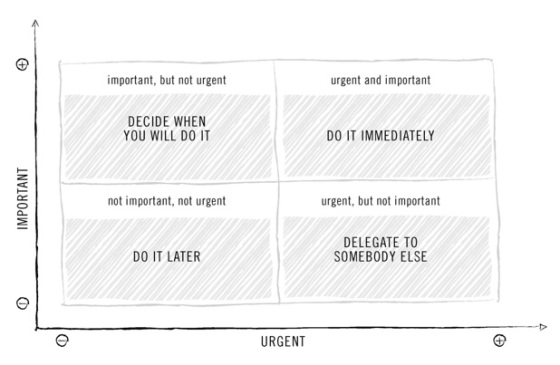
You feel good when you check a lot of things off your to-do list. But were they things that are most important and urgent?That’s what matters.
Eating at least seven portions of fresh fruit and vegetables a day was linked to a 42% lower risk of death from all causes. It was also associated with a 25% lower risk of cancer and 31% lower risk of heart disease or stroke. Vegetables seemed to be significantly more protection against disease than eating fruit, they say.
There was a surprise finding – people who ate canned or frozen fruit actually had a higher risk of heart disease, stroke and cancer.
Oyebode and colleagues took into account the socio-economic background, smoking habits and other lifestyle factors that affect people’s health. What they have found, they say, is a strong association between high levels of fruit and vegetable consumption and lower premature death rates – not a causal relationship.
Eating at least seven portions of fresh fruit and vegetables a day was linked to a 42% lower risk of death from all causes. Photograph: Jeff J Mitchell/Getty Images
Five portions of fruit and vegetables a day – a familiar mantra for those concerned about their own and their children’s health – may not, after all, be enough, according to a new report by scientists, who suggest we should instead be aiming for seven a day, and mostly vegetables at that. Alarmingly for some who thought they were doing the right thing, tinned and frozen fruit may not be helpful at all.
The latest wisdom – guaranteed to raise a groan from those already perplexed over stories of suspect sugars and dodgy fats – arises from a study carried out by experts at University College London, who analysed the eating habits of 65,000 people, revealed through eight years of the Health Survey for England, and matched them with causes of death.
The clear finding was that eating more fresh fruit and vegetables, including salads, was linked to living a longer life generally and in particular, to a lower chance of death from heart disease, stroke andcancer.
Eating at least seven portions of fresh fruit and vegetables a day was linked to a 42% lower risk of death from all causes. It was also associated with a 25% lower risk of cancer and 31% lower risk of heart disease or stroke. Vegetables seemed to be significantly more protection against disease than eating fruit, they say.
There was a surprise finding – people who ate canned or frozen fruit actually had a higher risk of heart disease, stroke and cancer.
The authors, Dr Oyinlola Oyebode and colleagues from the department of epidemiology and public health at UCL, said they were unsure how to interpret the findings on canned or frozen fruit . It could be that people eating canned fruit may not live in areas where there is fresh fruit in the shops, which could indicate a poorer diet.
Alternatively, they could be people who are already in ill-health or they could lead hectic lifestyles. There is also another possibility: frozen and tinned fruit were grouped together in the questions, but while frozen fruit is considered to be nutritionally the same as fresh, tinned fruit is stored in syrup containing extra sugar. More work needs to be done to see whether sweetened, tinned fruit is in fact the issue, the researchers say.
Oyebode and colleagues took into account the socio-economic background, smoking habits and other lifestyle factors that affect people’s health. What they have found, they say, is a strong association between high levels of fruit and vegetable consumption and lower premature death rates – not a causal relationship.
The “five a day” advice was launched by the government in 2003, after the World Health Organisation advised in 1990 that our minimum daily intake of fruit and vegetables should be 400g a day.
France and Germany also recommend five a day, while the US abandoned the numbers in favour of a “fruit and veggies – more matters” campaign in 2007. But Australia advises people to eat substantially more. In 2005, the Australian government launched “Go for 2+5”, meaning two 150g portions of fruit and five 75g portions of vegetables. That is 675g, the equivalent in the UK of 8.5 portions.
Oyebode said she thought the Australian example was probably the one to follow. “I think it makes a lot of sense,” she said. “It is aiming for more and the balance is two fruit and five veg. From our study it looks like vegetables are better than fruit. But I don’t feel very strongly that the guidelines should be changed because the majority of people know they should eat five a day and only 25% manage that.”
Changes in policy, she said, would be needed to improve the UK score. “Anything that could increase the accessibility and affordability of fruit and vegetables would be very helpful, such as working with corner shops to make sure they stock them,” she said. Petrol stations could also offer fruit and vegetables and maybe the Healthy Start scheme – which gives families on less than £16,000 vouchers for fruit and vegetables – could be extended.
Other experts agreed that the study was sound and representative of the population, but cautioned that in a study of the habits of people in the real world, it is hard to take full account of complications, such as education, smoking habits and people failing to tell the exact truth about their diet. “A key outstanding question is whether this [reduced risk of disease] is entirely attributable to these specific foods, or whether they are acting as a marker of a broader dietary pattern associated with improved health,” said Professor Susan Jebb of the Nuffield department of primary care health sciences, University of Oxford.