Category Archives: healthy habits

HICCUP: Health Initiative Coordinating Council

This manifesto aligns tightly with my own vision of how preventive health funding should be financed – data-driven and in a for-profit context.

HICCup


The HICCup experiment: Manifesto

Just imagine:

It’s 2019 and the mayor is having a bad day.  She wants to spearhead a new community program for bike-sharing, but she’s not sure the town can afford it.  Meanwhile, one of the new council members is pushing for an overhaul of the school lunch program.  She sighs as the assistant deputy mayor walks in.  “What now, Henry?” she asks with a slight edge in her voice.  But Henry is cheerful: “Mayor, I think we may have a way to fix this. I was just reading about the HICCup Experiment in a town just like ours…. It seems that if we did both the bike program and the school lunches, and made some other changes..”

“But what about our rising health care costs?” asks the mayor.

“That’s the point,” says Henry.  “HICCup showed that we can actually reduce those costs if we do multiple interventions simultaneously…even though none of them by itself would make a difference. And there’s an investment banker who just called us that’s eager to work with us to finance the project.  They’re asking us to set up a meeting with the big employers and Mercy Saints Health. Using the HICCup data, they think they can finance it all out of the health-care cost savings that would result, as long as we commit to following certain protocols.”

And the vision:

Now it’s 2040.  The mayor’s teen-aged son, also called Henry, is discussing his history project on the HICCup Experiment with other members of his MOOC.  “Of course,” he concludes, “the HICCup Experiment proved that multiple interventions can dramatically include the overall health of a community.  But the Experiment itself wouldn’t work anymore, as a funding vehicle.”

“Why not?” asks Susan, who clearly hasn’t done her homework.

Henry responds patiently with the obvious answer: “Because there are very few places with inflated, unnecessary health care costs anymore.”

The background

It is hard to find anyone in health care who does not believe that spending an extra $100 now on healthy behavior – exercise and proper nutrition, counseling for pre-diabetics, risk monitoring, and so on – could yield more than $120 in lowered costs and improved outcomes later. The numbers are fuzzy, of course, and there are plenty of methodological caveats, but there is little dispute about the plausibility and desirability of such an approach.

Yet neither individuals nor communities seem to act on the basis of this knowledge. Moreover, it’s likely that spending $110 now has no impact, as other factors dissipate any gain, but spending $110 million now (vs. a health-care budget of $100 million) should indeed return savings of $20 million annually over time.  Individuals often lack willpower or access to healthy food or convenient exercise facilities, and are surrounded by poor examples that encourage instant gratification rather than effort and restraint. And, on a broader, institutional scale, the money spent and the money to be gained do not belong to the same pocket.

Enter HICCup!

The goal of HICCup, the Health Initiative* Coordinating Council, is to facilitate the launch of five to eight community-wide experiments dedicated to proving that this can work, and to learning from both successful and unsuccessful efforts.  HICCup is a self-appointed counseling service and will persuade and guide local institutions to embrace a long-term perspective and launch a full-scale intervention experiment in their communities. For practical reasons, there are a few guidelines – but anyone who wants to do this without following our rules is welcome to do so.   (*Yes, it used to be “health intervention…” but initiative is more friendly and positive, and still let us keep the logo!)

For starters, HICCup will focus on communities of 100,000 people or fewer. The majority of each community and its institutions must be enthusiastic for the initiative to gain traction. If the community members mostly work for just a few employers and obtain health care from just a few providers, that makes the effort of corralling the players easier. And, of course, you need community leaders – mayor, city council, and others – who will work together rather than undermine one another.

So, how will this be funded? Not by HICCup, which is only a coordinating body.  The trick is for an investor in each community to capture some of what is being spent already on health care. As a rough calculation, assume $10,000 in annual per capita health-care costs, or $1 billion per year in a community of 100,000. (There are also all the separate costs of bad health, which are much harder to count or capture.)  That money ultimately comes from individuals and employers who pay it in taxes, insurance premiums or direct payments; the place to intercept it is somewhere between the payers and the health-care delivery system.

Instead of spending $1 billion a year, imagine spending $1.1 billion the first two years, but, say, only $900 million in the fifth year (possibly a $300 million savings off projected costs of $1.2 billion by then). That sounds like an attractive proposition – but only if someone else will make that initial investment in return for a claim to those presumed later savings.  These numbers are just for illustration; figuring out actual and predicted numbers for each community will be a key task.

The first challenge is for each HICCup community to get the involvement of a benevolent but ultimately profit-driven billionaire or hedge fund, or a philanthropic fund that sees a way to do good while earning money for future goodness. There are a lot of billionaires out there, some with vision. There are health-care companies that might bite, hedge funds looking for large-scale projects, and so-called social-impact bonds. There also are large employers that might decide to work with other employers in certain communities.

The funder makes a deal with whoever is responsible for the health-care costs (buyers): The funder makes upfront investment in health interventions and pays the health-care costs, against continued payment from the health-care buyers of the $1-billion yearly baseline, with the funder to keep (most of) the savings against originally predicted rising costs in later years. The money may be paid by employers, private insurers (which collect it from individuals, who, in the United States, are now required to buy insurance) or from government health-care funds, which will be the trickiest source.

One way or another, the investor/experiment manager will need to figure out how to realign some of the sick-care facilities and workers to some other role, including prevention, serving outsiders or some other use entirely.  That’s the second challenge HICCup experimenters need to address – one that is being addressed in part by the creation of Accountable Care Organizations, but without community involvement in preventive health.

All together now!


All these entities will be taking a substantial leap of faith. But we believe they can succeed – especially if they work together through HICCup to figure out the numbers, study the effects of small-scale healthy-living/preventive health-care efforts, and encourage one another to move forward. Regardless, each investor must work with existing institutions – if only to get at the revenue stream initially and benefit from the lowered costs in later years.

Although grants are a nice source of funding for demonstration projects and research, the best way for HICCup’s vision to catch on and be widely copied is by adopting a for-profit approach that attracts broader investment once it is shown to work.  Indeed, if a benefactor makes a donation, they feel good when they send off the money. An investor feels good only after the investment actually pays off.

Community officials and voluntary organizations also need to sign on…or  they can drive the process and find the benefactor/investor. They will also contribute by implementing complementary changes in school meals and gym classes; enacting zoning and other changes to encourage cycling, walking, and the like; hiring health counselors and care workers; and perhaps working with local restaurants and food stores to subsidize healthy choices and discourage unhealthy ones.   Local media can report on the experiment’s progress, and each community will likely engage in healthy rivalry with other HICCup experimenters.

Though it won’t get to keep the direct health-care cost savings, each community will get all the ancillary benefits of a healthy population, including an enhanced reputation.  Indicators of population health include not just rates of obesity, diabetes, high blood pressure, and diseases and related costs, but also whether the elderly can live (and be cared for) at home, absenteeism, school grades and graduation rates, employment statistics, accidents, and the like. Although the funder keeps the reduction in health-care costs, the community gets the benefit in the many payoffs from a healthier population over time.

Open enrollment

HICCup will not choose which communities participate. They will be choosing them selves. HICCup’s role will be to advise them and help them to communicate and learn from other communities going through the same process. We also want to be a clearinghouse for vendors of health-oriented tools, services, and programs. There are many bargains to be struck between communities and vendors offering discounts in exchange for wholesale adoption of their tools or programs.

However, there is one unbreakable rule: To work with HICCup, communities must collect and publish a lot of independently vetted data (without personal information, of course). For starters, they will need benchmarks of current conditions and projected costs, and then detailed statistics on the adoption of the measures, their impact and costs, and what happens over time.  HICCup will welcome input from lawyers and actuaries!

It is now time to try this on a broad scale. Five years from now, we will wonder what took us so long to get started. So, again, who will those investors be?
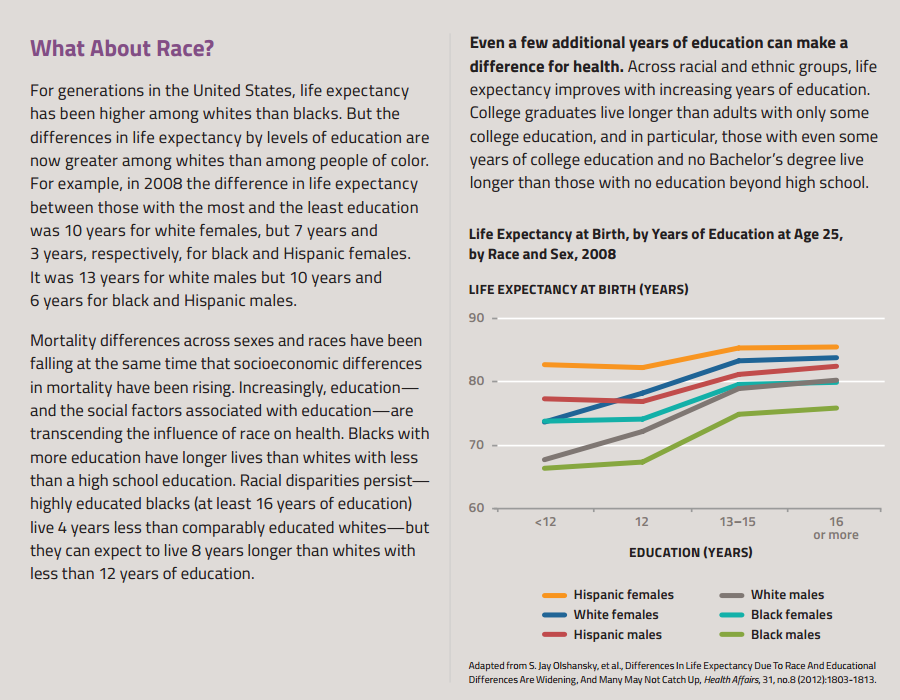
Education matters to health more than ever before

  • education matter more know because the economy has evolved to be more knowledge-based
  • white women are the key group affected by this change
  • whites as a group are no longer top of the heap
  • the graph below indicates that hispanic women of all educational levels are longer lived than most other groups of any educational exposure – interesting


education_health_rwjf

http://www.rwjf.org/en/research-publications/find-rwjf-research/2014/01/education–it-matters-more-to-health-than-ever-before.html

Brief (PDF): education_health_rwjf409883

thumbnail


Education: It Matters More to Health than Ever Before

We know with greater certainty than ever before that Americans with fewer years of education have poorer health and shorter lives. In fact, since the 1990s, life expectancy has fallen for people without a high school education, a decrease that is especially pronounced among White women.

Why is the link between education and health more distinct today? In the current knowledge economy, education paves a clear path to good jobs and a steady income. Completing more years of education creates better access to health insurance, medical care, and the resources to live a healthier lifestyle.

This brief and video are products of the Virginia Commonwealth University Center on Society and Health’s Education and Health Initiative, a program to raise awareness about the links between education and health. This is the first in a series of four briefs that will explain these complex connections, discuss the role of health care reform, and demonstrate why investing in education can cut health care costs.

Key Findings

  • People with less education are living shorter, sicker lives than ever before.Americans with less education face higher rates of illness, higher rates of disability, and shorter life expectancies. In the U.S., 25-year-olds without a high school diploma can expect to die 9 years sooner than college graduates.
  • These health disparities are even more prominent among White women.While overall life expectancy has generally increased, it has decreased for Whites with fewer than 12 years of education—especially White women. White women without a high school diploma are living shorter lives than they did in 1990.
  • Investing in education saves lives and dollars. More education leads to higher earnings that can provide access to healthy food, safer homes, and better health care. In contrast, people with fewer years of education generate higher medical costs and are less productive at work.

Big food go lite for the First Lady

  • Included only in the interests of balance, US big food exceeded a target to reduce calories – likely a modest, meaningless target, easily gamed? due to the GFC?
  • the denominator for the 6.4 trillion calories is 60.4 trillion calories
  • between 2007 and 2011, better-for-you, lower-calorie foods and beverages also drove financial performance for many of these same companies. Companies with a higher percentage of their sales coming from such products recorded stronger sales growth, higher operating profits, superior shareholder returns, and better company reputations.

http://www.rwjf.org/en/about-rwjf/newsroom/newsroom-content/2014/01/major-food–beverage-companies-remove-6-4-trillion-calories–fro.html

Major Food, Beverage Companies Remove 6.4 Trillion Calories from U.S. Marketplace

Independent evaluation finds industry exceeded Healthy Weight Commitment Foundation pledge to remove 1.5 trillion calories by more than 400 percent.

January 9, 2014thumbnail


Princeton, N.J.—Sixteen of the nation’s leading food and beverage companies sold 6.4 trillion fewer calories in the United States in 2012 than they did in 2007, according to the findings of an independent evaluation funded by the Robert Wood Johnson Foundation (RWJF) and announced today. The companies, acting together as part of the Healthy Weight Commitment Foundation (HWCF), pledged to remove 1 trillion calories from the marketplace by 2012, and 1.5 trillion by 2015. The evaluation found that, thus far, the companies have exceeded their 2015 pledge by more than 400 percent.

The participating companies sold 60.4 trillion calories in 2007, the year defined as the baseline measurement for the pledge. In 2012, they sold 54 trillion calories. This 6.4 trillion calorie decline translates into a reduction of 78 calories per person in the United States per day. This is the first effort to track all the calories sold by such major companies in the American marketplace.

“It’s extremely encouraging to hear that these leading companies appear to have substantially exceeded their calorie-reduction pledge,” said James S. Marks, MD, senior vice president and director of the Health Group at RWJF. “They must sustain that reduction, as they’ve pledged to do, and other food companies should follow their lead to give Americans the lower-calorie foods and beverages they want.”

In October 2009, more than 40 of the nation’s largest retailers, non-profit organizations, food and beverage manufacturers and trade associations launched HWCF, with the goal of helping to reduce obesity, especially childhood obesity, by 2015. Sixteen companies participated in the calorie-reduction pledge, announced in May 2010 as one pillar of the work of HWCF. The pledge was part of an agreement between HWCF and the Partnership for a Healthier America, an independent, non-partisan organization dedicated to advancing the goals of First Lady Michelle Obama’s Let’s Move initiative by working with the private sector to end childhood obesity.

Together the 16 companies produced 36 percent of the calories from all packaged foods and beverages, items such as cereals, snacks, canned soups, and bottled beverages, sold in the United States in 2007. In 2010 the companies noted that, in order to meet the pledge, they likely would develop new lower-calorie options, change existing products so that they had fewer calories, and change portion sizes to introduce more lower-calorie packaging.

In order to evaluate the impact of the pledge, researchers at the University of North Carolina at Chapel Hill (UNC) combined data on foods and beverages sold by participating companies with nutritional information for those products. They then determined which individual products were included as part of the pledge and tracked sales of those products over time. All data used were publicly or commercially available. The full, peer-reviewed study is expected to be published later this year.

“The companies whose sales we analyzed have a big influence over the foods and beverages almost every American eats and drinks every day,” said Barry Popkin, PhD, the W.R. Kenan, Jr. Distinguished Professor in the School of Public Health at UNC, who is leading the evaluation team. “The evaluation system we’ve created will enable to us to determine how changes to what’s sold influences what people consume.”

Other research has shown that, between 2007 and 2011, better-for-you, lower-calorie foods and beverages also drove financial performance for many of these same companies. Companies with a higher percentage of their sales coming from such products recorded stronger sales growth, higher operating profits, superior shareholder returns, and better company reputations.

“Making the shift from traditional items to lower-calorie ones is not just the right thing for customers, it’s the right thing for these companies’ bottom lines,” said C. Tracy Orleans, PhD, senior scientist at RWJF. “The next big question is how these changes to what’s available on store shelves actually impact the health of children and families.”

The 16 companies committed to the HWCF calorie-reduction pledge include:

  • Bumble Bee Foods, LLC
  • Campbell Soup Company
  • ConAgra Foods (includes Ralston Foods)
  • General Mills, Inc.
  • Hillshire Brands (previously Sara Lee Corporation)
  • Kellogg Company
  • Kraft Foods Group/Mondelez
  • Mars, Incorporated
  • McCormick & Company, Inc.
  • Nestlé USA
  • PepsiCo, Inc.
  • Post Foods
  • The Coca-Cola Company
  • The Hershey Company
  • The J.M. Smucker Company
  • Unilever

Top piece… obesity and diabetes

This guy is an arts/law student at Sydney University and he does a terrific job of crystallizing the issue… recognised in him winning the Wentworth Prize. Good on him.

Obesity cannot be controlled through personal responsibility alone

Policymakers have invested in the exhausted, glib explanation that maintaining nutritional health is a matter of personal and parental responsibility. But is it?

Assuming collective responsibility for obesity and diabetes would likely require highly invasive disincentives like sugar or beverage taxes. Photograph: Foodfolio/Alamy

McDonald’s cookies have an energy density comparable to hydrazine. Hydrazine is a rocket fuel used to manoeuvre spacecraft in orbit. It was astonishing, then, to watch a small child graze through two boxes of the desiccated biscuits in one sitting. His parents watched on, preoccupied with their own colossal meals: a noxious amalgam of meat, grease and sugar.

The prime minister, once our federal health minister, has explained his attitude. “The only person responsible for what goes into my mouth is me,” he said, “and the only people who are responsible for what goes into kids’ mouths are the parents”. The Gillard government agreed, ignoring recommendations produced by its own preventative health taskforce to tax unhealthy foods and eliminate junk food advertising directed at children.

Policymakers have invested in the exhausted, glib explanation that maintaining nutritional health is a matter of personal and parental responsibility – a corporate defence strategy adapted from the tobacco and alcohol industries. By implication, obesity is the result of individualirresponsibility: poor dietary choices, idle lifestyles, questionable parenting, or inadequate resolve.

Intuitively, it is easy to understand the political appeal of this doctrine. It conforms to cultural stereotypes, that “fat people” are slothful and indolent. Moreover, assuming collective responsibility for obesity and diabetes would likely require highly invasive disincentives like sugar or beverage taxes. Policymakers are eager to avoid the political liability associated with these proposals.

But this “personal responsibility” paradigm is troubling. First, it reflects popular indifference to the obesity epidemic. It is properly called an epidemic. Over 63% of Australian adults are overweight or obese. A fifthof all cancer deaths in the US are attributable to obesity. A quarter of the world population will likely acquire type 2 diabetes, while diabetes sufferers constitute two-thirds of all the deaths caused by cardiovascular disease. Globally, abnormal body mass index accounts for 23% of disability-adjusted life-years.

And if the number of sufferers continues to grow, children born today will enjoy shorter life expectancies than both their parents and grandparents.

Yet numbers make no sense unless they are properly communicated. Both obesity and type 2 diabetes are deeply human tragedies, but that is yet to register among the public and policymakers. They are tragedies that happen to “other people”, after a seemingly predictable descent into sedentary living and poor eating. Neither disease has the terrifying arbitrariness of cancer, nor the abruptness of a sudden heart attack – neither seems to warrant the same commitment to prevention.

Coca-Cola CEO: 'Obesity is a serious problem'.
Coca-Cola CEO: ‘Obesity is a serious problem’. Photograph: Geoff Abbott/Demotix/Corbis

Australians, for instance, remain acutely aware of the causal links between smoking and lung cancer or emphysema. Anti-smoking campaigns here are intensely visual and heavily funded. Comparable anti-obesity campaigns receive a third of the funding. Obesity is substantially lower as a preventative health priority.

Second, the personal responsibility doctrine allows government and industry to play an interminable game of pass-the-parcel with obesity control. At its most basic, obesity develops when a person’s energy consumption exceeds their energy expenditure. Commercial interests are best served by preserving the rate of consumption, and instead appealing to exercise and sport. “Think. Drink. Move.” intones Coca-Cola. “Confectionery is designed to be enjoyed,” writes Cadbury, “as part of a balanced diet and active lifestyle.”

Central, then, to the corporate responsibility mission is a selective emphasis on physical activity over diet, and a denial of the good food/bad food dichotomy. Blame is deflected instead onto the consumer. The CEO of Coca-Cola, Muhtar Kent, provides a typical illustration of this disingenuous, faux-conscientious marketing. “Obesity is a serious problem. We know that,” he silkily conceded. “And we agree that Americans need to be more active and take greater responsibility for their diets.”

So policymakers are stuck in a trap of industry’s design. Through the personal responsibility conceit, the debate over tackling obesity has been reduced to a simplistic binary: consumption control versus the promotion of sport and exercise.

It is a neat and digestible expression of the basic obesity problem, but it lazily defers some crucial questions. Consumption is the half of the obesity equation which has the greatest effect, and over which we have the most control. But governments have been caught up in the food politics of “energy-in-energy-out” without asking why 10% of the Australian population visits McDonald’s every day despite school curriculums saturated in dietary education, why Indigenous communities suffer disproportionately high rates of obesity and diabetes, or why ultra-processed foods are cheaper than healthy alternatives.

Clearly, understandings of personal responsibility will play an important role in any obesity control regime. Eliminating it entirely is unhelpful, and would only sustain the worn cliché that obesity is an exclusively genetic problem, to be cured rather than prevented.

Yet a country does not get fat for lack of responsibility. That cannot explain the rapid growth or severity of the obesity-diabetes epidemic. It is a caricature of the complex factors which influence the lifestyle patterns of individuals, and it fails to address the roots of overconsumption: cost of living, manipulative marketing, nutritional misinformation and – often overlooked – simple palatability.

Australia is the muffin top of Asia, and it is killing our citizens. Dispensing with the fiction of personal responsibility is the first step to a truly holistic solution – one which finds an appropriate balance between education, industry self-regulation, and firm government intervention.

Weight training reduces diabetes risk by 18%


http://www.medicalobserver.com.au/news/weight-training-cuts-type-2-diabetes-risk-in-women

Weight training cuts type 2 diabetes risk in women

Emily Dunn   all articles by this author

WOMEN who regularly lift weights or do other resistance exercise may reduce their risk of developing type 2 diabetes, a study has found.

Researchers from Harvard Medical School followed up 99,316 women aged 36–81 years who were participants in the Nurses’ Health Study and found that those who reported weekly sessions of just 30 minutes of total muscle-strengthening activity had an 18% lower relative risk of type 2 diabetes, compared to their non-weight lifting counterparts.

Total muscle strengthening activities included resistance training as well as lower-intensity exercise such as yoga or stretching.

Women who participated in resistance exercise had the lowest relative risk, but even those who only participated in the lower-intensity activity showed an improvement in relative risk compared to those who did nothing.

The benefits were on top of any benefits gained from aerobic exercise. The women who engaged in the recommended 150 minutes of aerobic activity and at least an hour of muscle-strengthening activity per week had the most substantial relative risk reduction, cutting their chance of developing type 2 diabetes by a third.

Previous research has shown the importance of aerobic activity to stave off type 2 diabetes, and regular resistance training is already recommended for both men and women to maintain muscle mass and protect against other diseases.

However, this is the first study to demonstrate the benefits of muscle-strengthening for the prevention of type 2 diabetes, and that the findings concur with similar research in men.

The results are also consistent with those published last year from the 2004–05 Australian Diabetes, Obesity and Lifestyle Study that found regular strength training was associated with lower prevalence of impaired glucose metabolism, independent of other physical activity.

PLOS Med 2014; online 14 January

Nutrition labels don’t work in NZ

  • Complicated nutrition labels don’t help… who would have thought?
  • Running, walking and traffic light labels were far better recalled.

http://www.foodnavigator-asia.com/Markets/Nutritional-food-labels-not-working-in-New-Zealand-says-study

Nutritional food labels not working in New Zealand, says study

By Ankush Chibber, 13-Jan-2014

Related topics: Markets, Asian tastes

A new study from New Zealand has found that nutritional food labels in use under the country’s daily intake system of labelling are not as effective as once thought and could be adversely impacting public health.

The study, which was conducted by researchers at the University of Canterbury, instead found that Kiwi consumers reacted better to labels which provide relatable, transparent information that is easily converted into exercise expenditure or clearly states which products are good and which are bad.

Under the study, UC researchers collected a total of 591 online responses from participants who were given an identical survey, where the way in which the nutritional information was communicated differed across the sample.

Michelle Bouton, a researcher on the study, said that they included a star system which displayed one, two or three stars on the product, depending on how many calories were in the product.

“A traffic light label was divided into five categories of the main nutritional components and coloured red [bad], orange [moderate] or green [good],” Bouton said, adding that they also included walking and running labels which stated how many minutes of exercise were needed to burn off the product.

Daily intake system ineffective

“Our findings showed that the current daily intake system was so insignificant that only 23% of participants recalled seeing it. This was alarmingly low compared to the recall rate of the running [89%], walking [93%] and traffic light label [70%],” she said.

Bouton said that through their study, the researchers found that those who were presented with the walking label were most likely to make healthier consumption choices, regardless of their level of preventive health behaviour.

“Therefore, consumers who reported to be unhealthier were likely to modify their current negative behaviour and exercise, select a healthier alternative or avoid the unhealthy product entirely when told they would need to briskly walk for one hour and 41 minutes to burn off the product,” said Bouton.

Traffic lights work

“The traffic light system was found to be effective in deterring consumers from unhealthy foods, while also encouraging them to consume healthy products,” she added.

“Although the running label was found to be effective with participants who reported a healthy lifestyle, it was found to be ineffective with those who were yet to adopt a healthy lifestyle. A consumer who does not actively exercise is less likely to start running than a consumer who is already active.”

Ekant Veer, associate professor of marketing at UC’s Department of Management, Marketing and Entrepreneurship and study supervisor, said the findings differ from what people initially thought would be an effective communication method.

“Information and numeric figures are ineffective at aiding consumers with low levels of health literacy to make healthy consumption choices. Images and colours are found to be much more effective and understandable forms of communication,” he said.

“As the overwhelmingly high obesity rates in New Zealand continue to climb, something needs to be done to improve the health of our society. This information provides valuable insight into understanding consumption behaviours’ associated to food labels. New Zealand still has one of the highest obesity rates in the world.”

Recommended vs actual eating…

Great post from Marion – recommended vs actual. As she says… oops!!

http://www.foodpolitics.com/2014/01/what-are-americans-eating/

What are Americans eating?

I’ve only just come across this USDA chart, which first appeared in an article in Amber Waves.

USDA’s Economic Research Service (ERS) researchers looked at 1998-2006 grocery store food expenditures and compared what consumers buy to dietary guidelines for healthy eating.

Oops.

NEJM: Daily small amounts of nuts leads to reduction in all cause mortality

  • 20% reduction in 30-year all cause mortality
  • portion size critical given energy density
  • lower body weight
  • 11% cancer reduction
  • 29% heart disease reduction
  • from the Nurses’ Health Study

Eating nuts daily tied to lower overall death rate: Harvard study

By Maggie Hennessy, 26-Nov-2013

Related topics: Fruit, vegetable, nut ingredients, Suppliers, R&D, Health & Wellness, Markets, Manufacturers

People who ate a daily handful of nuts were 20% less likely to die from any cause over a 30-year period than those who didn’t, according to the largest study of its kind by scientists from the Dana-Farber Cancer Institute, Bringham & Women’s Hospital and the Harvard School of Public Health.

The report, published in the New England Journal of Medicine last week, also showed that those who ate nuts daily also weighed less.

“I think the results are very exciting,” said Peter Pribis, assistant professor of nutrition and dietetics at the University of New Mexico, applauding the “extensive adjustments” made by the researchers during the study in order to best represent a long-term diet and minimize individual variations.

“The message is getting slowly through that nuts are very healthy and something we should eat in small amounts every day. And it’s very easy to do. We talk about exercise, and it can be hard for a lot of people to commit to doing it. But eating nuts takes a few seconds. And look at the huge benefits this group of food can do for us health wise.”

For the study, the researchers analyzed nut consumption with total and cause-specific mortality among 76,464 women in the Nurses’ Health Study and 42,498 men in the Health Professionals Follow-up Study. Consumption of a handful of nuts—which included both groundnuts such as peanuts and tree nuts including almonds, Brazil nuts, cashews, hazelnuts, macadamias, pecans, pine nuts, pistachios and walnuts—was inversely associated with total mortality in both men and women, independent of other predictors for death.

In this case, a “handful” translated to 1 ounce or three tablespoons, seven or more times per week. This shouldn’t be hard to achieve, according to the NPD Group, which recently found that 77% of U.S. households have nuts or seeds on-hand and 19% of individuals eat nuts at least once in a two-week period.

In addition, the study found that there were significant inverse associations for deaths due to cancer (11% reduction), heart disease (29% reduction) and respiratory disease. And those who regularly ate nuts also tended to have a healthy lifestyle, such as smoking less and exercising more.

Nuts contain an optimal lipid profile, but portion size is important

“One truth is that all nuts contain a very optimal lipid profile,” Dr. Pribis noted. “They have done careful studies to examine the weight issue. Looking at the Nurse’s Health Study, when we age, we tend to gain weight. Those people who ate nuts tended to gain less.”

Indeed, Jenny Heap, MS, RD, manager of global health and nutrition communications at the Almond Board of California, said that the study “adds to the strong body of evidence showing that eating tree nuts regularly is part of a healthy lifestyle.” She also pointed to recent research published in the European Journal of Clinical Nutrition, which showed that participants eating 1.5 ounces of dry-roasted, lightly salted almonds every day experienced reduced hunger and improved dietary vitamin E and monounsaturated fat intake without increasing body weight.

But portion size is key, said Dr. Pribis. “Nuts are very energy dense, so they can curb hunger. But also in realizing that they’re so energy dense, if you exceed two servings per day, then you might start to gain weight. It’s about balance.”

This could also have implications as food manufacturers may look to incorporate more nuts into formulations on the heels of such strong positive results. 
“It definitely has implications for food manufacturers,” Dr. Pribis noted. “I am afraid we’ll see some of them take junk food and add nuts to it and try to sell it like it’s ‘healthier’. On the other hand, maybe we’ll see more items like cereal with nuts incorporated. But again, consumers would need to eat less of it to get the benefits”—a variable that could prove difficult for manufacturers to control.

Source: New England Journal of Medicine 
Association of Nut Consumption with Total and Cause-Specific Mortality”
DOI: 10.1056/NEJMoa1307352
Authors: Ying Bao, M.D., Sc.D., Jiali Han, Ph.D., Frank B. Hu, M.D., Ph.D., Edward L. Giovannucci, M.D., Sc.D., Meir J. Stampfer, M.D., Dr.P.H., Walter C. Willett, M.D., Dr.P.H., and Charles S. Fuchs, M.D., M.P.H.

Sugary Drink Tax in India could reduce diabetes

20% tax on sugar sweetened beverages (2014-2023) could

  • avert 11.2M cases of overweight and obesity
  • 400,000 cases of type 2 diabetes
  • the largest impact would be on young rural men
  • impacts even bigger if the 13% linear sales growth rate is exceeded

Study: SSB tax could dramatically reduce diabetes incidences in India

09-Jan-2014

Related topics: Policy, Food safety, Beverages

India could prevent an estimated 400,000 people from contracting diabetes over the next 10 years if the government were to impose a 20% tax on sugar-sweetened beverages (SSB), a new study has suggested.

According to a study published this week in PLOS Medicine by researchers at the Public Health Foundation of India, New Delhi, along with academic institutions in the US and the UK, it is estimated that imposing such a tax across India could avert 11.2m cases of overweight and obesity, and 400,000 cases of type 2 diabetes between 2014 and 2023, based on the current rate of increases in SSB sales.

Statistical analysis

The researchers analysed soft drink consumption from over 100,000 households between 2009 and 2010, studying how they responded to price changes in the past, then using that information to predict how a tax on soft drinks would influence consumption trends.

The findings come at a time when Indian health policymakers have been arguing that a combination of education and disincentives should be used to curb the consumption of soft drinks.

If SSB sales were to increase more steeply than the current rate, as predicted by drinks industry marketing models, the researchers estimate that the tax would avert 15.8m cases of overweight and obesity, and 600,000 cases of diabetes.

Sustained SSB taxation at a high tax rate could mitigate rising obesity and type 2 diabetes in India among both urban and rural subpopulations,” the researchers wrote.

Future research should replicate the findings observed here in other rapidly developing middle-income countries where SSB consumption is increasing at a rapid rate.”

The researchers combined data on how price changes affect the demand for SSBs with historical data on SSB sales trends, BMIs, and new cases of diabetes to estimate the effect that a 20% SSB tax would have on energy consumption, the prevalence of overweight and obesity, and the number of new cases of diabetes among Indian subpopulations.

Surprising results

The researchers were surprised to observe that the largest relative effect of the SSB tax was likely to be among young men in rural areas.

Given current consumption and BMI distributions, our results suggest the largest relative effect would be expected among young rural men, refuting our a priori hypothesis that urban populations would be isolated beneficiaries of SSB taxation“, they wrote.

They also calculated that the gains from the tax could be even bigger if sales of sweetened beverages in India grow in the coming years not at a linear 13%, as has been the case since 1998, but more steeply as the drinks industry predicts will be the case.

Industry response to launch of Action on Sugar

increase fibre content (as a bulking agent) instead of reducing portion size – they have half the calories, but are more expensive and less stable.

New word – rheology: the study of the flow of matter, primarily in the liquid state.

Sugar under siege: Reformulation can win the battle, says Barry Callebaut

By Oliver Nieburg+, 09-Jan-2014

Related topics: Carbohydrates and fibers (sugar, starches), Chocolate and confectionery ingredients, Sweeteners (intense, bulk, polyols), Suppliers, R&D, The obesity problem, Health & Wellness, Confectionery

Replacing sugar with fibers in chocolate could be more effective in reducing global sugar consumption than cutting portion sizes, but will come at a cost, according to Barry Callebaut.

Campaign group Action on Sugar was established today with the aim of pressuring manufacturers to reduce sugar in products by 30% over the next four years. Its chairman told ConfectioneryNews that the organization favored cutting sugar by reducing portion sizes rather than substitution.

Portion control: Foolproof plan to cut calories?

Marijke De Brouwer, innovation manager at Barry Callebaut, said that global salt reduction came through reformulation, so why couldn’t sugar?

“Reducing the portion size is rather easy because it’s only playing with the weight, but with portion size you do not reduce the sugar percentage.”

Fibers for positive health impact

She argued that reformulation would have a greater impact and suggested replacing up to 30% of sugar in chocolate with fibers to perform a bulking function.

 “It has a positive health impact. Fibers have some functional benefits versus sugar.”

A fiber replacement would help increase global fiber consumption and would also limit calories in a product since sugar is 4 kcal per gram and fibers 2 kcal per gram.

The cost

Asked why the practice of replacing sugar with fibers had not yet been widely adopted by the chocolate industry, De Brouwer said: “It’s because of the price impact.”

Barry Callebaut acknowledged that fibers were more expensive but would not say by how much.

Fibers may also impact processability depending on the application, potentially adding an extra cost to ensure products have the same rheology, taste and texture.

“If you want to guarantee it has 30% less sugar, you need to avoid contamination,” added De Brouwer.

She said that brands could feasibly combine reformulation with portion size reduction to cut sugar.

Health implications

Action on Sugar contends that added sugar in food and drinks is an unnecessary source of calories in the diet that is responsible for rising global obesity. It adds that sugar is linked to other damaging health effects such as type II diabetes.

The World Health Organization (WHO) recommends that no more than 10% of calories in a person’s diet should come from added sugars for optimal health, but The Sunday Times claims to be in possession of a leaked WHO draft document that says the organization is considering cutting its recommendation to 5% in light of fresh scientific research linking sugar to obesity, heart disease and tooth decay.

What’s the reference?

Action on Sugar hopes manufacturers will reduce sugar by 30% in products over the next four years compared to current levels of sugar in that product.

For example, if Mars opted only for portion control, a 51 g Mars bar would become 42 g.