Category Archives: healthcare

Health Miranda: You have the right to keep your health information private, anything you disclose about your health can and will be used against you.

  • The Affordable Care Act now lets employers charge employees different health insurance rates, based on whether they exercise, eat healthful foods and other “wellness” choices they make outside of work.
  • As different phases of the law have taken effect and companies have better understood how to implement it, there basically have been three levels of wellness engagement:
  • Level 1 encourages employees to join a wellness program with exercise and nutrition activities and undergo biometric screenings that check weight, body mass, cholesterol and other health indicators.

    Level 2 trades the carrot for the stick. Employees (and insured family members) who don’t submit to the screening and participate in wellness programs face steep penalties; they may have to pay up to 30 per cent more for their share of health insurance costs.

  • Level 3 in the march towards wellness adopts “outcomes” based programs that can require employees to meet specific fitness goals or pay higher insurance costs.
  • WELLOGRAPH.com looks like an interesting prospect at AUD354

http://www.afr.com/p/technology/wearable_tech_privacy_headed_on_1uDsKFvA5cacLwe6vTKIBN

Wearable tech, privacy on collision course

PUBLISHED: 8 HOURS 48 MINUTES AGO | UPDATE: 4 HOURS 28 MINUTES AGO

Wearable tech, privacy on collision courseThe Zepp Labs wearable sensor on a golf glove … this year’s Consumer Electronics Show was dominated by the next generation of fitness devices. With more advanced sensors and improved hardware.

BRIER DUDLEY

Outrage over NSA spying is nothing compared to how people may react to the upcoming collision with wearable computing, medical privacy and new insurance rules.

You don’t need leaked documents to see it coming, though it took me a while to connect the dots after seeing the bewildering array of new health and fitness-tracking gadgets shown at January’s Consumer Electronics Show.

The show was seen as a turning point for “wearables”, including watches, wristbands, headsets and other gadgets. The most popular wearables monitor physical activity and connect wirelessly to phones, which may then upload the data to online services.

Research firms expect the fitness-wearables category to soar over the next few years, outpacing the growth of smartphones and tablets.

Not everyone wants to have a little computer on the wrist or head keeping track of what a wearer does around the clock. But I wonder if they won’t have much choice in the future, under new insurance laws in the US that invite companies to scrutinise and monitor their employees’ health and fitness.

In the past, medical information was generally none of your employer’s business. It’s still technically private. But the health-care overhaul known as Obamacare is chipping away at this wall.

The Affordable Care Act now lets employers charge employees different health insurance rates, based on whether they exercise, eat healthful foods and other “wellness” choices they make outside of work.

A 2013 survey by Aon Hewitt consulting found that motivating employees to change health behaviours is a “significant focus” over the next three to five years at 69 per cent of employers.

It doesn’t seem like a bad thing because it’s wrapped up in warm and fuzzy doublespeak. This isn’t about saving companies money; it’s about your health. Companies aren’t forcing you to participate, they’re offering rewards. We all want to be healthy, right?

As different phases of the law have taken effect and companies have better understood how to implement it, there basically have been three levels of wellness engagement.

TRACKING HEALTH


The first encourages employees to join a wellness program with exercise and nutrition activities and undergo biometric screenings that check weight, body mass, cholesterol and other health indicators.

Level 2 trades the carrot for the stick. Employees (and insured family members) who don’t submit to the screening and participate in wellness programs face steep penalties; they may have to pay up to 30 per cent more for their share of health insurance costs.

The law calls this a “reward” for participation. Flip it around and it’s a penalty for not authorising your employer to manage and monitor how you live outside of work.

Better health overall is in everyone’s best interest. But you can’t help but be cynical when it becomes tied to benefit levels, especially in an era of vanishing pensions, flat pay cheques and longer work days.

It’s too early to say whether wellness programs will make a big difference. In the meantime, they can change the workplace dynamic.

By insinuating that individual choices are the driver of health-care costs, they erode the social contract of group plans in which everyone contributes to coverage that takes care of each other and their families in case something happens.

I’m digressing.

Level 3 in the march towards wellness adopts “outcomes” based programs that can require employees to meet specific fitness goals or pay higher insurance costs.

At this point, when body tracking and measurements are used to adjust benefits, it gets harder to maintain the pretence of privacy. Even if individual records are masked, the data will provide enough insight to assess employees’ potential health costs as well as job performance, enabling a new form of discrimination.

Aon Hewitt’s survey said 64 per cent of employers that offer health-care coverage are using data to find cost savings and as they shift towards health-improvement strategies, they’re relying “more on integrated, dynamic data aggregation tools to laser in on the best opportunities for reduction of unnecessary costs”.

TECHNOLOGY ADVANCEMENTS HELP MONITORING


Tech companies are ahead of the game. One is Limeade, a hot start-up in Bellevue that last year doubled sales of its software platform, which employers and insurance companies use to encourage and monitor wellness activities. The platform can sync with dozens of fitness-tracking devices and apps.

Last month’s Consumer Electronics Show was dominated by the next generation of fitness devices. With more advanced sensors and improved hardware, they’re building on the success of activity trackers such as the Fitbit and Nike FuelBand that millions of people — including me — already use. Show organisers gave an “innovation award” to the $US320 ($354) Wellograph Watch, which includes a continuous heart-rate monitor, wellness tracker and running watch in a sleek case.

Fitness tracking may become hard to avoid. Intel unveiled sensors at CES that can be embedded into common devices such as earbuds, which then track physical activity. The data can be relayed to a wellness app on a phone and online wellness programs.

Apple also is chasing this opportunity. With the iPhone 5S, it began using a processor with built-in sensors that can be used by fitness apps.

On January 31, word surfaced that Apple had a big meeting with the Food and Drug Administration, apparently to discuss medical apps and perhaps its own version of a health-monitoring watch. This isn’t too surprising. After years of back and forth with tech companies and others, the FDA in September issued guidelines for health-related apps and gadgets, to clarify which will be considered medical devices and require regulatory approval.

I suggest regulators go a step further and issue privacy guidelines for wellness programs, health apps and wearable devices that may share data with insurers and employers. They could be modelled on the Miranda warnings that police use, informing people of their right to avoid self-incrimination under the Fifth Amendment:

“You have the right to keep your health information private, anything you disclose about your health can and will be used against you.”

Doctors move to salaried positions…

Spineless rent seeking psychopaths.

http://www.nytimes.com/2014/02/14/us/salaried-doctors-may-not-lead-to-cheaper-health-care.html?_r=0

Apprehensive, Many Doctors Shift to Jobs With Salaries

By 

Launch media viewer
Dr. Suzanne Salamon, with a patient at Beth Israel Deaconess Medical Center in Boston, said she has had trouble filling a prestigious fellowship because of relatively low salaries. Katherine Taylor for The New York Times
American physicians, worried about changes in the health care market, are streaming into salaried jobs with hospitals. Though the shift from private practice has been most pronounced in primary care, specialists are following.

Last year, 64 percent of job offers filled through Merritt Hawkins, one of the nation’s leading physician placement firms, involved hospital employment, compared with only 11 percent in 2004. The firm anticipates a rise to 75 percent in the next two years.

Today, about 60 percent of family doctors and pediatricians, 50 percent of surgeons and 25 percent of surgical subspecialists — such as ophthalmologists and ear, nose and throat surgeons — are employees rather than independent, according to the American Medical Association. “We’re seeing it changing fast,” said Mark E. Smith, president of Merritt Hawkins.

Health economists are nearly unanimous that the United States should move away from fee-for-service payments to doctors, the traditional system where private physicians are paid for each procedure and test, because it drives up the nation’s $2.7 trillion health care bill by rewarding overuse. But experts caution that the change from private practice to salaried jobs may not yield better or cheaper care for patients.

“In many places, the trend will almost certainly lead to more expensive care in the short run,” said Robert Mechanic, an economist who studies health care at Brandeis University’s Heller School for Social Policy and Management.

When hospitals gather the right mix of salaried front-line doctors and specialists under one roof, it can yield cost-efficient and coordinated patient care. The Kaiser system in California and Intermountain Healthcare in Utah are considered models for how this can work.

But many of the new salaried arrangements have evolved from hospitals looking for new revenues, and could have the opposite effect. For example, when doctors’ practices are bought by a hospital, a colonoscopy or stress test performed in the office can suddenly cost far more because a hospital “facility fee” is tacked on. Likewise, Mr. Smith said, many doctors on salary are offered bonuses tied to how much billing they generate, which could encourage physicians to order more X-rays and tests.

Mr. Mechanic studied 21 health systems considered good models of care — including the Mayo Clinic and the Palo Alto Medical Foundation — and discovered that many still effectively rewarded doctors for each procedure. “It doesn’t make any sense,” he said.

Hospitals have been offering physicians attractive employment deals, with incomes often greater than in private practice, since they need to form networks to take advantage of incentives under the new Affordable Care Act. Hospitals also know that doctors they employ can better direct patients to hospital-owned labs and services.

“From the hospital end there’s a big feeding frenzy, a lot of bidding going on to bring in doctors,” Mr. Mechanic said. “And physicians are going in so they don’t have to worry — there’s a lot of uncertainty about how health reform is going to play out.”

In addition, Medicare had reduced its set doctors’ fees over the last decade, while insurers have become more aggressive in demanding lower rates from individual practices that have little clout to resist. Dr. Robert Morrow, a family doctor in the Bronx, said he now received $82 from Medicare for an office visit but only about $45 from commercial insurers.

Dr. Cathleen London practiced family medicine for 13 years outside Boston, but recently took a salaried job at a Manhattan hospital. She said she accepted a pay cut because she could see that she was losing ground in her practice. “I think the days of what I did in 1999 are over,” she said. “I don’t think that’s possible anymore.”

The base salaries of physicians who become employees are still related to the income they can generate, ranging from under $200,000 for primary care doctors to $575,000 in cardiology to $663,000 in neurosurgery, according to Becker’s Hospital Review, a trade publication.

Because of the relatively low salaries for primary care doctors, Dr. Suzanne Salamon said that for the last two years she has had trouble filling a prestigious Harvard geriatrics fellowship she runs.

Dr. Howard B. Beckman, a geriatrician at the University of Rochester, who studies physician payment incentives, said reimbursements for primary care doctors must be improved to attract more people into the field. “To get the kinds of doctors we want, the system for determining salaries has to flip faster,” he said.

Dr. Joel Jacowitz, a cardiologist in New Jersey, and his 20 or so partners decided to sell their private practice to a hospital. In addition to receiving salaries, that meant they no longer had to worry about paying malpractice premiums themselves or finding health insurance for their staff members.

Dr. Jacowitz said that the economics drove the choice and that the only other option would have been to bring in more revenue by practicing bad medicine — ordering more heart tests on patients who did not need them or charging exorbitant rates to people with private insurance. He said he knew of one cardiologist in private practice who charges more than $100,000 for a procedure for which Medicare pays about $750.

“Some people are operators and give the rest of us a bad name,” he said, adding that he had changed his opinion about America’s fee-for-service health care system. “I’m fed up — I want a single-payer system.”

Dr. Kirk Moon, a radiologist in private practice in San Francisco, also sees advantages for the nation when doctors become employees. “I think it’s pretty clear that sooner or later we’re all going to be on salary,” he said. “I think there’ll be a radical decrease in imaging, but that’s O.K. because there’s incredible waste in the current system.”

Various efforts to change incentives for doctors and hospitals are being tested. An increasing number of employers or insurers, for example, pay health systems a yearly all-inclusive payment for each patient, regardless of their medical needs or how many tests are dispensed. If doctors order unnecessary tests, it costs the hospital money, rather than bringing it in.

And instead of offering bonuses for productivity — doctors cite pressures from hospital employers to order physical therapy for every discharged patient or follow-up M.R.I. scans on every patient who got an X-ray — some hospital systems are beginning to change their criteria. They are providing bonuses that reward doctors for delivering high quality and cost effective care, such as high marks from patients or low numbers of patients with asthma who are admitted to the hospital.

“The question now is how to shift the compensation from a focus on volume to a focus on quality,” said Mr. Smith of Merritt Hawkins. He said that 35 percent of the jobs he recruits for currently have such incentives, “but it’s pennies, not enough to really influence behavior.”

Senior Doctors rorting Queensland Health

  • double-billing
  • charging but not present
  • overtime while on holidays

Queensland auditor-general refers some public hospital doctors to CMC over possible fraud

By Melinda Howells

Updated Tue 11 Feb 2014, 7:15pm AEDT

The Crime and Misconduct Commission (CMC) has been asked to investigate whether some senior doctors have defrauded Queensland Health by claiming excess overtime and double-billing.

The auditor-general investigated 88 of the state’s 2,500 Senior Medical Officers.

He found that seven of them did not attend work during their rostered hours for more than 30 days, and that doctors who were on leave were paid $500,000 in overtime.

Health Minister Lawrence Springborg says the evidence gathered warrants further investigation.

Mr Springborg says the report shows systemic failings and ‘double-dipping’ by some doctors in the state’s public hospitals.

“The report highlights gaps in both rostering and attendance processes and treatment and billing practices, which have been open to exploitation,” he said.

He says some doctors were paid overtime while on holidays, turned up late but claimed overtime, or billed patients privately when they had no right of private practice.

“Inadequate oversight and administration, and we’ve had double dipping and we’ve had people that have taken advantage,” he said.

Mr Springborg admits better checks are needed.

“I’m talking here today about a small number of doctors – the majority of people are doing the right thing,” he said.

“Matters are going to be referred to the Crime and Misconduct Commission in Queensland.

“Also there are a number of recommendations which have been made to improve scrutiny and oversight in the system, which will all be implemented and adopted by the Government.”

Report a ‘smokescreen’ amid contract push

Alex Scott from the Together Union says the report comes as the State Government pushes for individual contracts with doctors.

“This Government is trying to use a smokescreen of this auditor-general’s report to completely misrepresent the true state of affairs in relation to the hours of work for doctors, the private practice arrangement for doctors,” he said.

Dr Shaun Rudd from the Australian Medical Association says it is an attack on the profession.

He says only a small percentage of Senior Medical Officers appear to be involved.

“If that’s correct that’s very worrying,” he said.

“However again it’s usually a system problem in the fact they’re probably working somewhere else in the public system, or it’s not been recorded what they’re actually doing.

“The problem with the Queensland Health system has been that it is a system which has been very difficult.

“It’s had its problems as well with the payroll system etcetera.

“The vast majority of doctors in the public system work long and hard.”

The report comes amid a dispute between the State Government and unions about putting senior doctors onto individual work contracts.

Liberal Chief of Staff with extremely close ties to food lobbying company

Just disgraceful…

http://www.smh.com.au/federal-politics/political-news/government-official-who-opposed-healthy-food-website-owns-shares-in-food-lobbying-company-20140212-32h83.html

Government official who opposed healthy food website owns shares in food lobbying company

Date 

Senator Nash reveals staffer’s lobby links

Assistant Health Minister Fiona Nash tells the Senate her chief of staff, Alastair Furnival, owns shares in a company that lobbies for the junk food industry.

A senior government staffer who demanded a healthy food website be taken down owns shares in a company that lobbies for the junk food industry.
Assistant Health Minister Fiona Nash revealed in a late-night statement to the senate on Tuesday that her chief of staff, Alastair Furnival, owns shares in the lobbying company Australian Public Affairs – only hours after she had first told Parliament there was “no connection whatsoever” between her chief of staff and the company.

Assistant Health Minister Fiona Nash allegedly intervened to have food ratings site pulled down.Assistant Health Minister Fiona Nash is under fire over the withdrawal of a food rating website. Photo: Katherine Griffiths

Australian Public Affairs is listed on the lobbyist register as representing the Australian Beverages Council and Mondelez Australia, which owns the Kraft peanut butter, Cadbury and Oreo brands, among others.

Advertisement

The latest development comes after Fairfax Media reported Mr Furnival is also married to the head of the company. A spokeswoman told Fairfax Media that Mr Furnival had “no role whatsoever in his wife’s business”.

In Parliament last night, Senator Nash stated that “for the sake of completeness” she was updating her earlier statements to include Mr Furnival’s shareholding.

A screen grab of the website before it was discontinued.A screen grab of the website before it was discontinued.

She said that he had no active involvement with the company, and “arrangements” had been put in place so that his business activities would not conflict with his role. His wife had committed to not lobbying the health minister, assistant health minister or health department.

Health groups have condemned the intervention of Senator Nash and Mr Furnival in the health star rating food site, which set up a system that enabled food manufacturers to label their products with easy-to-understand nutritional information.

The site was developed through a Council of Australian Governments process run by state ministers, and was launched last Wednesday with the wide support of health groups, including the Heart Foundation, CHOICE, and the Public Health Association of Australia.

Fairfax Media understands that Mr Furnival insisted staff take the website down – a directive that was refused, only to have Senator Nash intervene with the same request. The site was taken down by 8pm that same night.

Public Health Association head Michael Moore said the decision to take down the site was inappropriate.

“The disappointing thing to me was that it was a unilateral decision that overrode a decision of the food ministers,” he said.


http://www.medicalobserver.com.au/news/withdrawn-food-rating-website-linked-to-lobbyist

Withdrawn food rating website linked to lobbyist

12th Feb 2014

LABOR is claiming a conflict of interest and possible breach of parliamentary conduct on the part of a senior federal government staffer over his links to the junk food industry.

Late on Tuesday, Assistant Health Minister Fiona Nash told the Senate her chief of staff Alastair Furnival remains a shareholder of Australian Public Affairs (APA), a company operated by his wife, Tracey Cain.

The business represents the Australian Beverages Council, Mondel?z and Cadbury which opposed a new website providing nutritional information about food.

The website was removed 20 hours after it began operation last week and Labor have questioned Mr Furnival’s involvement.

“Prior to working for me Mr Furnival was APA’s chairman and because of that previous position he has a shareholding in the company,” Senator Nash told the Senate.

But before his parliamentary appointment “arrangements were put in place” to prevent his work history conflicting with his obligations under the Statement of Standards for Ministerial Staff, she added.

Ms Cain subsequently gave undertakings that neither her nor APA would make representations to Health Minister Peter Dutton, the health department, or any commonwealth minister in relation to the health portfolio, Senator Nash said.

“On the advice available to me these undertakings have been honoured in full.

“Indeed, neither he nor my office has met with Mondel?z, formerly Kraft, and owners of Cadbury with whom he worked as a chief economist,” Senator Nash said.

Opposition Senate leader Penny Wong said Senator Nash’s response required further explanation.

“She’s in fact conceded that her chief of staff had a direct pecuniary interest in a firm which… had a commercial interest in the policy decisions in her portfolio,” Senator Wong said.

“There are some very serious questions to be answered by the minister, and frankly by the government, about how that arrangement can possibly comply with the ministerial standards and the standards applicable to ministerial staff.”

Senator Wong said Mr Furnival’s involvement in the website removal is yet to be explained.

She also asked to be told when Mr Furnival declared his interest to Senator Nash, the health department and the prime minister’s office.

38 lessons from Digital Health CEOs

My favourites from the list (bolded):

7. “If I wanted to be a doctor today I’d go to math school not med school.” Vinod Khosla

12. “One of the best things data can enable us to do is to ask questions we didn’t know to ask.” Vinod Khosla

16. “Turn your HIPAA status into marketing materials and put it in the sales deck with the goal pre-empting the Chief Security Officer or the like. Otherwise, you spend most of a sales conversation fighting them off with compliance questions.”

21. “When considering an acquisition, on either end, make sure your missions and operations are tightly aligned; it will make the onboarding process that much easier, and the long-term success of the marriage much more likely.”

24. “After 5 deals, start to get your pricing right. Ask a trusted internal champion (that you’ve already sold to) if they would’ve paid more.”

28. “Build trust with potential customers by teaching them about the market.”

29. “Get out of R&D, they tend to just kick around the tires.”

30. “The first hospital customer is really difficult. By 10 it gets easier. At 25, you should know how to scale.”

31. “Early on, find a ‘development partner’ hospital to work with. Find a hospital that’s well respected as well as progressive.”

33. “Don’t give away your product for free (to a hospital), or they won’t value or use is.”

35. “Find an influencer in the industry to serve as your ‘reference customer.”

36. “You can hide from the FDA until you impinge on an incumbent’s business. They’re going to point you out very quickly to the FDA if they feel threatened. Startups are always carrying that risk, and thus it’s better to be proactive.”

http://rockhealth.com/2014/02/top-quotes-lessons-digital-health-ceo/

38 lessons from digital health CEOs

Mollie McDowell
February 09, 2014


With keynotes from healthymagination VP and CEO Sue Siegel, prolific VC Vinod Khosla, Oscar Insurance founder Joshua Kushner, and TechCrunch Managing Editor Leena Rao on top of 20 breakout sessions with leading digital health executives, our 2014 CEO Summit covered everything from hardware pro-tips to selling tactics and ‘Fun with the Feds’.


Relive the magic and dive into the top 38 quotes and lessons learned throughout the day, as told by digital health CEOs.


The state of things

1. “Healthcare is yet to be transformed by technology.”
Joshua Kushner


2. “The state of healthcare today is that we are busy in the practice of medicine vs. being in the science of medicine.”
Vinod Khosla


3. “We humans think linearly but tech trends are exponential.”
Vinod Khosla


4. “People like Congress more than their health insurance companies.”
Joshua Kushner


5. “People don’t really understand the difference between health coverage, benefits, plans, services, etc. That’s not the way consumers think—it’s all wrapped up together.”
Alternative Delivery Models / Insurance Reform


6. “The net promoter score of health insurers averages 4/100. Amazon is 74/100.”
Joshua Kushner


Breaking in

7. “If I wanted to be a doctor today I’d go to math school not med school.”
Vinod Khosla


8. “You need a degree of foolishness to cause disruptive change in healthcare. Dare to dream.”
Vinod Khosla


9. “Learn to cold call.”
Selling to Hospitals session


10. “If you’re going to re-invent healthcare you have to start from scratch.”
Vinod Khosla

11. “Spreadsheets are fiction. Believing in what you’re doing and what you’re building is what’s important.”
Vinod Khosla


12. “One of the best things data can enable us to do is to ask questions we didn’t know to ask.”
Vinod Khosla


Business

13. “A great CFO can make going public all the easier; make sure you’re under good leadership, because the experience is extraordinarily difficult.”
Steps to an S-1 session


14. “Find your competitor’s FDA consultants (look at the predicates for your own device). A lot of times the academic site where the clinical testing was done is a good lead.”
FDA session


15. “HR is a cost center, a burden on the organization and getting squeezed.”
Selling to Employers session


16. “Turn your HIPAA status into marketing materials and put it in the sales deck with the goal pre-empting the Chief Security Officer or the like. Otherwise, you spend most of a sales conversation fighting them off with compliance questions.”
HIPAA session


17. “Find P&L owners (Brand Managers or Directors of Wellness); just don’t get stuck in the ‘Innovation’ group”
B2B Partnerships session


Money, money, money

18. “Don’t bother with crowd-funding schemes that involve selling equity in the company, they’re very confusing.”
Navigating Funding Channels session


19. “Do not apply for grants that are not perfectly aligned with your business. Grant writing can take hundreds of hours.”
Free Money session


20. “Know your ROI and how it will reduce costs.”
Selling to Employers session


21. “When considering an acquisition, on either end, make sure your missions and operations are tightly aligned; it will make the onboarding process that much easier, and the long-term success of the marriage much more likely.”
Building, Transforming and Disrupting Through M&A session


22. “It’s important that you choose investors that trust you. If you pivot or if make other wild changes, you need to know that they have your back.”
Navigating Funding Channels session


23. “There are so many factors that aren’t in your control when trying to go public. If the window presents itself and you have done the necessary preparations, go for it. You never know when the window will close or the market becomes too inhospitable, and you may lose your chance.”
Steps to an S-1 session


24. “After 5 deals, start to get your pricing right. Ask a trusted internal champion (that you’ve already sold to) if they would’ve paid more.”
Selling to Hospitals session


Making good products

25. “No old person wants to buy tech thats made for old people.”
AARP


26. “The key to good product is invisibility for the user.”
Converting Skeptics session


How to play well with others

27. “Partnership is going to be absolutely key to taking healthcare to the next transition in evolution.”
Sue Siegel


28. “Build trust with potential customers by teaching them about the market.”
B2B Partnerships session


29. “Get out of R&D, they tend to just kick around the tires.”
B2B Partnerships session


…especially hospitals

30. “The first hospital customer is really difficult. By 10 it gets easier. At 25, you should know how to scale.”
B2B Partnerships session


31. “Early on, find a ‘development partner’ hospital to work with. Find a hospital that’s well respected as well as progressive.”
Selling to Hospitals session


32. “Avoid academic medical centers early on. They move too slowly and are full of committees. For-profit hospitals move faster.”
Selling to Hospitals session


33. “Don’t give away your product for free (to a hospital), or they won’t value or use is.”
Selling to Hospitals session


34. “Typical sales cycle to a hospital is 3-18 months.”
Selling to Hospitals session


35. “Find an influencer in the industry to serve as your ‘reference customer.”
Selling to Hospitals session


Keeping the Feds happy

36. “You can hide from the FDA until you impinge on an incumbent’s business. They’re going to point you out very quickly to the FDA if they feel threatened. Startups are always carrying that risk, and thus it’s better to be proactive.”
FDA session


37. “You have to get the lingo down. There’s no such thing as ‘HIPAA-compliant’ unless you are the Covered Entity. You (as a startup) are HIPAA-secure.”
HIPAA session


38. “Go above and beyond HIPAA-secure. There’s a distinction between ‘security’ (actually secure) and ‘compliance’ (checking the boxes).”
HIPAA session


Rock Health: Treating patients like consumers

White House’s “Consumer Privacy Bill of Rights

keep your product dialed on:

  • Focused Collection
  • Transparency
  • Access, and
  • Control

http://www.gocovered.com/

http://rockhealth.com/2014/01/why-patients-need-to-be-treated-like-consumers-qa-noah-lang/

Why patients need to be treated like consumers

Sonia Havele 

January 28, 2014

Noahlang

We sat down for a little Q&A with Rock Health entrepreneur and Covered CEO and privacy expert Noah Lang.  You can catch Lang at Rock Health’s CEO Summit next week, where he’ll be diving into privacy issues on his panel, Privacy by Design.

What was your inspiration for Covered?

A year ago, I needed to select a health plan from my wife’s employer options.  There were only 4 choices, and we’re pretty healthy people, so it couldn’t be that hard, right? I searched for our favorite doctors, but had to do it in four different places. I tried to search for some preferred drugs to figure out what they would cost and found it nearly impossible to compare.  In search of an apples-to-apples comparison, I built an excel model to figure out what might happen if I tear my knee up skiing again or one of us needed emergency care, but very quickly realized it takes more data than a single person can wrangle with to find the answer to those questions. And that data is very hard to get.

Everybody told me there were already tools out there to help consumers with their coverage decisions. I tried all of them. None of the tools gave me confidence in my decision or helped me understand the product I was purchasing. In fact, none treated health insurance like a consumer product at all. The average consumer is willing to spend 9 minutes choosing a plan so often ends up taking an “educated guess.” It was clear to me that it was time for a new vocabulary: insurance in the context of the individual.  I set out to ensure consumers can make a logic-driven decision in that amount of time, or less—without picking up the phone, without confusion, and without resorting to educated guesses.

 Why must health transactions become more accessible to consumers?

 Nobody uses the word consumer in healthcare.  It’s a patient, an employee, an insured.  Healthcare companies are focused on the traditional “payers,” not the consumer.  Well, guess who pays the bills at the end of the day?  Us.  We are customers and deserve to be treated like we’re buying expensive, complex products.

Not only does health coverage come in just behind housing and transportation as one of the largest personal investments of the year, it’s the hub-of-the-wheel that impacts every downstream health transaction that a family makes. This is the reality in a world where only 14% of the employed population are able explain the four key concepts of insurance (deductibles, co-pays, co-insurance, and out-of-pocket maximums). When consumers don’t understand their own coverage, they’re not equipped to understand each subsequent transaction in their doctor’s office, the pharmacy, or the hospital.  As a result, we as Americans often under-use, overpay, and remain in a general state of confusion.

255M Americans see a doctor every year. Most have no idea how much they’ll pay.  150M Americans take a drug every month, but only 19% mail-order those drugs to save 30% of costs. Why? Because the matrix of plan “benefits” from our carriers and employers is pure cognitive overload for most of us. I believe in speaking the language of the consumer—not the insurance carriers—so I set out to simplify the experience, ensure product comprehension, and save consumers money.  At Covered, we translate coverage into a language everybody can understand.


How has your background in data collection and tracking influenced your approach to Covered?

Prior to founding Covered, I built and sold privacy products at Reputation.com for 5 years.  In the midst of the social media revolution, I witnessed both the underbelly of the personal data trade and the beautiful experiences that can be built when that data is used effectively.

Personalization is not a commonly used word in healthcare. The “payer” focus is traditionally on the population, rather than the individual. I think it can be done a different way, particularly if we want to liberate individuals and families to direct their own health spending. Covered borrows from streamlined consumer experiences in recommendation engines like Netflix and Amazon, and delivers them to health insurance transactions. Users can enjoy personalized experiences by sharing data with us, but we can only succeed so long as we’re honest about what we know about you as a consumer and how we use that information. The value at Covered for the user is explicit: you’re not wasting time starting from scratch filling out an overwhelming form. Covered uses your shared data to make the process easier and provide high-confidence recommendations. Then, we earn your trust for the long run by responding with value every time you share information, never asking for more information than we need at that point in time (“Focused Collection”), and never sharing it with 3rd parties unless you ask us to.

What role does privacy protection play in the digital health space?

 We have to start thinking of it in terms of the consumer perspective on privacy rather than just falling back on HIPAA as our only guide. Consumers stand to benefit from health data collection and analysis with tangible improvements to their health shopping experiences, but each individual must decide if they are comfortable with the trade-off. At Covered, there’s a lot of good we can do with personal health information.  The more a family shares with us the more refined a plan recommendation we can deliver.  But the only way to trump very real privacy fears and execute on our responsibility to protect your data is to design a privacy-centric experiences from the ground up (“Privacy by Design”).

In digital health today there’s an attitude we’ve seen before: collect as much information as you can about this person and there will be some way to monetize it later. The last go-round, many multi-billion dollar brands like Facebook and Experian were tarnished by personal data privacy fiascos in the social revolution.  Let’s make sure this doesn’t happen in the health tech revolution, I’d highly recommend reading the White House’s “Consumer Privacy Bill of Rights” to any consumer health entrepreneurs out there—keep your product dialed on Focused Collection, Transparency, Access, and Control.

—-

Noah Lang is the Founder and CEO of  Covered, Inc., aiming to translate health coverage transactions into simple language. He is a recognized expert in online behavioral tracking, consumer data collection, and digital PII publication, and he sits on the DMA’s Data Governance Advisory Board. Before Covered, Lang was a founding VP of Business Development at Reputation.com and in 2011, he was selected as a “Privacy by Design Amabassador.”

Apple stalking wearable opportunities


http://rockhealth.com/2014/02/five-signs-apple-creating-health-product/

Five signs that Apple is creating a health product

Malay Gandhi
February 03, 2014

Last week, Apple announced record quarterly revenue and earnings and was subsequently rewarded with almost 10% of its stock value being wiped out. Analysts cited anemic growth for the tech giant, and apparent saturation in the high-end smartphone market. Not surprisingly, many investors are wondering whether the category invented by the iPhone was a once in a lifetime opportunity. In fact, smartphones represent an era of computing that has far exceeded the previous era of personal computers in both install base and usage. Apple seems less concerned, perhaps because their eyes are set on the next era of computing—wearables.

Over the past year, Apple has been quietly building up the resources necessary to release a health product of their own. If the past continues to repeat itself, the digital health landscape could see a huge shift as the standard setter works to create a product that consumers love and use. Culminating in a meeting late last year between senior Apple execs and the FDA, here are five signs that a potentially game-changing digital health product is on the horizon.

1. “The whole sensor field is going to explode.” -Apple CEO Tim Cook

Tim Cook has indicated that wearables are an area of intense interest for Apple, labeling it as a “key branch of the tree” for the post-PC world at D11 last year.

2. The M7 coprocessor.

Apple has already released dedicated hardware for tracking health. The M7 coprocessor is included in every iPhone 5s and has been designed specifically to monitor physical activity, using motion data from the phone’s embedded sensors. The chip has been engineered from the ground up to sip power, extending battery life while allowing for high resolution capture of activity data. Leading fitness apps including Moves, Nike+ Move and Fitbit’s MobileTrack feature take advantage of the new hardware.

Shipping this component in the high volume iPhone product category has allowed Apple to bring the M7 to scale much faster than if they had initially released it within a new product category. The company’s relentless focus on integrated hardware and software experience has allowed them to achieve unmatched performance, and battery life is likely to be one of the keys to winning in wearables.

Bonus: With its “secure enclave” in the A7 processor designed for managing fingerprint data, Apple has also proven it can manage biometric data that is intended to be kept highly secure.

3. They’re hiring medical device experts.

  • Ravi Narasimhan, a Stanford PhD with expertise in “biomedical algorithms, data analysis and wireless technologies” and former VP of R&D in Biosensor Technologies at Vital Connect joined Apple in December 2013 (LinkedIn).
  • Nancy Dougherty, who previously worked at digital health sensor startups Proteus and Sano Intelligence, was hired in December (LinkedIn).

  • Michael O’Reilly, the former CMO of Masimo, developers of a pulse oximeter for the iPhone, joined Apple in July (LinkedIn).
  • Dr. Todd Whitehurst, a self-proclaimed “medical device R&D professional” and former VP of Product Development of Senseonics, a developer of glucose sensors, joined Apple 8 months ago as a Director of Hardware Development (LinkedIn).

  • Ueyn Block who was formerly with C8 MediSensors developing “non-invasive measurement of substances in the human body” joined 10 months ago as a Technical Lead for Optical Sensing (LinkedIn).

  • Yuming Liu, who previously worked at O2MedTech and Accuvein, was hired as an Analog Engineer (LinkedIn).

  • Bob Mansfield, Apple’s longtime lead for hardware engineering, was lured out of retirement to develop unspecified “future products.” The New York Times reports that Mansfield has been exploring sensor technologies for health and is directly involved with the future smartwatch project.

4. Intellectual property.

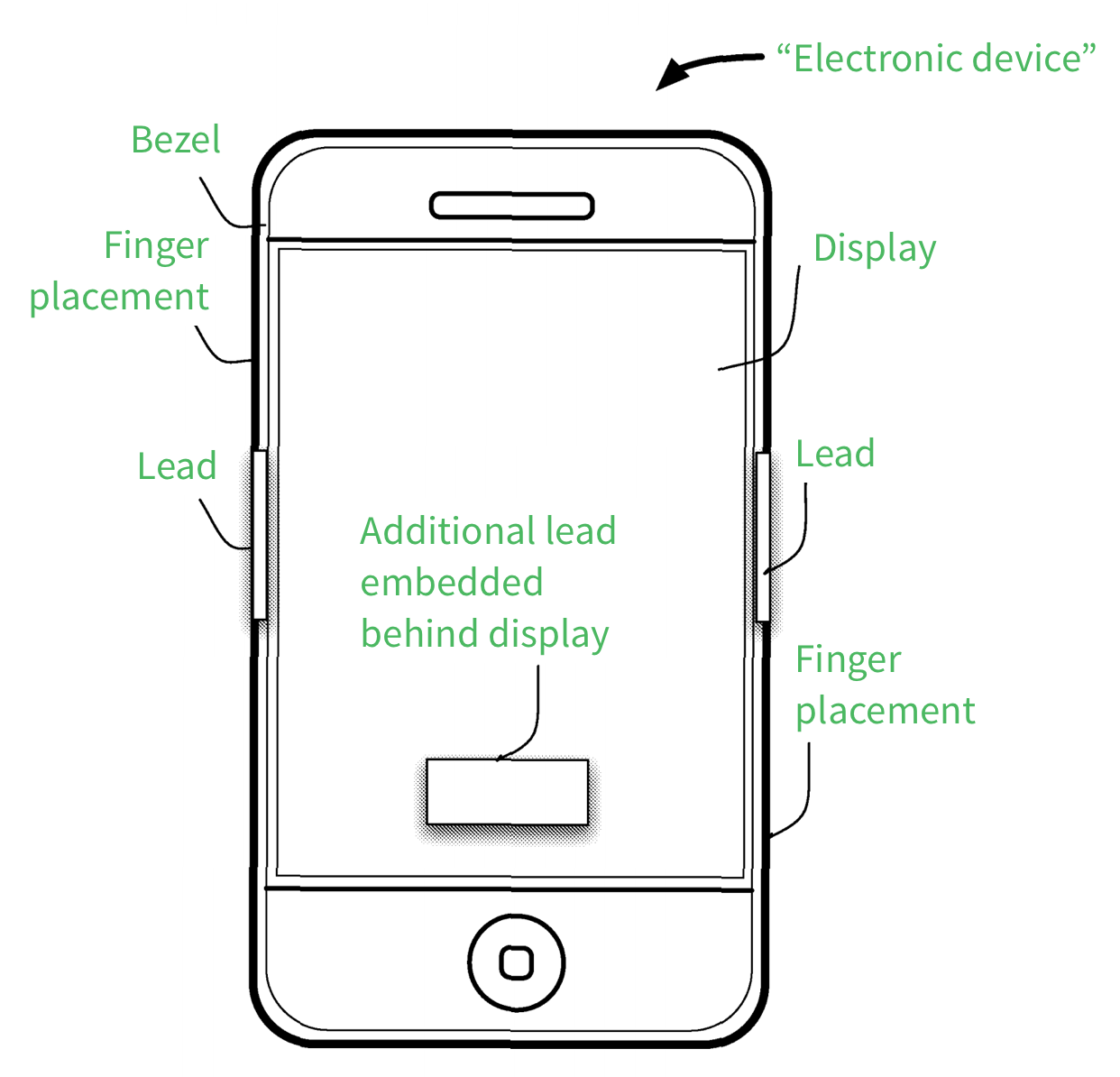
In 2009, Apple filed a patent for a “seamlessly embedded heart rate monitor” and was ultimatelyawarded the patent by the United States Patent and Trademark Office (USPTO) in late 2013. The patent covers the use of embedded sensors to measure a user’s heartbeat, heart rate, or other cardiac signals. The patent further covers locating the leads in accessories, such as headphones (or perhaps a wearable device).Embedded Heart Sensor

Source: USPTO, annotations by Rock Health

Apple has also explored using personal area networks that would cover items such as the “event monitor device” (EMD) that would include an adhesive strip, a processor, a detector, and a communications port. The patent provides an example of monitoring an individual’s heart rate for events over a threshold (e.g., 180 beats per minute). While such a device sounds familiar to iRhytm’s Zio patch, the patent suggests Apple is looking more broadly into the development of an ecosystem of products that would be anchored by a single wearable platform device (likely wrist-worn), and augmented through various hardware sensors that could live in, on, or around the body and communicate with the primary device.

EMD Heart Rate Monitor Patch

Source: USPTO, annotations by Rock Health

Most recently, Patently Apple has uncovered a patent application for a medical app that can monitor physiological data (e.g., arrhythmias), and either store it on a device like an iPhone and/or transmit the data to health facilities via a communication network. The patent was filed by Naeem Ansari, who was also behind a recent financial system patent that was ultimately assigned to Apple.

5.  Check-in with the Food and Drug Administration (FDA).

Senior Apple executives met with FDA leadership, including the Director of the Agency’s Center for Devices and Radiological Health, which has oversight of medical devices, and Bakul Patel, the author of the FDA’s guidance on mobile medical applications. Patel’s guidance indicates that any mobile technologies which are intended for use in the diagnosis of a medical condition, or in the cure, mitigation or treatment of one will be regulated as medical devices.

Marion Nestle on Bariatric Surgery

The seething, self-serving, medical-pharma-device-publishing complex just can’t help itself some times.guess they picked the wrong academic to play spiv for them on this occassion…

Is surgery really the best way to deal with obesity?

Is surgery really the best way to deal with obesity?

I received an e-mail message from Dr. Justine Davies, the editor of The Lancet Diabetes & Endocrinology, announcing a series of review articles on bariatric surgery for treatment of obesity.

Bariatric surgery, she says,

is the most effective treatment for both obesity and type 2 diabetes. In many people with type 2 diabetes, bariatric surgery not only limits disease progression, but also reverses complications.

She asks: So why is this procedure not being used more often to treat
patients with obesity?

Bariatric surgery has substantial benefits in terms of weight loss, metabolic status, and quality of life. It is safe and effective, and the future savings made through prevention of comorbid diseases could counterbalance its high cost. The surgery should, therefore, be available as an option to use when appropriate, and not only when all other options have been eliminated. Bariatric surgery offers a real opportunity for preventing comorbid diseases and complications of obesity. If it is only used as a final resort, this opportunity will be missed.

I can think of several good reasons: pain and suffering, treatment complications, questionable long-term prognosis, and cost, for starters.

Prevention is a better option.

If only we knew how….

Here are the papers:

Menadue on cutting waste and costs in health

  • A universal health scheme does not have to be free. But it must be fair and efficient.
  • We need to change the perverse incentives, such as fee-for-service, which is associated with bulk-billing. Clinicians are rewarded by the number of transactions rather than health outcomes.
  • FFS is particularly inappropriate for chronic care like mental health and services with high fixed costs and low variable costs, such as imaging.
  • The government should move away from fee for service and set budgets for general practitioners when they prescribe drugs, order pathology tests or imaging services.
  • We need more doctors on salaries and capitation payments for caring for patients-not on a service by service basis.
  • The government should abolish the subsidy for private health insurance which costs all up about $6-7 billion p.a.
  • The real elephant in the room in health care cost reduction is avoidable mistakes, including deaths. They are euphemistically called “adverse events”. But Ministers, clinicians and managers do their best to avoid the issue. Based on earlier surveys in NSW and SA I estimated, very conservatively the cost of avoidable mistakes in our health sector at $5b pa (see my blog of June14, 2013).

From: http://johnmenadue.com/blog/?p=1217

More thoughts on cutting waste and costs from others:

  • Doggett: http://johnmenadue.com/blog/?p=1231
  • Dwyer: http://johnmenadue.com/blog/?p=1221
  • McAuley: http://johnmenadue.com/blog/?p=1219
  • Webster: http://johnmenadue.com/blog/?p=1223

John Menadue. Cutting waste and costs in health.


The Minister for Health, Peter Dutton, has said that we must reduce waste and reduce costs in health. I agree. In 2011/12 total health expenditure in Australia was $140b up from $83b in 2001/2. Costs are rising rapidly, partly due to population increase.

In a paper in July 2007 I estimated that there was at least $10 billion in possible savings and productivity improvements in health. That represented about 10% of our total health costs in that year. I have spoken and written extensively on the matter. See my web site.

It is important however that as we work to reduce waste and costs we do it in a way that is fair to all and does not prejudice quality care.

But to reduce waste and costs requires political will to stare down the powerful interests and rent seekers that are determined to protect their territory and their high costs –e.g.  the AMA, the Private Health Insurance firms, the Pharmacy Guild of Australia and Medicines Australia. In the past no governments has been game to tackle these vested interests.

The lack of accountability in health

Despite the rapid increases in costs and escalating demand in the healthcare industry, there is no accountability in any meaningful way for what the health industry produces. Doctors are accountable for malpractice but not for their overall performance particularly in general practise. This is despite the fact that taxpayers pay 80% of doctors’ incomes. Taxpayers have a legitimate reason to ask – ‘Are we getting value for money?’  In a survey a couple of years ago by the Health Council of Canada, 97% of over 1,800 senior respondents said that healthcare providers should be required by law to reach certain service benchmarks in such areas as patient outcomes , the use of preventive strategies like screening and waiting times.

The Council also asked the group ‘Do you believe healthcare in Canada will improve if the government spends more money on healthcare?’  58% said ‘no’. There is the same lack of accountability in Australia.

Managing the demand for health services

The demand for health services is increasing rapidly across all age groups and not just among the old. We are over-diagnosed and over-treated. In 1984-85, medical services per head were 7.1 per annum. In 2007-08 they were 13.1 per annum – about double. The trend continues. We need to address this over servicing particularly by GPs and specialists such as pathologists and radiologists.

  • We must accept that we cannot have all that we want in health and that governments, in consultation with the community, have to set priorities. Can we afford continuing existing levels of funding for IVF and end-of-life treatments at the expense of funding for mental health and indigenous health?
  • We need to rationalise our co-payments to make them efficient and equitable. We all should take more responsibility for the way we use health services, particularly as we are now much wealthier than we were 30 years ago when Medicare was introduced. A universal health scheme does not have to be free. But it must be fair and efficient. But co-payments are a dog’s breakfast! We pay about 18% of health costs out of our own pockets, but there is very little rhyme or reason in how this is done. The $6 GP levy would make the confused situation worse.
  • We need to change the perverse incentives, such as fee-for-service, which is associated with bulk-billing. Clinicians are rewarded by the number of transactions rather than health outcomes. FFS is particularly inappropriate for chronic care like mental health and services with high fixed costs and low variable costs, such as imaging. The government should move away from fee for service and set budgets for general practitioners when they prescribe drugs, order pathology tests or imaging services. We need more doctors on salaries and capitation payments for caring for patients-not on a service by service basis.
  • We need to tackle the wide variations in the incidence of clinical practice across the country, e.g. caesarean sections and cataracts. Medicare should be much more proactive in exposing and limiting very expensive and inexplicable variations in clinical practice.

Getting costs down

  •  The government should abolish the subsidy for private health insurance which costs all up about $6-7 billion p.a. This subsidy favours the wealthy, is inefficient, has underwritten rising specialist fees through gap insurance, has not taken the pressure off public hospitals and has weakened Medicare’s ability to control costs. The immediate abolition of this subsidy would do more to improve our health system than almost anything else. This is corporate welfare big time-more even the welfare to the motor industry.
  • We need a more productive workforce. Health is the largest and fastest growing sector in the Australian economy. Despite all the talk of improving productivity in Australia no-one has been game to take on the entrenched privileges in the health workforce.Where is the honesty and consistency here? The blue collar workforce is fair game but not doctors and lawyers. We need expanded roles across the board particularly for nurses, pharmacists, allied health workers and ambulance officers. The Productivity Commission in its February 2007 report estimated that a 5% improvement in the productivity of health services would deliver savings of about $3 billion p.a. This is a very conservative estimate. The health sector in Australia is rife with demarcations and restrictive work practices. eg 5 % of normal births in Australia are delivered by mid wives. In the Netherlands it is 70%, in the UK 50% and in NZ 95%. We have a few hundred nurse practitioners when there should be thousands. The work practices at Holden, Toyota and Ardmona are light years ahead of the work practices in the health sector.
  • We could save about $2 billion p.a. in drug costs if we paid drug suppliers the same prices that are paid in NZ. See my blog of January 17.We also pay a high price for the protection of  pharmacists through the 5000 limit on the number of community pharmacies and the restrictions on where new pharmacies can be located. Pharmacies cannot be established in supermarkets.
  • We need to raise productivity in our hospitals. The Productivity Commission suggests that the productivity gap from best practice in public hospitals ranges from 3% to 89%. In private hospitals the range is 22% to 37%.  There is major governance problems in many hospitals with a dis- connect between management and clinical functions. Running hospitals is very difficult with clinicians coming and going from private practise like the cottage industries of old.
  • The Commonwealth/State fragmentation in healthcare results in blame-shifting, the evasion of responsibility and higher costs. If for example the Commonwealth Government or a joint Commonwealth/State body had responsibility for all health care in a state, there would be a clear incentive for focus on treatment in the community and in homes to ensure that the high cost hospitals are really a last resort. They are now often a first resort.
  • The real elephant in the room in health care cost reduction is avoidable mistakes, including deaths. They are euphemistically called “adverse events”. But Ministers, clinicians and managers do their best to avoid the issue. Based on earlier surveys in NSW and SA I estimated, very conservatively the cost of avoidable mistakes in our health sector at $5b pa (see my blog of June14, 2013). Despite a great deal of money and effort there is no sign of improvement. Insiders won’t solve the problem Good people are caught in a bad system

We need to address waste and cost-cutting in a measured way. We should not panic, but we should get it done.  Australian healthcare costs are 9-10% of GDP. This is not high by world standards. It is below the OECD average. A major reason why we have been able to do better than others is that we have Medicare as a public insurer. One lesson is clear all around the world. The countries that have high levels of private health insurance, like the US, have high costs.


Making of Medicare – review by Andrew Podger

PDF of book review:
AHv38n1_BR1_MakingOfMedicare_PodgerBookReview

More important than the ‘ideas’ were the interests and institutions. The medical profession won the battle in the 1940s for fee-for-service against not only the advocates of a salaried national health system along the lines of the British National Health Service, but also against advocates of private approaches, who saw advantage in the friendly societies’ use of ‘lodge payments’, which were like capitation grants. The subsequent challenge, debated for decades (and still relevant today), was to find an affordable and equitable system consistent with fee-for-service. Whatever the balance of public and private health insurance, fee-for-service exacerbated the problem of ‘moral hazard’ where doctors, professing interest in their patients, are able to add to costs beyond what their patients or customers may be willing to pay because the costs are met by third party insurers.

Other interests that needed to be managed over the decades included the private health insurance industry, the union movement and the States. There were also factions within each interest group, most significantly between specialists and general practitioners (GPs) within the medical profession, and among a range of GP organisations. It remains the case that governments will wisely avoid taking on both the specialists and GPs at the same time, and will ensure any proposal provides at least one group with benefits they value, whether in terms of narrow self-interest or genuine improvements for their patients.