Category Archives: healthy habits

Sandra Aamodt at TED: Why diets don’t work

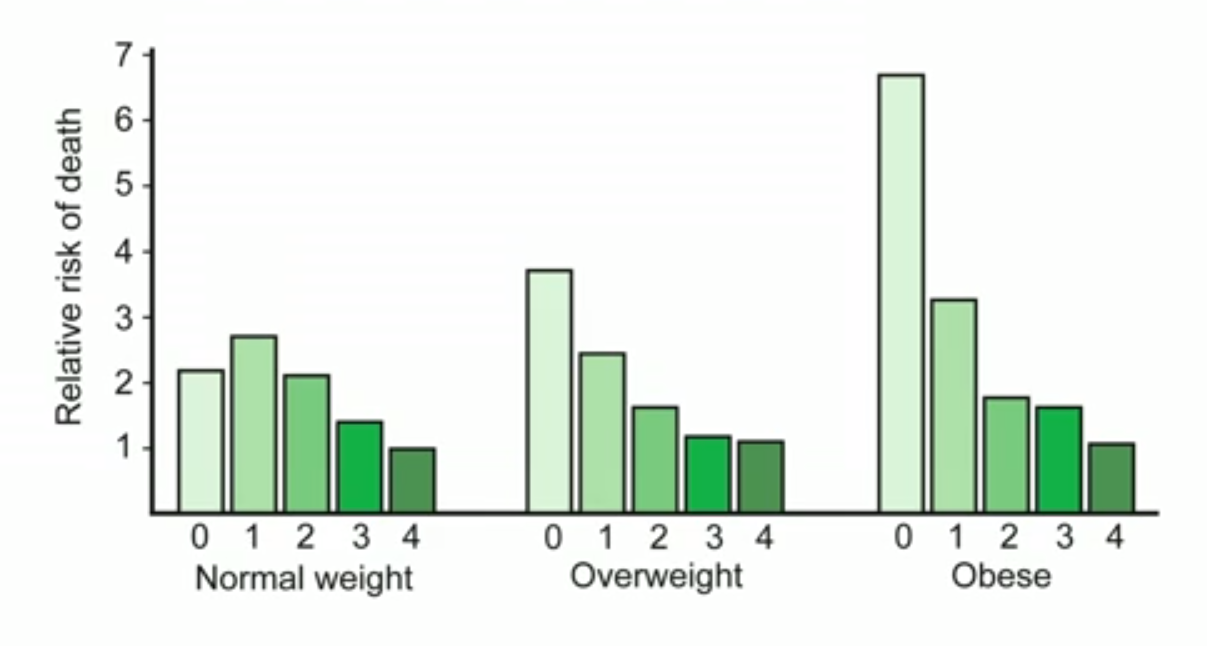
healthy_habits_relative_risk

http://www.ted.com/talks/sandra_aamodt_why_dieting_doesn_t_usually_work.html

I don’t really align with the message that dieting is futile, but I did like the section on mindful eating:

  • Learning to understand your body’s signals
  • Permission to eat as much as you want
  • Figure out what makes your body feel good
  • Regular meals without distractions
  • Focus on how your body feels when you start and stop eating
  • Let your hunger decide when you’re done

If diets worked, we’d all be thin already.


Consensus Action on Salt & Health (CASH) launches

And so it begins… the long march to effect entirely legitimate change.

With a strong and independent food regulator, the UK is the western democracy best placed to see this through. All strength to their arm – it’s going to be a doozy!

From Marion Nestle: http://www.foodpolitics.com/2014/01/action-on-sugar-to-the-food-industry-reduce-sugar-now/

Action on Sugar to the food industry: reduce sugar now!

A group of public health experts based mainly in Britain have announced a new anti-sugar campaign.

Called Action on Sugar, it is modeled on Great Britain’s campaign to get the food industry to gradually reduce salt in processed foods—voluntarily.  That campaign is considered to have led to a reduction of 25% to 40%.

Action on Sugar’s objective: Reduce sugar in packaged foods by 20% to 30% over the next 3 to 5 years.

Action on Sugar is a group of specialists concerned with sugar and its effects on health. It is successfully working to reach a consensus with the food industry and Government over the harmful effects of a high sugar diet, and bring about a reduction in the amount of sugar in processed foods. Action on Sugar is supported by 18 expert advisors.

As one of the experts put it, “Everywhere, sugary drinks and junk foods are now pressed on unsuspecting parents and children by a cynical industry focused on profit not health”—just like the tobacco industry behaves.

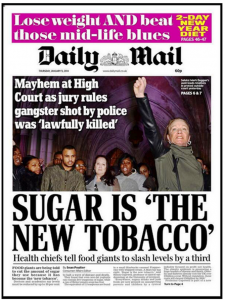
You have to love the British press:

New Picture


Source: http://www.actiononsugar.org/

  • To achieve a reduction in refined added sugar intake in the UK and ensure it does not contribute to more than 5% of total energy intake.

• To reach a consensus with the food manufacturers and suppliers that there is strong evidence that refined added sugar is a major cause of obesity and has other adverse health effects.

• To persuade the food processors and suppliers to universally and gradually reduce the added sugar content of processed foods.

• To ensure clear and comprehensive nutritional labelling of added sugar content of all processed foods and beverages, using the recommended traffic light system.

• To educate the public in becoming more sugar aware in terms of understanding the impact of added sugar on their health, checking labels when shopping and avoiding products with high levels of added sugar.

• To ensure that children are highlighted as a particularly vulnerable group whose health is more at risk from high added sugar intakes.

• To ensure the body of scientific evidence about the dangers of excessive refined added sugar consumption becomes translated into policy by the Government and relevant professional organisations.

• To conduct a Parliamentary campaign to ensure the Government and Department of Health take action, and that, if the food industry do not comply with the sugar targets, they will enact legislation or impose a added sugar tax.

• To work with other organisations and stakeholders in order to maximise the message about what is a healthy diet, ensuring this includes reducing the current national high added sugar intake.

• To work with experts in individual countries, the World Health Organisation (WHO) and individual ministries of health and other relevant bodies.

Jawbone health report: what kept us up late…

This is the first wave of publicity generated from aggregating data from health  trackers.

At some stage we’re going to have their data incorporated into weather reports to see how well we slept, how much weight we put on and how inactive we were.

Cant wait for that…

Jawbone’s health report highlights key events where people stayed up late.

Serena Chu Serena Chu on December 19, 2013.
As a means to better understand people’s sleep patterns, the Data Science team at Jawbone compiled a list of major world events and correlated it to specific outlier findings. The study shows that people lost an average of 6 minutes of sleep on the night of the Oscars. And back when Barack Obama was re-inaugurated, 29 minutes were lost.While some events directly affected the amount of sleep, other events, like the George Zimmerman trial and Miley Cyrus twerking at the VMA’s, made no impact. Jawbone’s sleep cycle analysis lets us view our habits and anomalies from a birds-eye view perspective.

In order to come to these conclusions, Jawbone collected over 47 million nights of sleep log from thousands of UP wearers in 2013. So what is an UP device? It is a system that tracks and organizes your movement and sleep data into an holistic report. You can purchase one here.

Take a look at the researcher’s results, some of the findings might catch you by surprise.

DataArt_Year-in-review-FINALSource: Jawbone 

Traffic lights don’t kill people…

Punchy demonstration of the effect of traffic lights on food purchases. No wonder unhealthy food industry is opposed to them…

http://www.rwjf.org/en/about-rwjf/newsroom/newsroom-content/2014/01/infographic-promoting-healthy-food-choices-using-traffic-light-guide.html?cid=XEM_A7869

Infographic: Using Traffic Lights to Promote Healthy Eating

A workplace cafeteria used “traffic light” labeling to indicate the healthiness of food and drinks and rearranged items so that healthier, green-labeled items were more visible. According to a study of 2,285 Massachusetts General Hospital employees who regularly used the cafeteria sales of healthy items jumped, and after two years, employees continued to make healthier choices.

Infographic: Can a Traffic Light Guide You to Make Healthier Choices?

Samsung receives FDA approval for fitness tracking app

captured mainly for the image – this is a heavy weight consumer electronics company making a big statement re. health – glucometers, blood pressure monitors, heart rate monitors… BOOM!

From: http://www.medgadget.com/2014/01/samsung-receives-fda-approval-for-the-s-health-fitness-tracking-app.html

samsung health app Samsung Receives FDA Approval for the S Health Fitness Tracking AppSamsung has received FDA 510(k) clearance for its fitness and calorie tracking app called S Health to be used as a cardiac signal transmitter, according to a report by Mobihealthnews. With this approval, the app can be synced with third party wireless blood glucometers, blood pressure monitors, and heart rate monitors. Samsung also sells a body scale and heart rate monitor that works seamlessly with the S Health app to register weight data and heart rate information for more accurate fitness tracking.

In order to use the S Health app, the user first enters relevant personal information such as age, sex, and weight, and then has the option to make use of the pedometer on phones such us Galaxy S4 and S5 to track the number of steps taken during the day. The app then uses this step data along with previously entered weight information to estimate the amount of calories burned. Users can enter “daily step goals” in the app to help motivate them to stay fit and active. The app also pulls room temperature and humidity information from the sensors in phones, such the Galaxy S4 and S5, to give the user a complete picture during their workouts.

Users can enter their calorie intake by selecting the type and portion of each meal and the app automatically determines the amount of calories consumed based on that data. Users can also tag each entry with a photo of the meal to help keep track of their entries.

With all the syncing capability, as well as calorie intake and fitness monitoring, users can not only have more accurate inputs for advanced calorie measurements, but can also see all their health information on the S Health dashboard and have access to pertinent cardiology metrics in the palm of their hands.

Product page: S Health…

MobihealthnewsSamsung gets FDA clearance for S Health app…

RAND: Top 5 Obesity Myths

  •  Obesity is not genetic
  • Obesity is not due to lack of self-control
  • Lack of fresh fruit and veg is not responsible
  • We are not too sedentary – we simply eat too much
  • Education about diet and nutrition will not conquer obesity
  • What’s really needed is regulation – for example, limits on marketing that caters to our addiction to sugar and fat — OH DEAR

The top five obesity myths

Published: December 29, 2013 – 1:01PM

The obesity epidemic is among the most critical health issues facing countries like the US and Australia. Although it has generated a lot of attention and calls for solutions, it also has served up a super-sized portion of myths and misunderstandings.

1. If you’re obese, you can blame your genes

As obesity rates have soared, some researchers have focused on individuals’ genetic predisposition for gaining weight. Yet, between 1980 and 2000, the number of Americans who are obese has doubled – too quickly for genetic factors to be responsible.

So why do we eat more than we need? The simple answer: Because we can. At home and at restaurants, a dollar puts more calories on our plates than ever before. Before World War II, the average US family spent as much as 25 per centof its total income on food – in 2011, it was 9.8 per cent. And people eat out now more than in the past. In 1966, the average US family spent 31 per cent of its food budget dining from home – in 2011, it was 49 percent. Because restaurant meals usually have more calories than what we prepare at home, people who eat out more frequently have higher rates of obesity than those who eat out less. Meanwhile, the food industry has developed tens of thousands of products with more calories per bite, as well as new, effective marketing strategies to encourage us to buy and consume more than necessary. We should blame these business practices, which are modifiable, for obesity rather than our genes, which are not.

2. If you’re obese, you lack self-control

According to a 2006 study, “research on restrained eating has proven that in most circumstances dieting is not a feasible strategy”. In other words: People won’t lose weight by trying to eat less because they can’t easily control themselves. Unfortunately, this puritanical view of personal resolve plays down how our surroundings and mental state determine what we eat.

Research shows that if we are overwhelmed with too much information or preoccupied, we have a tendency to surrender to poor dietary choices. In one study, for example, people asked to choose a snack after memorising a seven-digit number were 50 per cent more likely to choose chocolate cake over fruit salad than those who had to memorise a two-digit number. When adults in another study were asked to sample a variety of foods after watching a television show with junk-food commercials, they ate more and spent a longer time eating than a similar group watching the same show without the junk-food ads. In the same study, children ate more goldfish crackers when watching junk-food commercials than those who saw non-food commercials.

Our world has become so rich in temptation that we can be led to consume too much in ways we can’t understand. Even the most vigilant may not be up to the task of controlling their impulses.

3. Lack of access to fresh fruits and vegetables is responsible for the obesity epidemic

The US Department of Agriculture estimates that fewer than 5 per cent of Americans live in low-income communities without access to fresh food, but about 65 percent of the nation’s population is overweight or obese. For most of us, obesity is not related to access to more nutritious foods, but rather to the choices we make in convenience stores and supermarkets where junk-food marketing dominates. Since we are buying more calories than we need, eating healthily could be made more affordable by eliminating unnecessary cheaper low nutrient foods and substituting higher quality foods that may be slightly more expensive.

Obesity is usually the consequence of eating too much junk food and consuming portions that are too large. People may head to the produce section of their grocery store with the best intentions, only to be confronted by candy at the cash register and chips and soda at the end of aisles. Approximately 30 per cent of all supermarket sales are from such end-of-aisle locations. Food retailers’ impulse-marketing strategies contribute significantly to obesity across the population, not just for those who do not live near a green grocer or can’t afford sometimes pricier healthful choices.

4. The problem is not that we eat too much, but that we are too sedentary

According to the US Centers for Disease Control and Prevention, there was no significant decrease in physical activity levels as obesity rates climbed in the 1980s and 1990s. In fact, although a drop in work-related physical activity may account for up to 100 fewer calories burned, leisure physical activity appears to have increased, and Americans keep tipping the scales.

There is compelling evidence that the increase in calories consumed explains the rise in obesity. The National Health and Nutrition Examination found that people consume, on average, more than 500 more calories per day now than they did in the late 1970s, before obesity rates accelerated. That’s like having a Christmas dinner twice a week or more. It wouldn’t be a problem if we stuffed ourselves only once a year, but all-you-can-eat feasts are now available all the time. It’s nearly impossible for most of us to exercise enough to burn off these excess calories.

5. We can conquer obesity through better education about diet and nutrition

According to a physicians’ health study, 44 per cent of male doctors in the US are overweight. A study by the University of Maryland School of Nursing found that 55 per cent of nurses surveyed were overweight or obese. If people who provide health care cannot control their weight, why would nutrition education alone make a difference for others?

Even with more information about food, extra-large portions and sophisticated marketing messages undermine our ability to limit how much we consume. Consider Americans’ alcohol consumption: Only licensed establishments can sell spirits to people older than 21, and no alcohol can be sold in vending machines. Yet there are very few standards or regulations to protect Americans from overeating.

In the 19th century, when there were no controls on the quality of drinking water, infectious disease was a major cause of death. Once standards were established, the number of these fatalities plummeted. Similarly, if Americans did not live in a world filled with buffets, cheap fast food, soft drinks with corn syrup, and too many foods with excess fat, salt and sugar, the incidence of obesity, heart disease, high blood pressure and diabetes probably would plummet. Education can help, but what’s really needed is regulation – for example, limits on marketing that caters to our addiction to sugar and fat.

The Washington Post

This story was found at: http://www.smh.com.au/lifestyle/diet-and-fitness/the-top-five-obesity-myths-20131229-301ch.html
Future Diets Report

  • with wealth comes an increase in animal products, fat and sugar, but globalisation is not leading to a convergence towards a single international norm with income becoming a weaker determinant of diet over time – this allows scope for public policy to intervene
  • Trajectories are not pre-ordained; there is scope to  influence the evolution of diet to get better outcomes for health and agriculture.
  • This has never been attempted, with the rare exception of the wartime rationing in Britain, which stands out as an unusual natural experiment that  led to better health; but one that the British public were delighted to abandon once supplies had been
    restored after the Second World War.
  • Studies such as that of Cecchini et al. (2010) show large benefits compared to costs from measures to influence people to  adopt healthier diets.
  • A final comment (and paradox): interest in diet has never been stronger in high-income countries as  we obsess about our waistlines, worry about the social impacts of the marketing strategies of (very) large food retail chains, and enthuse over the culinary art and tradition shown in countless television programmes. Scientifically, a plethora of papers have been drafted in the past 10 years that ponder the  rise of obesity worldwide and its implications.
    It seems, then, that it is only a matter of time before people will accept and demand stronger and effective measures to influence diets. When that time comes, we will need the evidence – provided in a very preliminary way by this review – on the main problems of emerging diets, and which policies  (and combinations of policies) will be most effective in addressing the emerging challenges.
  • overweight and obese in developing countries grew from 250M in 1980 to almost a billion (mostly Indians) in 2008
  • consumption of sugar has risen 20% per person between 1961 and 2009
  • 1 in 8 people (852m) in poor countries do not have sufficient access to food
  • 1/3 of infants in the developing world are stunted
  • 2 billion affected by micro-malnutrition
  • this impacts on the number of people developing certain types of cancers, diabetes, strokes and heart attacks
  • politicians are fearful of interfering in the dinner table, combined with powerful lobbying
  • South Korea has seen an increase in fruit and vegetable consumption after publicity, social marketing and an education campaign including large-scale teaching of women in preparing traditional, low-fat, high-vegetable meals

Future Diets Report (PDF):  http://www.odi.org.uk/sites/odi.org.uk/files/odi-assets/publications-opinion-files/8776.pdf

Source: http://www.foodnavigator-asia.com/Markets/Obesity-is-a-weighty-issue-for-almost-1bn-in-developing-world

By RJ Whitehead, 06-Jan-2014

Related topics: Markets, Asian tastes

The number of overweight and obese adults in developing countries has ballooned from some 250m in 1980 to almost a billion today, with Indians forming a huge chunk of this number.

This figure is highlighted in a major new review by the UK’s Overseas Development Institute to expose the global scale and consequences of overweight and obesity, and what it calls governments’ failure to address this growing crisis.

The Future Diets report is an analysis of public data detailing what the world eats. It selected five middle-income countries—India, China, Egypt, Peru and Thailand—as case studies to illustrate changes in dietary trends.

One in three overweight

The results highlight that the number of adults who are obese or overweight in the developing world more than tripled between 1980 and 2008, while in richer countries the figure has risen by over 200 million. One in three of the world’s adults are now overweight or obese, it found.

According to ODI research fellow Steve Wiggins, who authored the report, the growing rate of overweight and obesity in developing countries is alarming.

On current trends, globally, we will see a huge increase in the number of people suffering certain types of cancer, diabetes, strokes and heart attacks, putting an enormous burden on public healthcare systems,” Wiggins said, warning governments that they are not doing enough to tackle the growing crisis.

The percentage of obese and overweight in India rose from about 9% of the population in 1980 to 11% in 2008.

India’s consumption of animal products is approaching that of China’s in terms of its contribution to the average plate, but here the increase is almost entirely in milk consumption, with only limited increases for meat,” the report said.

Many Indians are vegetarian, avoiding beef or pork for cultural and religious reasons. The consumption of pulses remains relatively high in India, although it has been on the decline.”

Politicians fearful of meddling

Wiggins believes that the rise in obesity is partly due to politicians’ reluctance to interfere at the dinner table, along with the powerful influence of farming and food lobbies in the developing world and a large gap in public awareness of what constitutes a healthy diet.

Governments have focused on public awareness campaigns, but evidence shows this is not enough. The lack of action stands in stark contrast to the concerted public actions taken to limit smoking in developed countries.

Politicians need to be less shy about trying to influence what food ends up on our plates. The challenge is to make healthy diets viable whilst reducing the appeal of foods which carry a less certain nutritional value.”

However, the report does cite some successful examples of governments’ changing diets for the better. In South Korea, for example, policies that have led to an increase in fruit and vegetable consumption largely thanks to a publicity, social marketing and education campaign, including large-scale training of women in preparing traditional low-fat, high-vegetable meals.

Analysis of existing data shows that, amongst others, since 1980 overweight and obesity rates have almost doubled in China.

One indicator of changing diets is an increase in the consumption of sugar. Sugar and sweetener consumption has risen by over one-fifth per person globally from 1961 to 2009.

Fat consumption is also an issue. Among developing countries the highest consumption of fat is in East Asia, however industrialised countries still have much higher levels of fat consumption—often more than double.

Worryingly, despite a 50 per cent increase in the amount of food sourced from animals and a doubling in the quantity of fruit and vegetables being harvested, the report also notes that one in eight people (852m) in poor countries still do not have enough food to satisfy their basic needs.

WHO leaks sugar report – industry will be displeased

  • WHO will recommend sugar be limited to 5 teaspoons per day or 5% of total calories (current AU consumption around 35-45 teaspoons)

Source: http://www.raisin-hell.com/2014/01/the-world-health-organisation-has-taken.html

Sunday, January 5, 2014

The World Health Organisation has taken a tough stand on sugar. It’s about time we listened.

Last week the WHO (World Health Organization) leaked a draft report about sugar. The report will tell the world’s health authorities that they should be severely limiting the amount of sugar we all eat. It will recommend that we consume no more than 5 teaspoons of sugar a day. Given the average Australian is putting away somewhere closer to 35-45 teaspoons a day, it’s a very big call indeed.
The WHO is the health policy unit of the United Nations. Its aim is provide evidence based leadership on health research. It is well funded, free from corporate influence and motivated entirely by a desire to ensure that the 92 UN member countries get the best possible, evidence based, health advice. The WHO doesn’t run a Tick program or receive sponsorship from the processed food industry. Indeed it has even recently taken the extraordinary step of banning one ‘research’ group sponsored by industry from participating in its decision making processes.
Shrinath Reddy, a cardiologist and member of the WHO panel of experts, told the Sunday Times the WHO is moving on sugar because “There is overwhelming evidence coming out about sugar-sweetened beverages and other sugar consumption links to obesity, diabetes and even cardiovascular disease.”
The worldwide burden for those diseases is accelerating very quickly. According to a new report out this week the number of overweight and obese in the developing world has quadrupled since 1980.
A billion people in the developing world are now on the chronic disease express. But don’t worry, we still win. Less than a third of the population in China and India is overweight compared to our two thirds or more. They are just starting to get the hang of this Western Diet Thingy, so expect very big rises in the very near future.
The WHO have looked dispassionately at the evidence and have seen the tsunami of human misery caused by sugar coming for more than a decade They publicly warned that sugar was strongly implicated in obesity, type II diabetes, hypertension and heart disease in 2003.
They then took the extraordinary step of telling member governments that they should ensure their populations limited sugar consumption to a maximum of 10% of total calories (around 10 teaspoons of sugar a day – the same amount you would find in a Coke or a large Apple Juice). They did this despite an overt and vicious public campaign conducted by the Food industry.
The US sugar lobby demanded that the US Congress end its $406 million funding of the WHO. This is the same WHO that co-ordinates global action against epidemics like HIV, Bird Flu and SARS. But the US food industry wanted it destroyed because it dared to suggest we eat less sugar.
The lobbying behind the scenes was even more ruthless. Derek Yach, the WHO Executive Director who drove the sugar reduction policy work told a British documentary crew in 2004, that millions were spent trying to torpedo the policy. US Senators wrote directly to the WHO threatening its very existence. They also threatened the Food and Agriculture Organisation (a sister UN department concerned with food production) with a cut in funding.
In the end the food industry campaign paid off. The WHO removed its 10% recommendation from the final text of its recommendation. It was watered down to a suggestion that people ‘cut the amount of sugar in the diet’.
As one of the people involved at the time, Professor Phillip James, Chairman of the International Obesity Taskforce, predicted “we’ll end up with nice little policies telling [us] to have ‘just a bit less sugar and a little more balanced diet’ the nonsense that’s gone on since the Second World War during which time we’ve had this vast epidemic of heart disease, diabetes and obesity.”
Even the briefest glance at the official dietary guidance on sugar in Australia or the UK will tell you Professor James wasn’t too far from the mark with his prediction. Our guidelines are stuffed with words like ‘moderation’ and ‘balanced diet’ when it comes to sugar.
But the thing about evidence is, it doesn’t go away. And in the 10 years since the WHO last tried to save us from sugar, the evidence has become overwhelming (to quote Dr Reddy).
The WHO got a serious kicking when they tried to suggest a 10 teaspoon upper limit on sugar consumption, so you can imagine that the evidence they have reviewed must be truly overpowering to have them step up to the plate again. But this time they want the limit to be 5% (5 teaspoons) or less. I hope they’re wearing their flak jackets because I suspect a whole heap of blood money from the processed food industry is pouring into ‘lobbyists’ pockets as we speak.
The WHO is not running down sugar because it hates sugar farmers. It is not doing it because it likes getting mauled by the US Government (and its sponsors). It’s doing it because we will all suffer immensely if we don’t act on its advice.
I don’t know if the WHO can withstand the punishment they are about to receive. And I have no confidence that their recommended limit will make it through the firestorm of food industry sponsored ‘science’ which will suddenly surface. But I do know that when good people decide the evidence is so powerful that they should say it anyway, then the rest of us better be bloody listening.