Category Archives: rapid learning health systems

Weekend operations more dangerous


http://www.independent.co.uk/life-style/health-and-families/health-news/death-more-likely-aftera-weekendoperation-weekly-dip-in-recovery-rates-worldwide-proves-need-for-a-sevenday-nhs-9466802.html

Death more likely after a weekend operation: Weekly dip in recovery rates worldwide proves need for a ‘seven-day NHS

Global study involving 55m patients reveals deaths significantly more likely following Saturday surgery

As the NHS prepares to enter an era of seven-day working, data from 72 different research projects covering more than 55 million patients found that the “weekend effect” is international. Researchers from Tohoku University, Japan, who analysed worldwide hospital death rates, said the most likely explanation for the results was poorer quality care at weekends.

Their findings, to be presented today at a meeting of leading European anaesthesia specialists in Stockholm, are supported by another study which discovered similar concerns about mortality levels at Berlin’s hospitals. Researchers at the Charité medical school found death rates can be affected by not only the day of the week, but the time of year and even whether surgery is carried out in the morning or the afternoon. The findings, based on an analysis of nearly 220,000 patients treated at two of the university’s hospitals between 2006 and 2011, show that mortality was higher in the afternoons, at weekends, and peaked in February.

Dr Felix Kork of Charité said the precise causes are unknown. “It is speculation, but in the afternoon it may be that the surgeries are more likely to be urgent than in the morning, although we tried to control for that factor. It may also be that the human immune system reacts differently at different times of the day, but there is not a lot of data supporting that theory. February is usually a time when many people are ill due to viral infections – that may have an influence on the outcomes.”

He also suggested that seasonal hormonal rhythms, for instance of the “sleep hormone” melatonin, might be affecting the performance of staff and surgical responses of patients in February, but said this theory was “speculative”.

NHS England has already acknowledged that hospital care suffers at the weekends, and plans are in train to ensure more senior doctors are available to prevent problems and complications escalating into life-threatening situations. Plans for a “seven-day NHS” are also in place in Scotland and Wales.

Last year, a study in the British Medical Journal provided evidence to support long-standing fears that surgery in the NHS was more dangerous at the weekend. The study, led by Dr Paul Aylin of the Dr Foster Unit, the Imperial College research team which has pioneered the publication of hospitals’ surgical outcomes data, revealed that patients who had an operation on Friday or Saturday were 44 per cent or 82 per cent more likely to die within 30 days than those who had surgery on a Monday.

It also showed the risks of surgery became progressively higher from Monday to Saturday, although only 4.5 per cent of elective procedures are carried out at weekends, and the average mortality risk for such procedures is low – 0.67 per cent. Evidence has also shown patients admitted to NHS hospitals at the weekend, not necessarily for surgery, also have a higher mortality risk.

Commenting on the new studies, Dr Aylin said they added up to “powerful” evidence of a global problem in healthcare. “The German study is interesting in raising afternoon surgery as an issue, but as the authors acknowledge, it may be that ‘the patients treated in the afternoon and on the weekends were more severely ill’,” he said.

“The Japanese study is powerful in that it combines the results of 72 studies from around the world …. Both studies acknowledge the differences could reflect poorer care or simply that patients admitted at these times were more severely ill. More research is needed to find out exactly what contributes to higher mortality at weekends. Is it lack of clinical staff, nursing staff, diagnostic services, other hospital resources?”

NHS England has decided that the numbers and degree of seniority of staff at weekends is to blame. Reforms announced by NHS England’s medical director, Sir Bruce Keogh, at the end of last year could see more consultants, and many other NHS staff, made available at weekends. However, the plans could cost between £1bn and £2bn, and many in the health service have raised concerns that this may be unaffordable, given the huge financial pressure already faced by NHS trusts.

Wired Health – Proteus Digital Pill Presentation

Proteus occupy an interesting position… ingestibles are the ultimate in wearables. It’s smart also to be backed a big flailing incumbent player. It will be interesting to see if this stuff works.

http://www.proteus.com/andrew-thompson-on-transforming-healthcare-at-wired-health-2014/

Andrew Thompson on transforming healthcare at Wired Health 2014

Published On: May 5, 2014

Watch Proteus CEO Andrew Thompson present at Wired Health 2014 on transforming healthcare through digital medicines:  http://bit.ly/1lS7RLe 

WIRED Health is a one-day summit designed to introduce, explain and predict the coming trends facing the medical and personal healthcare industries. The inaugural event was held on Tuesday April 29, at the new home of the Royal College of General Practitioners, 30 Euston Square, London.Andrew Thompson at Wired

Economist: US Medicare Fraud


New word: A Pill Mill

http://www.economist.com/news/united-states/21603078-why-thieves-love-americas-health-care-system-272-billion-swindle

Health-care fraud

The $272 billion swindle

Why thieves love America’s health-care system

INVESTIGATORS in New York were looking for health-care fraud hot-spots. Agents suggested Oceana, a cluster of luxury condos in Brighton Beach. The 865-unit complex had a garage full of Porsches and Aston Martins—and 500 residents claiming Medicaid, which is meant for the poor and disabled. Though many claims had been filed legitimately, some looked iffy. Last August six residents were charged. Within weeks another 150 had stopped claiming assistance, says Robert Byrnes, one of the investigators.

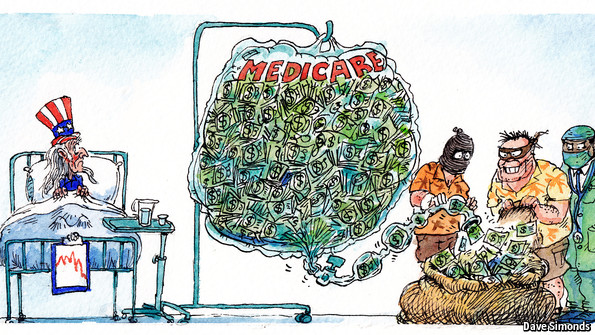
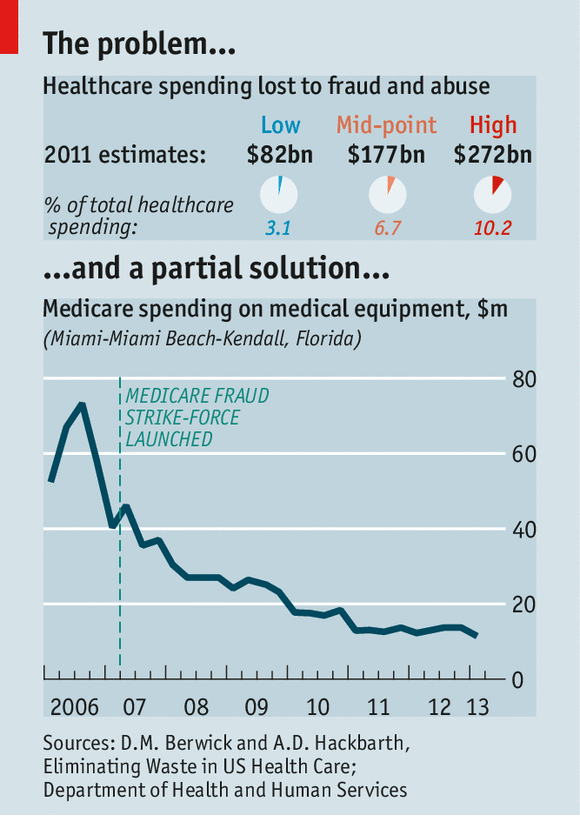
Health care is a tempting target for thieves. Medicaid doles out $415 billion a year; Medicare (a federal scheme for the elderly), nearly $600 billion. Total health spending in America is a massive $2.7 trillion, or 17% of GDP. No one knows for sure how much of that is embezzled, but in 2012 Donald Berwick, a former head of the Centres for Medicare and Medicaid Services (CMS), and Andrew Hackbarth of the RAND Corporation, estimated that fraud (and the extra rules and inspections required to fight it) added as much as $98 billion, or roughly 10%, to annual Medicare and Medicaid spending—and up to $272 billion across the entire health system.

Federal prosecutors had over 2,000 health-fraud probes open at the end of 2013. A Medicare “strike force”, which was formed in 2007, boasts of seven nationwide “takedowns”. In the latest, on May 13th, 90 people, including 16 doctors, were rounded up in six cities—more than half of them in Miami, the capital city of medical fraud. One doctor is alleged to have fraudulently charged for $24m of kit, including 1,000 power wheelchairs.

Punishments have grown tougher: last year the owner of a mental-health clinic got 30 years for false billing. Efforts to claw back stolen cash are highly cost-effective: in 2011-13 the government’s main fraud-control programme, run jointly by the Department of Health and Human Services (HHS) and the Department of Justice, recovered $8 for every $1 it spent.

As fraud-fighting has intensified, dodgy billing has tumbled in areas that were most prone to abuse, such as durable medical kit and home visits (see chart). Home-health fraud—such as charging for non-existent visits to give insulin injections—got so bad that the CMS, which runs the programmes, called a moratorium on enrolling new providers in several large cities last year. Since tighter screening was introduced under Obamacare, the CMS has stripped 17,000 providers of their licence to bill Medicare. Thousands of suppliers also quit after being required to seek accreditation and to post surety bonds of $50,000.

Economist_HealthcareFraud_20140531_USC154

Yet the sheer volume of transactions makes it easier for miscreants to hide: every day, for instance, Medicare’s contractors process 4.5m claims. In this context the $4.3 billion recovered by fraud-busters in 2013, though a record, looks paltry.

Better than cocaine

Fraud migrates. Take one popular scam: overbilling for HIV infusion, an outdated therapy that Medicare still covers despite the existence of cheaper, better alternatives. This scam waned in Florida after a crackdown, only to pop up in Detroit, run by relatives of the original perpetrators.

Fraud mutates, too. As old hustles are rumbled, fraudsters invent new ones. “We’ve taken out much of the low-hanging fruit,” says Gary Cantrell, an investigator at HHS—an example being the thousands of bogus equipment suppliers registered to empty shopfronts. Scams now need to be more sophisticated to succeed, he argues. Doctors, pharmacies, and patients act in league. Scammers over-bill for real services rather than charging for non-existent ones. That makes them harder to spot.

Some criminals are switching from cocaine trafficking to prescription-drug fraud because the risk-adjusted rewards are higher: the money is still good, the work safer and the penalties lighter. Medicare gumshoes in Florida regularly find stockpiles of weapons when making arrests. The gangs are often bound by ethnic ties: Russians in New York, Cubans in Miami, Nigerians in Houston and so on.

Stealing patients’ identities is lucrative. Medical records are worth more to crooks than credit-card numbers. They contain more information, and can be used to obtain prescriptions for controlled drugs. Usually, it takes victims longer to notice that their details have been pinched. The Government Accountability Office has recommended that the CMS remove Social Security numbers from Medicare cards to prevent fraud. It has yet to do so.

In one fast-growing area of fraud, involving pharmacies and prescription drugs, federal investigators have seen caseloads quadruple over the past five years. Elderly patients may receive kickbacks to sell their details to a pharmacist. He will then provide them with drugs they need while billing Medicare for costlier ones.

Paid recruiters scour nursing homes for accomplices. Some pharmacies also pay wholesalers to produce phoney invoices. Others bribe medical workers for leftover pills: in April a pharmacy-owner in Louisiana admitted to paying nursing-home staff a few hundred dollars a time to bring her unused drugs, which she repackaged and sold as new, billing Medicare $2.2m for the recycled meds between 2008 and 2013.

Another scam is to turn a doctor’s clinic into a prescription-writing factory for painkillers (or “pill mill”) and resell them on the street. A clinic in New York was recently charged with fraudulently producing prescriptions for more than 5m oxycodone tablets, which were sold locally for $30-$90 each. The alleged conspirators included doctors and traffickers who ran crews of “patients” so large that long queues sometimes formed outside the clinic. The doctors charged $300 per large prescription. One raked in $12m. To cover their backs they would ask for scans or urine samples purporting to show injuries. The fake patients typically obtained these from the traffickers at the clinic door.

False billing by pharmacies is rife. New York’s Medicaid sleuths have stepped up spot checks to see if the drugs in the back room square with invoices. But this is a lot of work, so most outlets are never checked.

Dozens of operators of ambulances and ambulettes (vans designed to take wheelchairs) have been caught offering kickbacks to patients to pretend they can’t walk. This lets them qualify for “emergency” pick-ups, for which the company can charge $400 per patient. New York has clamped down with roadside checks. But in one case, word that a checkpoint had been set up spread so quickly—as drivers called each other and a local Russian-language radio station put out a warning—that the number of ambulettes on the main street “went from several to none in a few minutes as they re-routed down side streets”, says Chris Bedell, who took part.

This sort of pavement-pounding investigative work remains important. Another approach is the “desk audit”, where possible overpayment is identified but the only way to ascertain losses is to sift through heaps of records manually. Florida’s Agency for Health Care Administration (AHCA) has recovered up to $50m a year solely from hospitals billing for treatment of illegal aliens that is wrongly coded as “emergency care”. But the work is labour-intensive. Data-crunching technologies are increasingly being used to complement the human eye. “When I started in 1996 we had little access to data,” says HHS’s Mr Cantrell. “It had to be requested ad hoc from CMS contractors.” Now a central database houses near-real-time information for Medicare. This helps the 300 workers at the inspector-general’s office who are trained in data analytics to “triage” the tips that flow in. “We receive far more than we can investigate closely,” says Mr Cantrell.

The CMS is still getting to grips with a new predictive-analysis system, which was introduced in 2011 to catch Medicare fraud earlier and is modelled on tools used by credit-card firms. This identified $115m of dodgy payments in 2012, its first full year. (The number for the second year has yet to be released.) Another useful tool is voice-recognition technology. In Florida, health workers who conduct home visits have to call in from the patient’s phone during each appointment to have their voice pattern matched against the one stored electronically. This has greatly reduced billing for non-visits.

Technology is no panacea, however. Medicare’s computers were pumping out thousands of payments a year for patients who had been struck off the programme before receiving their treatment, until human hands began to intervene this year. The electronification of patient records can allow “cloning”, in which treatments automatically trigger excessive billing codes by defaulting to set templates.

This is the medical world’s “dirty secret”, says John Holcomb of the Texas Medical Association. Everyone talks about it in the doctor’s lounge, but few complain. (What doctors do complain about is the complexity of the bill-coding system: see article.) Moreover, there are gaps in the data picture—some of which could grow. Federal investigators complain that there is no proper national repository for Medicaid information, which is held state-by-state.

A bigger worry is that, as ever more Medicare and Medicaid beneficiaries move to “managed  care” (privately administered) plans, government sleuths will have access to less data. This could lead to lower fraud-related recoveries.

Efforts have been made to improve information-sharing between government and private insurers, including the creation of a public-private forum, the National Health Care Anti-Fraud Association (NHCAA). But some insurers are reluctant to take part, fearing that being too open with their data would invite lawsuits over privacy. Fraudsters bank on public and private payers not working together to connect the dots, said Louis Saccoccio, the head of the NHCAA, at a recent hearing.

The NCHAA is pushing for federal immunity guarantees for insurers that share fraud-related information. On May 20th a bipartisan group of senators introduced a bill to make it easier for insurers to share data with Medicare. It would also require Medicare to check new providers for links to firms that have previously swindled the taxpayer (which you might have thought it was already doing).

Obamacare has had a big impact, says Shantanu Agrawal of the CMS. One thing it requires is that when a state kicks out a dodgy Medicaid provider, it shares that information with Medicare, and vice versa. Previously there were legal impediments to doing this, for some reason.

Resources are tight for investigators. New York has a Medicaid investigations division of 110 souls (including support staff) to scrutinise $55 billion of annual payments and 137,000 providers. Gloria Jarmon, an auditor with the HHS, told a recent hearing that budget cuts will probably force it to cut its oversight of Medicare and Medicaid by 20% in this fiscal year. “Everyone [in Congress] is excited that we bring in eight times more than we cost, but that hasn’t translated into more funding,” laments Mr Cantrell.

This squeeze makes it all the more important to enlist help. More than 5,000 old folk have joined “Medicare patrols”, which hold local meetings to raise awareness of common scams. A crucial part of the anti-fraud effort is the new, simpler Explanation of Benefits (summary statement) that lets recipients see who has billed the programme with their identification numbers. This is “a landmark change”, a CMS executive told Congress last year, adding: “Our best weapon in fighting fraud is our 50m Medicare beneficiaries.”

The case for eating steak and cream


http://www.economist.com/news/books-and-arts/21602984-why-everything-you-heard-about-fat-wrong-case-eating-steak-and-cream

Economist Book Review

The Case For Eating Steak and Cream

Shifting the argument

The Big Fat Surprise: Why Butter, Meat and Cheese Belong in a Healthy Diet. By Nina Teicholz. Simon & Schuster; 479 pages; $27.99. Buy from Amazon.com,Amazon.co.uk

“EATING foods that contain saturated fats raises the level of cholesterol in your blood,” according to the American Heart Association (AHA). “High levels of blood cholesterol increase your risk of heart disease and stroke.” So goes the warning from the AHA, the supposed authority on the subject. Governments and doctors wag their fingers to this tune the world over. Gobble too much bacon and butter and you may well die young. But what if that were wrong?

Nina Teicholz, an American journalist, makes just that argument in her compelling new book, “The Big Fat Surprise”. The debate is not confined to nutritionists. Warnings about fat have changed how food companies do business, what people eat, and how and how long they live. Heart disease is the top cause of death not just in America, but around the world. The question is whether saturated fat is truly to blame. Ms Teicholz’s book is a gripping read for anyone who has ever tried to eat healthily.

The case against fat would seem simple. Fat contains more calories, per gram, than do carbohydrates. Eating saturated fat raises cholesterol levels, which in turn is thought to bring on cardiovascular problems. Ms Teicholz dissects this argument slowly. Her book, which includes well over 100 pages of notes and citations, covers decades of nutrition research, including careful explorations of academics’ methodology. This is not an obvious page-turner. But it is.

Ms Teicholz describes the early academics who demonised fat and those who have kept up the crusade. Top among them was Ancel Keys, a professor at the University of Minnesota, whose work landed him on the cover of Time magazine in 1961. He provided an answer to why middle-aged men were dropping dead from heart attacks, as well as a solution: eat less fat. Work by Keys and others propelled the American government’s first set of dietary guidelines, in 1980. Cut back on red meat, whole milk and other sources of saturated fat. The few sceptics of this theory were, for decades, marginalised.

But the vilification of fat, argues Ms Teicholz, does not stand up to closer examination. She pokes holes in famous pieces of research—the Framingham heart study, the Seven Countries study, the Los Angeles Veterans Trial, to name a few—describing methodological problems or overlooked results, until the foundations of this nutritional advice look increasingly shaky.

The opinions of academics and governments, as presented, led to real change. Food companies were happy to replace animal fats with less expensive vegetable oils. They have now begun abolishing trans fats from their food products and replacing them with polyunsaturated vegetable oils that, when heated, may be as harmful. Advice for keeping to a low-fat diet also played directly into food companies’ sweet spot of biscuits, cereals and confectionery; when people eat less fat, they are hungry for something else. Indeed, as recently as 1995 the AHA itself recommended snacks of “low-fat cookies, low-fat crackers…hard candy, gum drops, sugar, syrup, honey” and other carbohydrate-laden foods. Americans consumed nearly 25% more carbohydrates in 2000 than they had in 1971.

In the past decade a growing number of studies have questioned the anti-fat orthodoxy. Ms Teicholz’s book follows the work of Gary Taubes, a science journalist who has cast doubts on the link between saturated fat and health for well over a decade—and been much disparaged for his pains. There is increasing evidence that a bigger culprit is most likely insulin, a hormone; insulin levels rise when one eats carbohydrates. Yet even now, with more attention devoted to the dangers posed by sugar, saturated fat remains maligned. “It seems now that what sustains it,” argues Ms Teicholz, “is not so much science as generations of bias and habit.”

Cth Fund: 40% of patient outcomes from social factors

Report: 1749_Bachrach_addressing_patients_social_needs_v2

http://www.commonwealthfund.org/publications/fund-reports/2014/may/addressing-patients-social-needs

As much as 40 percent of patient outcomes can be attributed to factors such as income, educational attainment, access to food and housing, and employment status—and low-income populations are particularly affected.

New Report Shows How Targeting Patients’ Social Needs Is Critical to Improving Quality and Reducing Costs

As public and private payers increasingly hold providers accountable for their patients’ health and health care costs and link payments to outcomes, providers are developing strategies to address the social factors that play so large a role in people’s health. As much as 40 percent of patient outcomes can be attributed to factors such as income, educational attainment, access to food and housing, and employment status—and low-income populations are particularly affected.

A new report prepared by Manatt Health Solutions for The Commonwealth Fund, The Skoll Foundation, and The Pershing Square Foundation explores the impact of social needs on health and the costs of care and identifies evidence-based strategies and interventions that can help providers target patients’ social needs, improve health, and reduce spending. The report examines payment models that incentivize or require providers to address not just their patients’ clinical needs but their social needs as well.

For providers unable or unwilling to invest in social interventions, the report suggests alternative opportunities for funding them. Research indicates that in addition to improving patient health, investing in these interventions can enhance patient satisfaction and loyalty, as well as satisfaction and productivity among providers.

Visit commonwealthfund.org to read Addressing Patients’ Social Needs: An Emerging Business Case for Provider Investment and learn about the variety of tools available to providers and the range of effective programs in the U.S. and abroad.


Addressing Patients’ Social Needs: An Emerging Business Case for Provider Investment

Extensive research documents the impact of social factors such as income, educational attainment, access to food and housing, and employment status on the health and longevity of Americans, particularly lower-income populations. These findings attribute as much as 40 percent of health outcomes to social and economic factors. Asthma is linked to living conditions, diabetes-related hospital admissions to food insecurity, and greater use of the emergency room to homelessness.

These findings are not lost on health care providers: 80 percent of physicians conclude that addressing patients’ social needs is as critical as addressing their medical needs. Yet until recently, providers rarely addressed patients’ unmet social needs in clinical settings.

However, changes in the health care landscape are catapulting social determinants of health into an on-the-ground reality for providers. The Affordable Care Act is expanding insurance coverage to millions more low- and modest-income individuals, and, for many, social and economic circumstances will define their health. Six years after analysts introduced the concept of the “Triple Aim,” its goals of improved health, improved care, and lower per capita cost of care have become the organizing framework for the health care system. As a result, growing numbers of providers are concluding that investing in interventions addressing their patients’ social as well as clinical needs makes good business sense.

The Economic Rationale for Investing in Social Interventions

Informed by the Triple Aim, public and private payers are introducing payment models that hold providers financially accountable for patient health and the costs of treatment. These models—including capitated, global, and bundled payments, shared savings arrangements, and penalties for hospital readmissions—give providers economic incentives to incorporate social interventions into their approach to care. For example, in October 2012, the Centers for Medicare and Medicaid Services penalized 77 percent of safety-net hospitals for excess readmissions of patients with heart attack, heart failure, or pneumonia. Meanwhile a review of 70 studies found that unemployment and low income were tied to a higher risk of hospital readmission among patients with heart failure and pneumonia.

To be certified as a patient-centered medical home (PCMH) or Medicaid health home, providers must integrate social supports into their care models. And these certifications almost always trigger higher levels of reimbursement. More than 40 states have adopted PCMH programs, providing important funding opportunities for qualified providers. Even if new payment models do not require social interventions, many providers have concluded that they are essential to achieving quality metrics and earning available revenue.

Beyond these direct economic benefits, providers that incorporate social supports into their clinical models can also reap indirect economic benefits. Patient satisfaction rises when providers address patients’ social needs, engendering loyalty. Patient satisfaction can also affect the amount of shared savings a provider receives from payers. Providers that include social supports in their clinical models also report improved employee satisfaction. And interventions that address social factors allow clinicians to devote more time to their patients, allowing them to see more patients and improving satisfaction among both patients and clinicians.

Strategies to Meet Patients’ Social Needs

A range of tools, both broad and targeted, are available to providers to address patients’ unmet social needs. Broad interventions—usually provided at primary care clinics—link clinic patients to local resources that can address their unmet social needs. For example:

  • Health Leads, which operates in hospital clinics and community health centers in six cities, enables health care providers to write prescriptions for their patients’ basic needs, such as food and heat. Trained volunteers who staff desks at the hospitals and clinics connect patients to local resources to address those needs. Across all sites, Health Leads volunteers addressed at least one need of 90 percent of patients referred to them.
  • Medical-Legal Partnerships (MLPs) place lawyers and paralegals at health care institutions to help patients address legal issues linked to health status. This program has had marked success: an MLP in New York City targeting patients with moderate to severe asthma found a 91 percent decline in emergency department visits and hospital admissions among those receiving housing services.

Targeted interventions, in contrast, link individuals with chronic or debilitating medical conditions to social supports as part of larger care management efforts. For example, in the Seattle-King County Healthy Homes Project, community health workers conduct home visits to low-income families with children with uncontrolled asthma. Urgent care costs for participants in a high-intensity intervention were projected to be up to $334 per child lower than among those receiving a less intensive intervention. The share of individuals using urgent care services also fell by almost two-thirds during the intervention.

Looking Forward

As more low-income people gain health care coverage, evidence on which interventions are most cost-effective in addressing their social needs and improving their health will grow, and value-based reimbursement will become standard across payers. With these changes in the health care landscape, the economic case for provider investment in social interventions will become ever more compelling.

This publication was supported in partnership with The Skoll Foundation and The Pershing Square Foundation.

Economist Daily Chart: Peak Fat

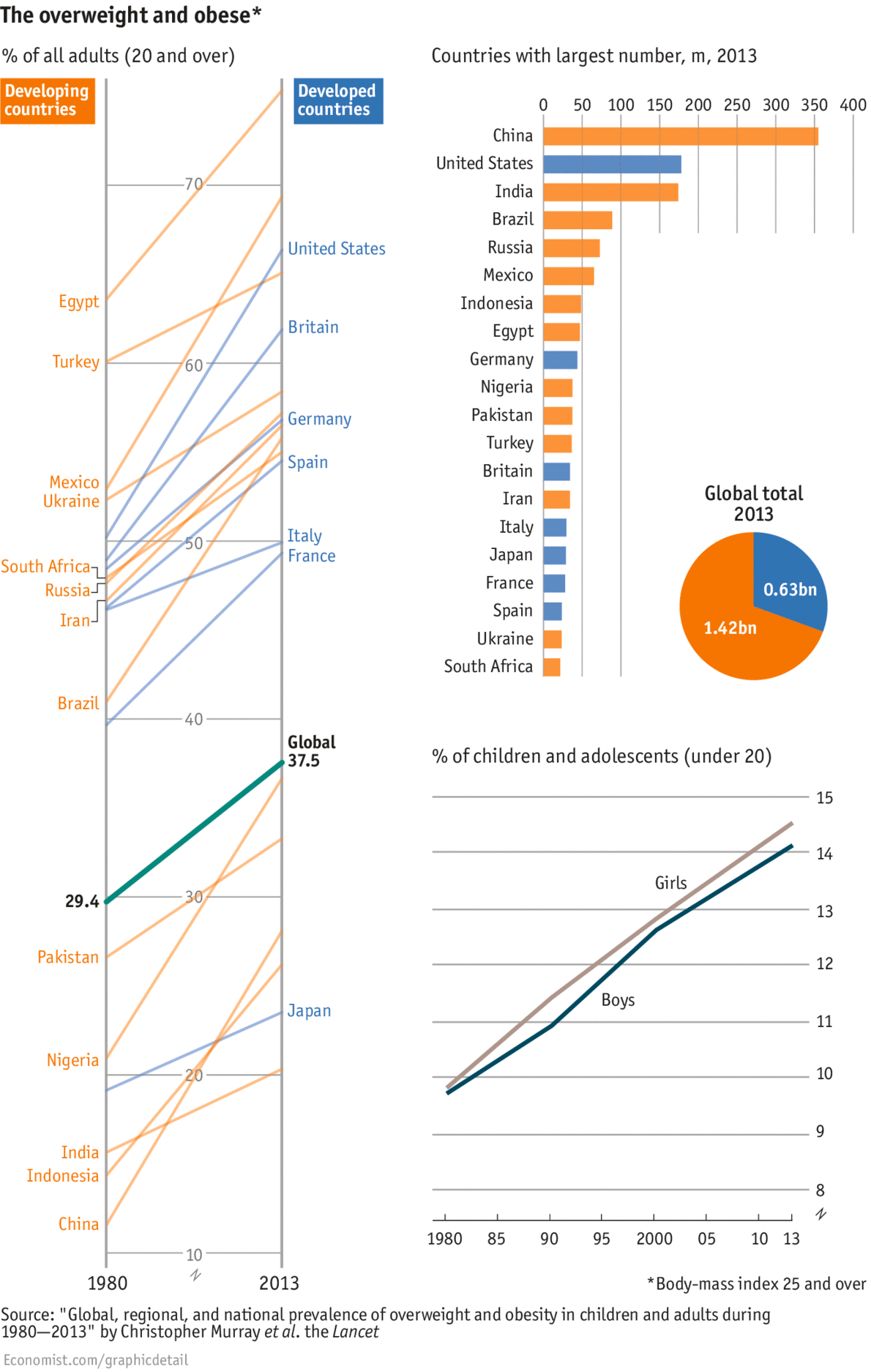
Worryingly, the study—led by the Institute of Health Metrics and Evaluation at the University of Washington—showed that children are fattening at a faster pace than adults. Last week the World Health Organisation set up a new commission to curb child obesity. But it will be some time yet before the world reaches peak fat.

http://www.economist.com/blogs/graphicdetail/2014/05/daily-chart-19?fsrc=scn/fb/wl/dc/peakfat

Daily chart

Peak fat

20140531_gdc156_0 Economist Peak Fat

WAISTLINES are widening everywhere. The percentage of adults who are overweight or obese has swelled from 29% in 1980 to 37% in 2013, according to a new study in the Lancet. People in virtually all nations got larger, with the biggest expansions seen in Africa, the Middle East and New Zealand and Australia. The chunkiest nations overall are found in the tiny Pacific islands and Kuwait, where over three-quarters of adults are overweight and over half are obese. And the world is unlikely to slim down soon. While the rate of increase has slowed in the rich world, it is still rising in poorer countries, where two-thirds of the world’s 2.1 billion overweight adults live. China is home to the largest number anywhere—335m, more than the population of America. This is not just because of its sheer size, but also because economic growth led to cellulite growth: a quarter of adults are now overweight compared with one in ten in 1980.Mexicans just outweigh neighbouring Americans. In both countries, two-thirds of people could lose a pound or two, though more Americans are obese. Agreeing on how to combat the problem is tricky, given that experts continue to bicker on what, precisely, makes us fat. Worryingly, the study—led by the Institute of Health Metrics and Evaluation at the University of Washington—showed that children are fattening at a faster pace than adults. Last week the World Health Organisation set up a new commission to curb child obesity. But it will be some time yet before the world reaches peak fat.

Deeble Inst: Jury still out on P4P


PDF: deeble_issues_brief_no_6_partel_k_can_we_improve_the_health_system_with_performance_reporting

The jury is still out on pay-for-performance and other financial incentive mechanisms

Date:

Wed, 28/05/2014

Spokesperson:

Australian Healthcare and Hospitals Association (AHHA)

Can we improve the health system with pay-for-performance? is the latest Health Policy Issues Brief released by the Australian Healthcare and Hospitals Association’s Deeble Institute for Health Policy Research. Outlining Australian and international experiences with pay-for-performance, the brief unpacks the latest research evidence and implications for policymakers.

“The healthcare system is moving toward greater efficiency, transparency and accountability, and this trend is not likely to change,” Alison Verhoeven, Chief Executive of the AHHA said today. “To meet these goals, a number of financing reforms have been implemented across its health system, but it is unclear where the reform process is now headed.”

“We need to remember there is no single fix to improve service delivery and patient outcomes, to ensure financial sustainability and to increase accountability and transparency in a health system,” said Krister Partel, Policy Analyst with the AHHA’s Deeble Institute. “The jury is still out on whether financial incentive mechanisms, such as pay-for-performance, work as intended and deliver value for money, but if we want to go down that route then the research literature is rich in lessons to keep in mind when developing and rolling out pay-for-performance programs.”

“Regardless of how health financing is structured in the future, governments must ensure that changes strengthen the health system and improve public confidence in it,” said Alison Verhoeven.

“The AHHA is proud to support independent research to inform evidence-based policy development, and we look forward to furthering this discussion to maximise the use of health resources and enhance patient care.”

The Australian Healthcare & Hospitals Association represents Australia’s largest group of health care providers in public hospitals, community and primary health sectors and advocates for universal high quality healthcare to benefit the whole community.

Media inquiries:
Alison Verhoeven, Chief Executive, Australian Healthcare and Hospitals Association 0403 282 501


Samsung moving into value-based pharma..?!

Go Samsung… it would be great to see the traditional pharma model disrupted in this way…

A New Era in Value-Driven Pharmaceuticals

flying cadeuciiAt the end of March the Amercian College of Cardiology (ACC) and the American Heart Association (AHA) issued a joint statement saying they “will begin to include value assessments when developing guidelines and performance measures (for pharmaceuticals), in recognition of accelerating health care costs and the need for care to be of value to patients.”

You may have heard of value-based medicine, but are we entering a new era of value-based medications or value-driven pharma?

Price transparency is great, but it has be combined with efficacy to get to value (price for the amount of benefit). Medical groups are catching on to how important value assessments are, because if patients can’t afford their medication, they won’t take their medication, and that obviously can turn into poor outcomes.

Twenty-seven percent of American patients didn’t fill a prescription last year according to a Kaiser Family Foundation Survey. This trend seems likely to continue as we move toward higher-deductible plans, where those with insurance can have great difficulty affording medications.

Included in the ACC/AMA statement was a quote from Paul Heidenreich, MD, FACC, writing committee co-chair and vice-chair for Quality, Clinical Affairs and Analytics in the Department of Medicine at Stanford University School of Medicine.

“There is growing recognition that a more explicit, transparent, and consistent evaluation of health care value is needed…These value assessments will provide a more complete examination of cardiovascular care, helping to generate the best possible outcomes within the context of finite resources.”

Spreading risk and payment to different members of the health care value chain is beginning to make it apparent to more people and organizations that resources are finite. Patients and their physicians are starting to ask which treatments are worth the cost and have best likelihood of adherence.

An outgrowth of the move toward digital health and accountable care is that we’re entering every patient into a potential personal clinical trial with their data followed as a longitudinal study, and we can look much more closely at efficacy and adherence and reasons why it happens and why it doesn’t.

It won’t be long before we start to see comparative effectiveness across a variety of treatments and across a variety of populations. When we can connect outcomes data, interventions and costs all in the same picture we begin to see where the value (price against results) is and where it isn’t.


The opportunity to assess value of treatments is bringing non-traditional players into the value-driven pharma arena. Samsung recently announced that they are becoming a drug company. According to Quartz:

“Electronics giant Samsung recently announced a foray into big pharma. The South Korean company is set to invest over $2 billion into biopharmaceuticals—drugs developed from biological sources (e.g. vaccines or gene therapies) as opposed to traditional chemical cocktails—with a focus on creating cheaper versions of existing therapies.”

The real advantage may be access to patient information via mobile. The Quartz article goes on to say:

“…cheapness won’t be Samsung’s only advantage. The company better known for its smartphones could also take advantage of the fact that the pharma industry has been slow to explore mobile health technology…The biotech industry is expected to generate sales of more than $220 billion in five years, Bloomberg reports, and Samsung expects to be taking a $1.8 billion slice of the pie by that time. The company will start by copying Enbrel (an arthritis therapy by Amgen Inc.) and Remicade (Johnson & Johnson’s autoimmune disease treatment) in the next couple of years.”

Samsung is going after arthritis, which Enbrel and Remicade treat. On the surface, this makes sense. Mobile devices are good at tracking and reporting what arthritis impairs– movement– opening up the opportunity for Samsung to close the loop on the effectiveness of their own drugs using their smart phones, tracking progress and improvement.

Pharma has been slow to explore mobile health and data science and slow to leverage social media and other sources of consumer health data effectively for a variety of reasons — some legal (we aren’t responsible for what  we don’t know) and some historical.

This could be a severe disadvantage when looking to leverage existing therapies. Combing through available data from existing research can provide new and cheaper alternatives and, with relatively easy biosimilar approval, see how they compare.

Industry observers are beginning to see this shift and this opportunity, raising alarm bells for big pharma. Are they listening? Over the past month there’s been a virtual outcry for a business model for Pharma that’s based on value. Ernst & Young released a report (.pdf) calling for “radical collaboration.” Dan Munro at Forbes picked out the key line and bold proclamation from the report:

“Almost every life sciences company, regardless of their product or offering, will soon be expected to help change behaviors and deliver better health outcomes.”

EY hits the nail on the head. The combination of value-based care, digital health, and mobile technologies is inevitably driving toward pharma price and evidence transparency and a much better look at the efficacy of various treatments.

Samsung came late to the smart phone market, then experimented with pricing and models before taking over the top place from Apple. Now focusing on biosimilars, Samsung could be following a similar pattern in pharma, testing to see what combinations will work best, powered by ongoing results in a closed feedback-loop system.

Munro asks the question, “To what extent, and in what ways, should pharma companies move beyond the product?” Samsung may be answering that question.

AthenaHealth’s Jonathan Bush echoed the chorus for a new pharma business model in April to a group of pharma executives saying:

“Take every drug you have and organize it by disease by the number of hospital days that could go away…Find the moments that matter financially and clinically.” And further, “Follow up on the prescriptions that are written and make sure the patients get those drugs but also ‘don’t end up in the hospital…Relentlessly follow up on all conditions for success…”

We wonder if “all conditions for success” might also include the condition of affordability.

Jamie Heywood, CEO of PatientsLikeMe, hinted at a value-based medication future in a Nature Medicine interview recently on their new collaboration with Genentech, saying, “What we need to do is get more value for health care, and value means you have competitive outcomes. And that’s what, in our longest dreams, I think PatientsLikeMe begins to bring to bear.”

Samsung is in a unique position to capitalize on social, mobile and, peer interaction. Munro writes in Forbes about a social network/app,Whisper, that is on a fast-track trajectory because of its anonymous posting. Pharma companies could learn great deal of information on the derailing of adherence to treatment by following these posts. And if they don’t, others will fill the void by both providing and applying data to physicians and consumers as well as pulling in data from consumers.

On the data provider and application side, one Startup Health company seeks to provide cost and value transparency of medications at the point of care and bring the price discussion into the exam room.

RxREVU provides data services via API to use peer-reviewed value-based medication decisions for clinicians and their patients (full disclosure, RxREVU is a client of VivaPhi, Leonard Kish’s agency). Because it’s an API, it could also be deployed in the context of a mobile app at the point of care.

This data has always existed, what’s new is the demand for it and how it’s applied.

On the data intake side, more clinically-focused companies such as GoGoHealth are allowing remote EHR intake, improving access to consumer health data, including social determinants of health, to allow for faster, individualized attention by providers (GoGoHealth, also a StartupHealth company, is mentored by Center of Health Engagement, Nayer’s organization).

Part of that is allowing patients to lower barriers to enter the system, getting remote office visits and phone refills. A side product of these kinds of interactions is an understanding of what prevents and what enables patients from continuing on a course of treatment.

As providers and patients assume more of the risk and pay more of the bill, they are seeking solutions that can provide value-based treatment decisions that fit their personalized needs.

The most valuable solutions in a value-driven era will be those that we are able to customize based on information from a wide variety of sources and place the solutions into a contextual format in which patients ultimately have to treat themselves, including financial contexts.

Those that stick with the old pharma model, leaving data and consumers-as-patients out of the mix, will wind up with much less valuable medicine.

Leonard Kish (@leonardkish) is Principal and Co-Founder at VivaPhi, an agency that solves multi-disciplinary business problems involving data science, software, biomedical science, behavioral science, health care, product design, community development, marketing, consumer engagement and organizational design.

Cyndy Nayer (@CyndyNayer) is the founder and CEO of the Center of Health Engagement, an agency promoting strategic investments in health value for employers, health plans and provider organizations.

This post originally appeared in HL7 Standards

Paul Gross – a fan of Singapore’s Health System policy


PDF: gro11102_SingaporeHealthSystem

Singapore’s health system: a model for Australia?

Paul F Gross
Med J Aust 2014; 200 (9): 513.
doi: 10.5694/mja13.11102
  • Impressive, responsive and innovative, but not without its problems

A book by William Haseltine, a United States medical researcher and founder of the biopharmaceutical company Human Genome Sciences, describes the Singapore health care system — how it works, its financing, its history and its future directions.1 Might it hold any lessons for Australian health care?

The statistics on Singapore’s health care system are impressive. An enviable life expectancy, low infant and child mortality rates, and low rates of mortality from chronic conditions such as cancer and heart disease were achieved with health care expenditures of around US$2787 per capita in 2011 and health expenditure at 4.6% of gross domestic product (GDP), with the government financing about 1.2% of GDP. The sources of financing were employers (35%), government subsidies (25%), out-of-pocket payments (25%), private health insurance (5%), Medisave, a compulsory medical savings scheme (8%) and Medishield, a social insurance scheme for catastrophic medical conditions (2%).

The three original pillars of Singapore financing (Medisave in 1984, Medishield in 1990 and a government-subsidised Medifund to protect low-income citizens in 1993) were innovative and far-seeing. A subsequent fourth pillar (Eldershield in 2002 to pay the high costs of severe disability through insurance, followed by Medishield Silver in 2007) and changes to Medisave in 2006 to fund chronic disease management showed a government unafraid to update the original concepts when gaps appeared.

These pillars judiciously mix taxation, personal cost-sharing, personal savings and social insurance. Taxes and patient charges pay for primary health care and public health services, Medisave creates compulsory savings to pay for acute care, Medishield and ElderShield offer social and private insurance against the catastrophic costs of long-term care, and Medifund and Medifund Silver protect the indigent with targeted government subsidies.

The title of Haseltine’s book suggests that Singapore offers lessons to other nations. That position might be tenable if those nations also had a stable political system with one party in power for a long time, a relatively young population prepared to accept personal responsibility in health care financing, and citizens ready to surrender 40% of their income into a national savings plan (the Central Provident Fund) that funds access to home ownership, higher education, medical care and old-age security.

Unfortunately, there are no compelling insights into why it works. Haseltine applauds the competition between, and quasi-market pricing of, hospitals and medical services as major reasons for Singapore’s impressive health outcomes for a relatively low percentage of GDP. However, he understates the importance of a prescient and interventionist national government listening to the electorate, aiming subsidies at low-income residents and allowing greater risk-pooling of insurance for catastrophic illnesses to embody the ethos of collective responsibility. Furthermore, Singapore can provide uniform care and financing without answering complaints about geographical resource misallocation and the resulting political interference at a subnational level.

What Singapore does better than most nations is watch for signs of gaps in the access to or affordability of health care, building on the existing financing framework and directing subsidies to the neediest first. The August 2013 Medishield Life reform, offering compulsory universal coverage for pre-existing conditions and subsidies for low-income families, exemplifies this.

However, the system still has problems. In a 2012 survey, 72% of Singaporeans indicated that they “cannot afford to get sick these days due to high medical costs”. In a nation where public hospitals offer 80% of acute bed care, allowing competition between hospitals has seen doctors leave the subsidised wards for the poorer citizens to move to unsubsidised, profit-creating “A class” wards. With population ageing, once age-specific rates for the use of services involving expensive medical technologies rise, Singapore will be paying a forecast 6%–8% of GDP for health care.

Even with recent reforms, copayments remain a silent threat to the four pillars model of financing. If you mandate a medical savings scheme with copayments acting as price signals, you accept the risk that rising copayments will restrict access to both necessary and unnecessary care. With copayments and a steady movement of doctors away from the hospital care of the 85% of Singaporeans who live in public housing, Singapore has created a two-class health care system based on a range of amenities tied to charges in public hospitals. Wealth buys more amenities.

What does Haseltine’s book tell Australian politicians? If we were looking for a health financing system that made sense for its sustainability in both 1990 and 2013, Singapore stands out. To get to a similar position, Australia cannot delay reforms to doctor payment, quality-driven hospital reimbursement and price transparency. Affordable health insurance to deal with chronic illness, ageing and disability beyond age 65 years will be a massive challenge until we consider how Singapore’s four pillars model could inform a revamped health and social insurance system in Australia.

And then we have to find political leaders who eschew populist rhetoric and random tinkering, and who can tell us how they intend to achieve affordable excellence in care — a problem that Singapore has never experienced.

Provenance:

Not commissioned; not externally peer reviewed.