All posts by blackfriar

Endoscopic overservicing


Upper endoscopies may bilk Medicare

http://www.forbes.com/sites/peterubel/2014/05/22/are-gastroenterologists-scoping-for-dollars-on-medicare-patients/

Peter Ubel

Peter Ubel, Contributor

I explore medical controversies thru behavioral econ and bioethics.

5/22/2014 @ 11:23AM |801 views

Inappropriate Medicare Incentives Lead To Unnecessary Subspecialty Procedures

Sometimes people flat out need cameras shoved down into their stomachs.  A long history of reflux disease, for example, could prompt a gastroenterologist to perform an “upper endoscopy”—to run a thin tube down the patient’s throat in order to view their esophagus and stomach and look for signs of serious illness.  Medicare has correctly decided that such upper endoscopies are valuable medical tests, and reimburse physicians relatively generously for performing them.  But what should Medicare do when gastroenterologists unnecessarily repeat these tests in patients who do not show signs of serious illness on their first exam?

I became aware of this issue after reading an article in the Annals of Internal Medicine by Pohl and colleagues.  Pohl glanced at billing data from a random sample of almost 1 million Medicare enrollees. (I am pleased with myself when I pull together a study of a few hundred patients.  Perhaps I won’t be so pleased in the future.)

Pohl and colleagues analyzed how many patients received more than one upper endoscopy within a three year period.  They then tried to figure out how often these repeat procedures were necessary, because of abnormalities discovered in the initial exam.

Let’s start with the bad news.  Among those patients who should have received repeat tests, only half did so.  That means even when doctors found bad things that needed to be followed up, it was practically a flip of a coin whether they would do so.

Now for the worse news.  Among those who should not have received a follow-up test, a full 30% did, for a total of 20,000 such tests in this population.  Here is a picture summarizing the results:

repeat upper endoscopies

Here is another way to look at these results.  Among patients receiving upper endoscopies, the majority –54%—should not have received these tests.

Now for some back-of-the-envelope math.  The sample of patients Pohl and colleagues looked at made up 5% of the Medicare population.  That means if you take their estimates of how many gastroenterologists performed unnecessary upper endoscopies over the three year period of their study, and multiply that estimate by 20, you end up with 4 million unnecessary endoscopies nationwide.  With the average costs of such a procedure being around $3,000, that amounts to $1.2 billion of our tax dollars wasted on an unnecessary and, I should mention, uncomfortable and potentially harmful procedure.  (Warning: I don’t know what Medicare pays for this test.  But we are still talking hundreds of millions of dollars, in a best case scenario.)

In an editorial accompanying the Annals study, a gastroenterologist bemoaned these unnecessary procedures and recommended several steps we could take to reduce such testing.  First, the editorialist said we should help physicians better understand when they should and should not use such procedures.  Second, he said we “must also educate patients about the modest yield” of such tests.

I find this last idea…what’s a nice way to put this…highly naïve.  (Haive?)

What we need to do is to stop paying doctors for unnecessary tests.  Or alternatively, we need to pay doctors in ways that reduce their incentive to perform unnecessary tests, like lump sums to take care of all of their patients’ needs.

While some gastroenterologists may be cynically scoping patients for dollars—performing questionable tests because it pays for their kid’s private school tuition—I expect most believe such testing is in their patient’s best interests.  We need an incentive system that forces them to think more carefully about when—or whether—these expensive tests are necessary.

 

The case for eating steak and cream


http://www.economist.com/news/books-and-arts/21602984-why-everything-you-heard-about-fat-wrong-case-eating-steak-and-cream

Economist Book Review

The Case For Eating Steak and Cream

Shifting the argument

The Big Fat Surprise: Why Butter, Meat and Cheese Belong in a Healthy Diet. By Nina Teicholz. Simon & Schuster; 479 pages; $27.99. Buy from Amazon.com,Amazon.co.uk

“EATING foods that contain saturated fats raises the level of cholesterol in your blood,” according to the American Heart Association (AHA). “High levels of blood cholesterol increase your risk of heart disease and stroke.” So goes the warning from the AHA, the supposed authority on the subject. Governments and doctors wag their fingers to this tune the world over. Gobble too much bacon and butter and you may well die young. But what if that were wrong?

Nina Teicholz, an American journalist, makes just that argument in her compelling new book, “The Big Fat Surprise”. The debate is not confined to nutritionists. Warnings about fat have changed how food companies do business, what people eat, and how and how long they live. Heart disease is the top cause of death not just in America, but around the world. The question is whether saturated fat is truly to blame. Ms Teicholz’s book is a gripping read for anyone who has ever tried to eat healthily.

The case against fat would seem simple. Fat contains more calories, per gram, than do carbohydrates. Eating saturated fat raises cholesterol levels, which in turn is thought to bring on cardiovascular problems. Ms Teicholz dissects this argument slowly. Her book, which includes well over 100 pages of notes and citations, covers decades of nutrition research, including careful explorations of academics’ methodology. This is not an obvious page-turner. But it is.

Ms Teicholz describes the early academics who demonised fat and those who have kept up the crusade. Top among them was Ancel Keys, a professor at the University of Minnesota, whose work landed him on the cover of Time magazine in 1961. He provided an answer to why middle-aged men were dropping dead from heart attacks, as well as a solution: eat less fat. Work by Keys and others propelled the American government’s first set of dietary guidelines, in 1980. Cut back on red meat, whole milk and other sources of saturated fat. The few sceptics of this theory were, for decades, marginalised.

But the vilification of fat, argues Ms Teicholz, does not stand up to closer examination. She pokes holes in famous pieces of research—the Framingham heart study, the Seven Countries study, the Los Angeles Veterans Trial, to name a few—describing methodological problems or overlooked results, until the foundations of this nutritional advice look increasingly shaky.

The opinions of academics and governments, as presented, led to real change. Food companies were happy to replace animal fats with less expensive vegetable oils. They have now begun abolishing trans fats from their food products and replacing them with polyunsaturated vegetable oils that, when heated, may be as harmful. Advice for keeping to a low-fat diet also played directly into food companies’ sweet spot of biscuits, cereals and confectionery; when people eat less fat, they are hungry for something else. Indeed, as recently as 1995 the AHA itself recommended snacks of “low-fat cookies, low-fat crackers…hard candy, gum drops, sugar, syrup, honey” and other carbohydrate-laden foods. Americans consumed nearly 25% more carbohydrates in 2000 than they had in 1971.

In the past decade a growing number of studies have questioned the anti-fat orthodoxy. Ms Teicholz’s book follows the work of Gary Taubes, a science journalist who has cast doubts on the link between saturated fat and health for well over a decade—and been much disparaged for his pains. There is increasing evidence that a bigger culprit is most likely insulin, a hormone; insulin levels rise when one eats carbohydrates. Yet even now, with more attention devoted to the dangers posed by sugar, saturated fat remains maligned. “It seems now that what sustains it,” argues Ms Teicholz, “is not so much science as generations of bias and habit.”

Restaurants bite back with Dimmi

not sure I’m comfortable with this…

http://www.goodfood.com.au/good-food/food-news/when-restaurants-google-customers-20140601-zruc0.html

When restaurants google customers

Stevan Premutico, chief executive officer of dimmi.com.au

Stevan Premutico, chief executive officer of dimmi.com.auPhoto: Louise Kennerley

Are you a cheap tipper? A fussy eater who sends meals back to the kitchen? Whether you’re a dining dream or nightmare (and let’s be honest, the worst customers are probably the last to admit it), the internet age means for better or worse, now more than ever, your reputation precedes you.

When a diner walks into a restaurant these days, there’s a good chance the maitre d’ knows more about them than they realise, says Stevan Premutico, chief executive officer of online reservation website dimmi.com.au.

“What they look like, their job, their title, where they live, their social connections, any special celebrations and whether they are an avid foodie are all key things,” he says.

Last laugh: Restaurateur Darran Smith (pictured here, second from left, in 2009) always researches his guests.

Last laugh: Restaurateur Darran Smith (pictured here, second from left, in 2009) always researches his guests.Photo: Domino Postiglione

“It’s all part of getting to know your customers.”

Keeping notes on customers is hardly new. But as social media continues to knock gaping holes in the divide between personal and public, restaurants that bother to do their research are reaping bigger rewards for their efforts.

Shared online reservation systems like Dimmi’s ResDiary, as well as social media sites liked LinkedIn and good old Google searches, can be a double-edged sword. Systems can be used to track dining ‘performance’ – how much you ordered, whether you tipped well, how pleasantly you treated staff or whether you continued to camp out at the table long after you’d finished dessert.

The five most common pieces of information restaurants share, Premutico says, are customers’ food and wine preferences, notable habits (e.g. likes to have a drink at the bar before being seated), seating preferences (corner booth, window seat), allergies and – last but certainly not least – if the customer is a good or bad tipper.

But the Dimmi system goes even further, allowing restaurants to codify diners with attributes such as wine connoisseur, adventure eaters, quick eaters (good for table turnover) or friends of the chef or owner.

On the flip side are codes for loud talkers, frequent no-shows or PIAs – pain-in-the-ass customers with excessive demands.

Other tidbits restaurants note include postcode (you can infer a lot from four digits, Premutico says), whether someone is an ‘upgrader’ (diners who go for the works, like coffee and cognac) and, controversially, whether or not the diner is good-looking (some places may seat a diner differently based on their looks, Premutico says).

Restaurateur Darran Smith, who has worked in the industry for 20 years at venues including Icebergs Dining Room and Bar, the Hilton’s Glass restaurant and Hemmesphere at the Establishment hotel, says he always researches his guests.

“Whether it’s politicians or movie stars, lawyers or whatnot, I do my research,” Smith says.

“I remember Owen Wilson was coming in and finding out he really likes tequila so I made sure the bar was stocked up with tequila … It paid off.”

It’s the little things, which a restaurant can do without the customer even realising, that can make a good experience great or an excellent venue exceptional, he says.

Improved customer service and that personalised dining experience is the ultimate goal, restaurants say. And of course there are mutual benefits. (Smith recalls another experience when he discovered via Google that an Icebergs diner had sold his company the day before. “He came in and spent $5000,” he says.)

But Smith also admits that restaurants sometimes use online reservation systems to prepare themselves for the “one per cent” of customers who “just hate life”.

“With Dimmi, you do some research and you know they only like sitting at a particular table or they only like their salad with the dressing on the side,” he says.

“You know that if you go outside a certain circle they … will just be the worst customer in the world.”

Premutico says the practice is entirely justified. It’s a competitive industry and every bit of intelligence counts – whether you’re in front of the cash register or behind it.

“A customer that is rude, obnoxious, complains and doesn’t tip should be noted. A diner who appreciates the food concept, respects the staff, dines often and leaves tips should be given the better tables and taken care of more.”

As for the impact on customers, perhaps diners will learn to mind their Ps and Qs so as not to be labelled PIAs. After all, restaurants have been riding the rollercoaster of social media and user-generated ratings for years, Premutico says.

“This passes some of the power back to restaurants,” he says.

“Diners will behave better, tip better, treat staff better. It will help improve the industry and may help the diner get that all important upgrade next time.”

Cth Fund: 40% of patient outcomes from social factors

Report: 1749_Bachrach_addressing_patients_social_needs_v2

http://www.commonwealthfund.org/publications/fund-reports/2014/may/addressing-patients-social-needs

As much as 40 percent of patient outcomes can be attributed to factors such as income, educational attainment, access to food and housing, and employment status—and low-income populations are particularly affected.

New Report Shows How Targeting Patients’ Social Needs Is Critical to Improving Quality and Reducing Costs

As public and private payers increasingly hold providers accountable for their patients’ health and health care costs and link payments to outcomes, providers are developing strategies to address the social factors that play so large a role in people’s health. As much as 40 percent of patient outcomes can be attributed to factors such as income, educational attainment, access to food and housing, and employment status—and low-income populations are particularly affected.

A new report prepared by Manatt Health Solutions for The Commonwealth Fund, The Skoll Foundation, and The Pershing Square Foundation explores the impact of social needs on health and the costs of care and identifies evidence-based strategies and interventions that can help providers target patients’ social needs, improve health, and reduce spending. The report examines payment models that incentivize or require providers to address not just their patients’ clinical needs but their social needs as well.

For providers unable or unwilling to invest in social interventions, the report suggests alternative opportunities for funding them. Research indicates that in addition to improving patient health, investing in these interventions can enhance patient satisfaction and loyalty, as well as satisfaction and productivity among providers.

Visit commonwealthfund.org to read Addressing Patients’ Social Needs: An Emerging Business Case for Provider Investment and learn about the variety of tools available to providers and the range of effective programs in the U.S. and abroad.


Addressing Patients’ Social Needs: An Emerging Business Case for Provider Investment

Extensive research documents the impact of social factors such as income, educational attainment, access to food and housing, and employment status on the health and longevity of Americans, particularly lower-income populations. These findings attribute as much as 40 percent of health outcomes to social and economic factors. Asthma is linked to living conditions, diabetes-related hospital admissions to food insecurity, and greater use of the emergency room to homelessness.

These findings are not lost on health care providers: 80 percent of physicians conclude that addressing patients’ social needs is as critical as addressing their medical needs. Yet until recently, providers rarely addressed patients’ unmet social needs in clinical settings.

However, changes in the health care landscape are catapulting social determinants of health into an on-the-ground reality for providers. The Affordable Care Act is expanding insurance coverage to millions more low- and modest-income individuals, and, for many, social and economic circumstances will define their health. Six years after analysts introduced the concept of the “Triple Aim,” its goals of improved health, improved care, and lower per capita cost of care have become the organizing framework for the health care system. As a result, growing numbers of providers are concluding that investing in interventions addressing their patients’ social as well as clinical needs makes good business sense.

The Economic Rationale for Investing in Social Interventions

Informed by the Triple Aim, public and private payers are introducing payment models that hold providers financially accountable for patient health and the costs of treatment. These models—including capitated, global, and bundled payments, shared savings arrangements, and penalties for hospital readmissions—give providers economic incentives to incorporate social interventions into their approach to care. For example, in October 2012, the Centers for Medicare and Medicaid Services penalized 77 percent of safety-net hospitals for excess readmissions of patients with heart attack, heart failure, or pneumonia. Meanwhile a review of 70 studies found that unemployment and low income were tied to a higher risk of hospital readmission among patients with heart failure and pneumonia.

To be certified as a patient-centered medical home (PCMH) or Medicaid health home, providers must integrate social supports into their care models. And these certifications almost always trigger higher levels of reimbursement. More than 40 states have adopted PCMH programs, providing important funding opportunities for qualified providers. Even if new payment models do not require social interventions, many providers have concluded that they are essential to achieving quality metrics and earning available revenue.

Beyond these direct economic benefits, providers that incorporate social supports into their clinical models can also reap indirect economic benefits. Patient satisfaction rises when providers address patients’ social needs, engendering loyalty. Patient satisfaction can also affect the amount of shared savings a provider receives from payers. Providers that include social supports in their clinical models also report improved employee satisfaction. And interventions that address social factors allow clinicians to devote more time to their patients, allowing them to see more patients and improving satisfaction among both patients and clinicians.

Strategies to Meet Patients’ Social Needs

A range of tools, both broad and targeted, are available to providers to address patients’ unmet social needs. Broad interventions—usually provided at primary care clinics—link clinic patients to local resources that can address their unmet social needs. For example:

  • Health Leads, which operates in hospital clinics and community health centers in six cities, enables health care providers to write prescriptions for their patients’ basic needs, such as food and heat. Trained volunteers who staff desks at the hospitals and clinics connect patients to local resources to address those needs. Across all sites, Health Leads volunteers addressed at least one need of 90 percent of patients referred to them.
  • Medical-Legal Partnerships (MLPs) place lawyers and paralegals at health care institutions to help patients address legal issues linked to health status. This program has had marked success: an MLP in New York City targeting patients with moderate to severe asthma found a 91 percent decline in emergency department visits and hospital admissions among those receiving housing services.

Targeted interventions, in contrast, link individuals with chronic or debilitating medical conditions to social supports as part of larger care management efforts. For example, in the Seattle-King County Healthy Homes Project, community health workers conduct home visits to low-income families with children with uncontrolled asthma. Urgent care costs for participants in a high-intensity intervention were projected to be up to $334 per child lower than among those receiving a less intensive intervention. The share of individuals using urgent care services also fell by almost two-thirds during the intervention.

Looking Forward

As more low-income people gain health care coverage, evidence on which interventions are most cost-effective in addressing their social needs and improving their health will grow, and value-based reimbursement will become standard across payers. With these changes in the health care landscape, the economic case for provider investment in social interventions will become ever more compelling.

This publication was supported in partnership with The Skoll Foundation and The Pershing Square Foundation.

Geraldine: Hacking Management


http://www.abc.net.au/radionational/programs/saturdayextra/reinventing-management/5489320

Reinventing management

Saturday 31 May 2014 7:45AM

Business innovation expert Gary Hamel has been in Australia this week to speak at the World Business Forum in Sydney.

His message to business is to innovate well by harnessing the creative capacity of all employees, not just those in management positions.

Guests

Gary Hamel
Visiting Professor of Strategic and International Management, London Business School

Further Information

Management Innovation eXchange

Credits

Presenter
Geraldine Doogue
Producer
Jackie May


Parenthood = Stockholm Syndrome

Was watching Philomena on the plane to Singapore surrounded by 2 families each with 3 children under three. Let’s just say I was luck to have remembered my Seinnheisser DJ Headphones that blocked most of the noise out.

Anyway, it struck me that the relationship between children and their parents, orphans and their churches is similar to Stockholm Syndrome… Wikipedia seems all across it:

Stockholm syndrome, or capture-bonding, is a psychological phenomenon in which hostages express empathy and sympathy and have positive feelings toward their captors, sometimes to the point of defending and identifying with them. These feelings are generally considered irrational in light of the danger or risk endured by the victims, who essentially mistake a lack of abuse from their captors for an act of kindness.[1][2] The FBI‘s Hostage Barricade Database System shows that roughly 8% of victims show evidence of Stockholm syndrome.[3]

Stockholm syndrome can be seen as a form of traumatic bonding, which does not necessarily require a hostage scenario, but which describes “strong emotional ties that develop between two persons where one person intermittently harasses, beats, threatens, abuses, or intimidates the other.”[4] One commonly used hypothesis to explain the effect of Stockholm syndrome is based on Freudian theory. It suggests that the bonding is the individual’s response to trauma in becoming a victim. Identifying with the aggressor is one way that the ego defends itself. When a victim believes the same values as the aggressor, they cease to be a threat.[5]

Battered-person syndrome is an example of activating the capture-bonding psychological mechanism, as are military basic training and fraternity bonding byhazing.[dubious ].[6][7][8]

Stockholm syndrome is sometimes erroneously referred to as Helsinki syndrome.[9][10] Helsinki syndrome is more of a case of group think and inattentional blindnessto the negative in order to achieve some perceived benefit, a reference to the non-binding Helsinki Accords that attempted to settle post WWII Cold War tensions.


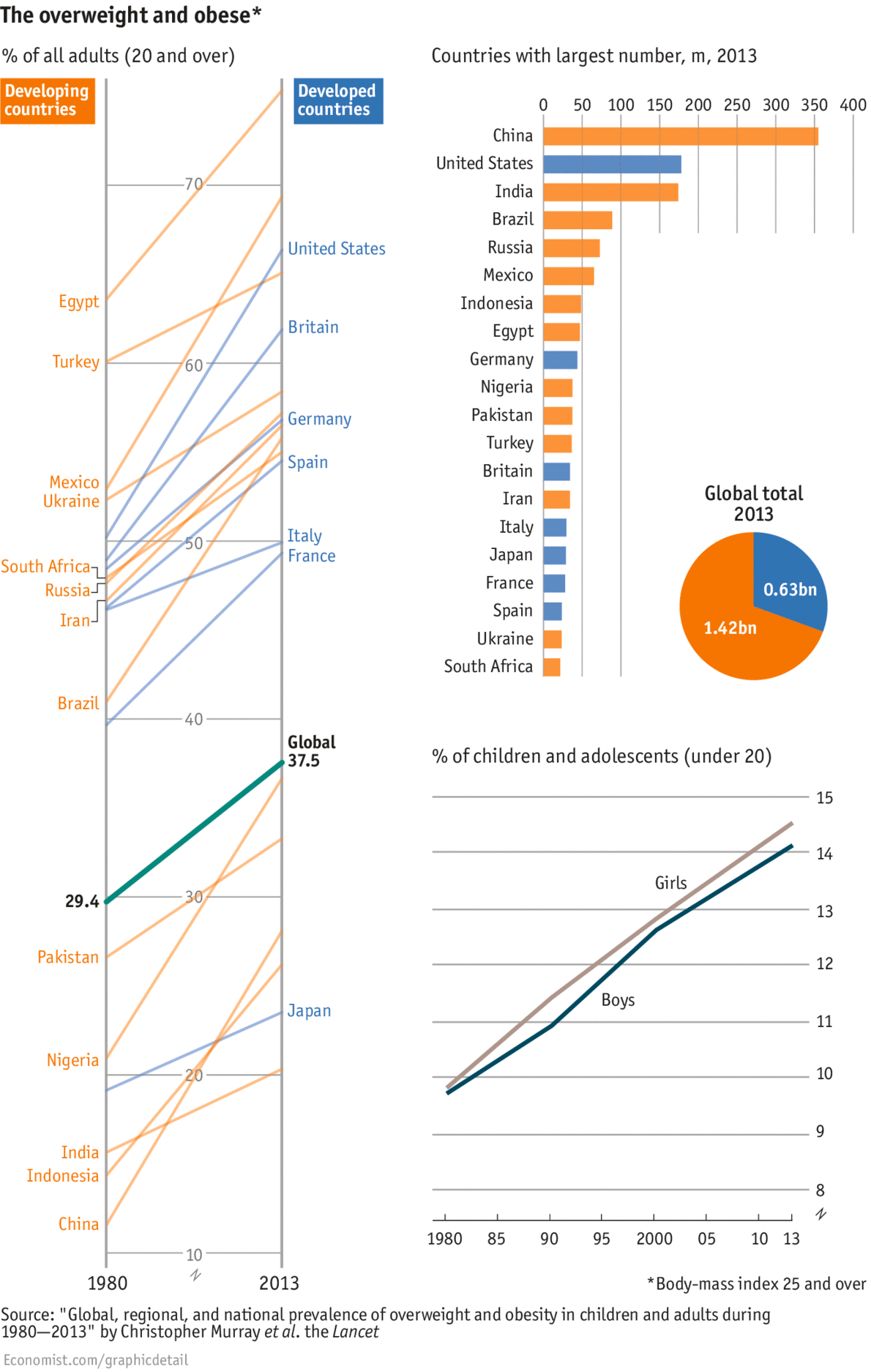
Economist Daily Chart: Peak Fat

Worryingly, the study—led by the Institute of Health Metrics and Evaluation at the University of Washington—showed that children are fattening at a faster pace than adults. Last week the World Health Organisation set up a new commission to curb child obesity. But it will be some time yet before the world reaches peak fat.

http://www.economist.com/blogs/graphicdetail/2014/05/daily-chart-19?fsrc=scn/fb/wl/dc/peakfat

Daily chart

Peak fat

20140531_gdc156_0 Economist Peak Fat

WAISTLINES are widening everywhere. The percentage of adults who are overweight or obese has swelled from 29% in 1980 to 37% in 2013, according to a new study in the Lancet. People in virtually all nations got larger, with the biggest expansions seen in Africa, the Middle East and New Zealand and Australia. The chunkiest nations overall are found in the tiny Pacific islands and Kuwait, where over three-quarters of adults are overweight and over half are obese. And the world is unlikely to slim down soon. While the rate of increase has slowed in the rich world, it is still rising in poorer countries, where two-thirds of the world’s 2.1 billion overweight adults live. China is home to the largest number anywhere—335m, more than the population of America. This is not just because of its sheer size, but also because economic growth led to cellulite growth: a quarter of adults are now overweight compared with one in ten in 1980.Mexicans just outweigh neighbouring Americans. In both countries, two-thirds of people could lose a pound or two, though more Americans are obese. Agreeing on how to combat the problem is tricky, given that experts continue to bicker on what, precisely, makes us fat. Worryingly, the study—led by the Institute of Health Metrics and Evaluation at the University of Washington—showed that children are fattening at a faster pace than adults. Last week the World Health Organisation set up a new commission to curb child obesity. But it will be some time yet before the world reaches peak fat.

Deeble Inst: Jury still out on P4P


PDF: deeble_issues_brief_no_6_partel_k_can_we_improve_the_health_system_with_performance_reporting

The jury is still out on pay-for-performance and other financial incentive mechanisms

Date:

Wed, 28/05/2014

Spokesperson:

Australian Healthcare and Hospitals Association (AHHA)

Can we improve the health system with pay-for-performance? is the latest Health Policy Issues Brief released by the Australian Healthcare and Hospitals Association’s Deeble Institute for Health Policy Research. Outlining Australian and international experiences with pay-for-performance, the brief unpacks the latest research evidence and implications for policymakers.

“The healthcare system is moving toward greater efficiency, transparency and accountability, and this trend is not likely to change,” Alison Verhoeven, Chief Executive of the AHHA said today. “To meet these goals, a number of financing reforms have been implemented across its health system, but it is unclear where the reform process is now headed.”

“We need to remember there is no single fix to improve service delivery and patient outcomes, to ensure financial sustainability and to increase accountability and transparency in a health system,” said Krister Partel, Policy Analyst with the AHHA’s Deeble Institute. “The jury is still out on whether financial incentive mechanisms, such as pay-for-performance, work as intended and deliver value for money, but if we want to go down that route then the research literature is rich in lessons to keep in mind when developing and rolling out pay-for-performance programs.”

“Regardless of how health financing is structured in the future, governments must ensure that changes strengthen the health system and improve public confidence in it,” said Alison Verhoeven.

“The AHHA is proud to support independent research to inform evidence-based policy development, and we look forward to furthering this discussion to maximise the use of health resources and enhance patient care.”

The Australian Healthcare & Hospitals Association represents Australia’s largest group of health care providers in public hospitals, community and primary health sectors and advocates for universal high quality healthcare to benefit the whole community.

Media inquiries:
Alison Verhoeven, Chief Executive, Australian Healthcare and Hospitals Association 0403 282 501